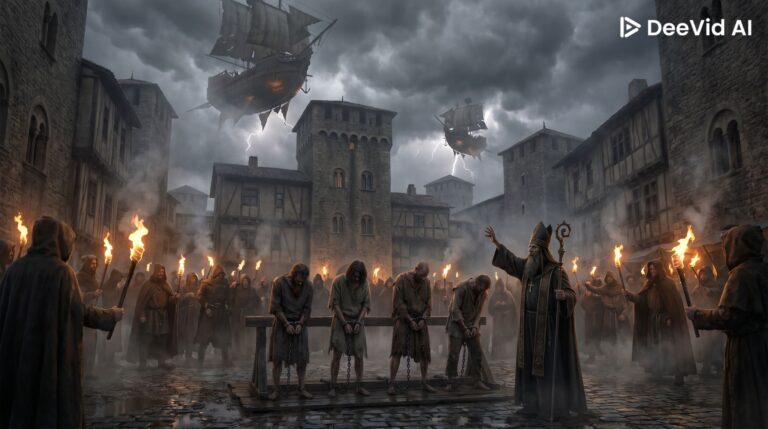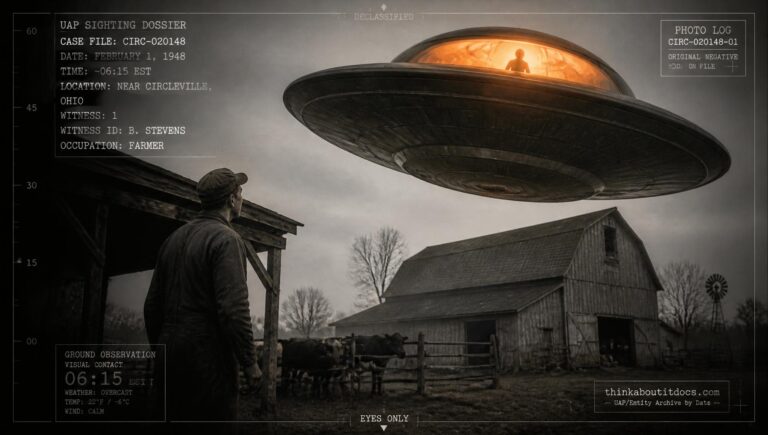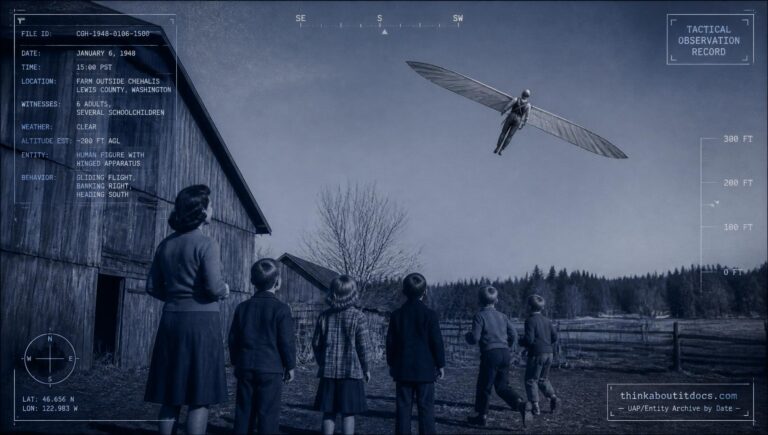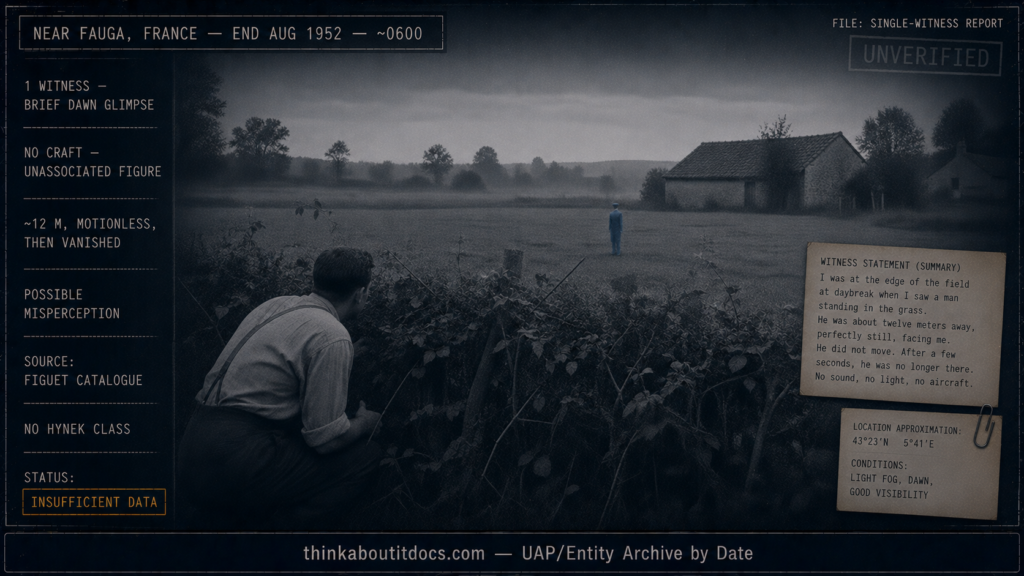
The 1952 Fauga, France sighting — at dawn a man watched a small figure in a blue uniform standing motionless in a field, which vanished as he stared. No craft; logged Insufficient Data. (thinkaboutitdocs.com — UAP/Entity Archive by Date)
THINK ABOUTIT UFO|UAP|ENTITY SIGHTINGS REPORT
1952: Small Humanoid Seen near Fauga, France
It is one of the slighter entity entries in the archive, and honesty about that is most of the report. At about six in the morning toward the end of August 1952, a man identified only as “M. N.” was coming home from work near Fauga, in southern France, when he noticed, in a field about twelve meters beyond a hedge, a small figure in a blue uniform standing perfectly still, like a statue. He ducked behind the hedge to watch, and as he stared the figure vanished in plain sight. That is the entire account: one witness, a brief dawn glimpse of a motionless small figure at middle distance, and no craft of any kind. A small, still, oddly-dressed figure seen briefly across a field at first light, which then seems to disappear, has obvious ordinary candidates the account cannot exclude. The archive keeps the entry, corrects its classification, and files it as Insufficient Data.
Date: End of August 1952 (no specific day)
Sighting Time: About 0600 (early morning)
Day/Night: Day (dawn / early morning)
Location: Near Fauga, Haute-Garonne, southern France
Urban or Rural: Rural (farmland, beside a hedge)
No. of Entity(‘s): 1
Entity Type: Small humanoid figure (no craft associated)
Entity Description: A being of small size, wearing a blue uniform, standing motionless like a statue; it vanished in plain sight as the witness watched
Hynek Classification: None — no craft or object is involved; this is an unassociated humanoid report, not a close encounter of the third kind (the prior CE-III is incorrect, as CE-III requires beings associated with a craft)
Duration: Brief (a short observation before the figure vanished)
No. of Object(s): None — no object or craft reported (the prior page listed “1 object” but left every object field blank, because there was no object)
Description of the Object(s): Not applicable
Shape of Object(s): Not applicable
Size of Object(s): Not applicable (the figure was small)
Color of Object(s): Not applicable (the figure wore a blue uniform)
Distance to Object(s): About 12 meters (the figure stood roughly 12 meters beyond the hedge)
Height & Speed: Not applicable (the figure was motionless, then vanished)
Number of Witnesses: 1 (“M. N.”)
Special Features/Characteristics: Early-morning, brief, single-witness sighting; a small motionless figure in a blue uniform at about 12 meters; no craft, sound, light, or trace; the figure appeared to vanish in plain sight — features consistent with ordinary misperception at dawn as well as with an anomalous encounter
Case Status: Insufficient Data
Source: Michel Figuet (with Jean-Louis Ruchon), “OVNI: Le Premier Dossier Complet des Rencontres Rapprochées en France” (1979) — a brief catalogue entry
Summary/Description: Near Fauga, France, at about 6 a.m. toward the end of August 1952, a man returning from work (“M. N.”) saw in a field about 12 meters beyond a hedge a small figure in a blue uniform standing motionless like a statue. As he hid behind the hedge and watched, the figure vanished in plain sight. No craft was observed. The account is a brief single-witness catalogue entry, fits ordinary dawn misperception as readily as an anomalous encounter, and is logged as Insufficient Data.
Related Cases: 1952: Giant Humanoids near Nîmes, France | 1952: Humanoid Encounter in Corby, England (another small-figure-that-vanishes account) | the broader French corpus of brief “motionless small figure” reports
DETAILED REPORT
The account is a single line in the French close-encounter literature and should be given plainly. Toward the end of August 1952, at about six in the morning, a man recorded only as “M. N.” was returning from work near Fauga, a commune in the Haute-Garonne of southern France. In a field roughly twelve meters beyond a hedge, he saw a being of small size, dressed in a blue uniform, standing completely motionless, like a statue. He concealed himself behind the hedge to watch it. As he stared, the figure vanished in plain sight, to his surprise. There is nothing more: no craft, no light, no sound, no trace, no second witness.
The first correction is one of category, and the archive applies it consistently. The prior page classified this CE-III, a close encounter of the third kind, but that class requires animate beings associated with a craft, and there is no craft anywhere in this report. Nothing flew, landed, or hovered; the witness saw a figure in a field and nothing else. The page’s own template gives the tell: it lists “one object” but leaves every object field — shape, size, color, distance — blank, because there was no object to describe. Under the archive’s standard, an entity report with no associated craft is an unassociated humanoid sighting carrying no Hynek classification, and the entry is corrected accordingly.
With the classification fixed, the honest question is what a man most likely saw at dawn, at twelve meters, across a field, in a single brief glimpse. The ordinary candidates are strong and cannot be excluded. A small motionless figure in a field at first light readily fits a child, a short adult, a farmworker, or a scarecrow, fence post, or piece of equipment briefly read as a figure in the low, uncertain light of early morning. The “vanishing in plain sight” — the detail that makes the account feel anomalous — is exactly what one would expect if the witness, hidden and staring from behind a hedge, glanced away for an instant, or if the figure simply moved out of his narrow sightline, or if a misperceived object resolved into what it actually was. None of this proves misperception; it identifies the most available prosaic reading, which the brief, distant, dawn circumstances cannot rule out.
The source is worth crediting properly. It comes through Michel Figuet, a serious French investigator who, with Jean-Louis Ruchon, compiled one of the standard catalogues of close encounters in France. That the entry sits in a respected catalogue means it is a real recorded report, not an invention. But a catalogue line is a record that a story was collected, not an investigation of it, and this one preserves only an anonymized witness, a time, a place, and a few sentences. For a single-witness, no-craft, vanishing-figure account, that is the thinnest tier of evidence, however reputable the cataloguer.
None of this impugns the witness, who may well have seen something he could not explain in the moment. But between one observer, no craft, no corroboration, a brief dawn glimpse, and a strong field of mundane candidates, there is nothing to confirm and nothing that rises to a documented anomaly. The proportionate verdict is Insufficient Data.
RESEARCHER’S NOTES
The Fauga Figure — France 1952 and an Entity Without a Craft
Classification correction (CE-III to none): The decisive fix is that there is no craft. CE-III denotes beings associated with a UFO, and this account contains no object of any kind — a small motionless figure in a field, and nothing else. Under the archive’s standard, that is an unassociated humanoid report carrying no Hynek class. The correction matches those already made to other craftless French and Anglo-American entity entries, and the prior page’s blank “object” fields confirm there was never an object to classify.
The mundane candidate, weighed fairly: The most useful analytical point is that nearly every feature — small, motionless, briefly seen, at twelve meters, at dawn, then “vanishing” — is what ordinary misperception produces. A child, a short worker, a scarecrow, a post, or equipment can read as a small still figure in early light, and a figure that “disappears” while a hidden witness stares is as easily explained by a glance away or a step out of the sightline as by dematerialization. This is offered not as proof but as the leading prosaic explanation, which the thin, brief, single-vantage record cannot exclude. France’s case literature contains a number of such “small figure that instantly vanished” reports, many of which careful investigators themselves rate as low-reliability.
Source-chain assessment: Michel Figuet and Jean-Louis Ruchon’s catalogue of French close encounters is a genuine and respected compilation, so the entry is a real recorded account. But the record is a brief line with an anonymized witness and no investigation detail; it documents that the report exists, not that it was checked or corroborated. For a no-craft, single-witness glimpse, the evidentiary value is low regardless of the catalogue’s standing.
Why Insufficient Data: With one witness, no craft, no corroboration, a brief dawn observation, and a strong mundane candidate, there is nothing to confirm and nothing to disprove. That is Insufficient Data — not a documented anomaly to call Unexplained, and not a demonstrated misperception or hoax to call Explained. The classification correction, not the verdict, is the entry’s main repair.
The Fauga figure is a minor entry, and the archive’s service is to size it honestly: one witness, at dawn, glimpsing a small motionless figure across a field that then seemed to vanish, with no craft and an obvious field of ordinary explanations. Stripped of the CE-III it never warranted, with its phantom “object” corrected away, and read against the prosaic candidates it so readily fits, it stands as Insufficient Data — kept for the record, and left as slight as it is.