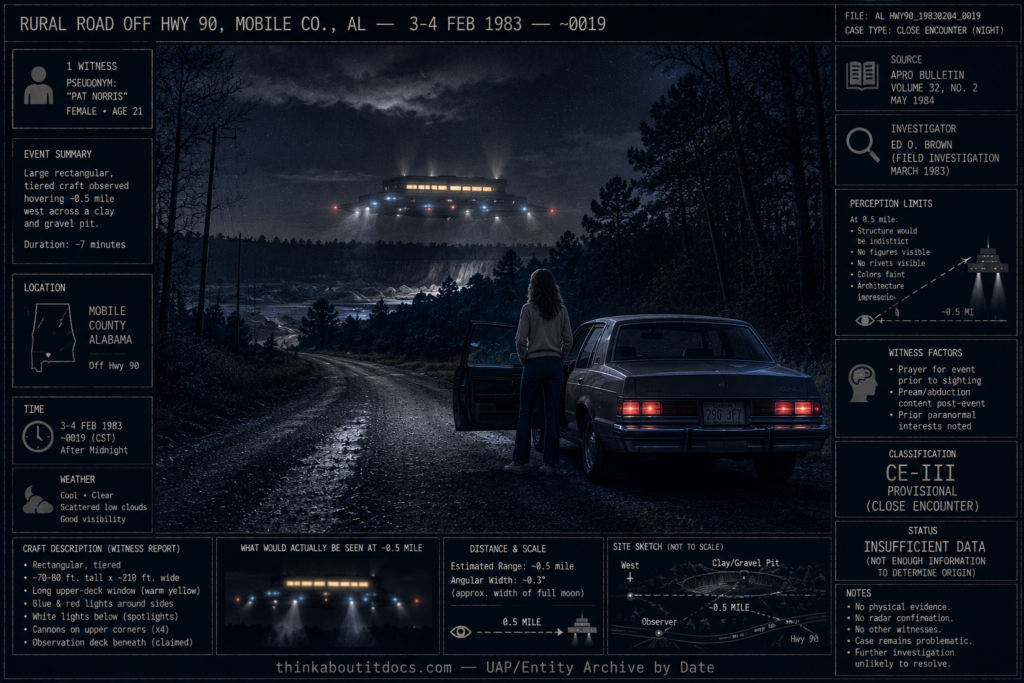
The 1983 Mobile, Alabama "Pat Norris" encounter — investigated through real APRO channels (Bob Gribble lead, Ed O. Brown field investigator, APRO Bulletin May 1984) but with perceptual detail exceeding what the unaided eye can resolve at half a mile, plus the witness's pre-event prayer for the experience and post-event dream-abduction material. Logged Insufficient Data. (thinkaboutitdocs.com — UAP/Entity Archive by Date)
THINK ABOUTIT UFO|UAP|ENTITY SIGHTINGS REPORT
1983: The “Pat Norris” Encounter near Mobile, Alabama — APRO Field Report with Impossible Detail
PSEUDONYMOUS SINGLE-WITNESS CASE — INVESTIGATED THROUGH REAL APRO CHANNELS BUT WITH PHYSICALLY IMPOSSIBLE PERCEPTUAL DETAIL AND EMERGING ABDUCTION CONTENT.
Witness “Pat Norris” alone in her car at half a mile distance reads architectural detail and counts 20–30 humanoids by their movement grace and ear shape inside the craft — perceptions impossible at the stated distance. She also discloses pre-sighting prayer for the encounter and developing post-sighting dream-abduction material.
On the night of February 3-4, 1983, a 28-year-old Mobile-area woman identified only by the pseudonym “Pat Norris” reported a five-minute close encounter with an enormous craft on a country road southwest of Mobile, Alabama. The case reached the record through a credible chain — lead from Bob Gribble’s Phenomena Research Hot Line, field investigation by APRO’s Ed O. Brown, publication in APRO Bulletin Vol. 32 No. 2 in May 1984 — and the source chain is the strongest thing the report has going for it. What does not survive scrutiny is the testimony itself: from half a mile away, at night, a single witness reports reading a 53-foot illuminated window, counting twenty to thirty humanoids inside, observing their chest size, ear shape, head shape, hairlessness, and the “great grace of their movements,” along with internal architectural details (curved white walls, an interior street of asphalt or concrete, I-beams holding glass, rivets, portholes “inside out”) that the unaided human eye cannot resolve at that distance under any conditions. The witness also discloses that she had prayed she might have such a sighting, and that she had extensive dream material both before and after the event including “a detailed physical examination and a scan of her emotions” — the structure of an emerging contactee/abduction narrative the APRO investigator notes will be presented “later when prepared.” The archive keeps the entry as a properly-investigated period case, sizes it honestly, and files it as Insufficient Data leaning toward an internal/visionary experience.
Date: February 3-4, 1983 — the page header says February 3, but the body text refers to “the February 4 incident” and the witness arrived home at 1:10 a.m., so the encounter began the night of Feb 3 and crossed into Feb 4; the internal date inconsistency should be noted
Sighting Time: Beginning approximately 12:19 a.m. on February 4 (after midnight)
Day/Night: Night
Location: Country road in the Mobile, Alabama area, off Highway 90, near a “clay and gravel pit”; specific location withheld at witness’s request
Urban or Rural: Rural (the prior page’s “Urban” is inconsistent with the body description — the witness was on a country road in a wooded area off Highway 90, returning from a visit; “suburban” is the witness’s home, not the sighting location)
No. of Entity(‘s): 20-30 claimed (inside the craft), plus additional figures in an observation deck — though these “perceptions” rest on visibility claims that exceed the resolving power of the unaided eye at the stated distance
Entity Type: Pale-skinned humanoid figures in white one-piece suits — described as about human height (5’10”), slender but with chests “larger than ours,” head top more prominent, hairless, with only the lower half of ears similar to humans
Entity Description: Pale-skinned, slim humanoids in white one-piece suits with proportionally larger chests, hairless and with the upper head shape more prominent, possessing only the lower portion of human-like ears; movements described as having “great grace”; atmosphere within the craft described as “sterile”; figures behind a curved white wall with no instruments visible; additional figures in a lower observation deck were said to be looking out
Hynek Classification: CE-III provisional (with strong contactee/abduction-template overlay; the prior page’s CE-I is conservative given that the witness describes interaction with humanoid figures, but the entire perception of those figures is at issue — see Researcher’s Notes)
Duration: Approximately 5 minutes (witness estimate)
No. of Object(s): 1
Description of the Object(s): An enormous craft estimated at 70-80 feet high (seven to eight stories) and 210 feet wide (“six telephone poles”), with a top deck featuring a 53-foot-long illuminated window, an opaque tinted window below it in inset sections, all white surrounding surfaces, rivets and portholes visible across the craft, a central closing door, a bottom formed of one-foot-square mirrors arranged in a cross pattern, an observation deck hanging below, four “pipes” projecting 6-8 feet from the craft mounted in 3-4 foot square boxes with hollow flanges (which the witness described as “looking like weapons”), and white spotlights with separate blue and red lights pointing both up to the clouds and down to earth
Shape of Object(s): Large rectangular or tiered craft, described by the witness as resembling “a ship or submarine” in construction
Size of Object(s): 70-80 feet × 210 feet (witness estimates) — dimensions roughly consistent with a small commercial dirigible or blimp
Color of Object(s): Predominantly white, with the bottom-mirror cross reflecting; lights white, blue, and red
Distance to Object(s): Approximately one-half mile west — a critical figure for evaluating the perceptual claims (see Researcher’s Notes)
Height & Speed: Approaching at 4-5 mph; eventually stopped; later moved on with a southerly turn back toward Irvington/Pascagoula direction
Number of Witnesses: 1 (the prior page’s “Multiple” is incorrect — only “Mrs. Pat Norris” is described as observing the craft; her husband Carl appears only in the post-event context, describing her subsequent UFO library research)
Special Features/Characteristics: A pre-sighting “explosion” sound followed by car vibration making steering difficult; on second look the witness found nothing wrong with the transmission; “chopping wind like a tornado,” high-pitched sound, and roaring sound during approach; witness’s initial fear “completely vanished” as object stopped, replaced by “unbelievable happiness”; witness discloses she had prayed she might have such a sighting; witness reports extensive dream material both before and after the event, including content described as “a detailed physical examination and a scan of her emotions” which APRO indicated would be “present[ed] later when prepared”
Case Status: Insufficient Data (leaning toward an internal/visionary experience with possible mundane priming event)
Source: APRO Bulletin, Vol. 32, No. 2 (May 1984); lead furnished to APRO by Bob Gribble of Phenomena Research Hot Line; field investigation by APRO Field Investigator Ed O. Brown; witness name and exact location changed at her request
Summary/Description: A 28-year-old woman identified only by the pseudonym “Pat Norris” reported a 5-minute close encounter on a country road off Highway 90 near Mobile, Alabama, beginning around 12:19 a.m. on February 4, 1983. She heard an explosion, experienced car vibration, then saw a 70-80 foot tall, 210 foot wide white craft approaching slowly half a mile to her west, with a 53-foot illuminated window through which she described counting 20-30 pale-skinned humanoid figures in white suits walking around “as if changing shift.” She also described interior architectural details (rivets, portholes, I-beams, an interior asphalt/concrete “street,” figures’ ear shapes and chest sizes, the “great grace” of their movements) at this distance and at night. She disclosed that she had prayed for such a sighting and reported extensive pre- and post-sighting dream material including a detailed physical examination. The case was investigated through real APRO channels by named field investigator Ed O. Brown and published in the May 1984 APRO Bulletin. The level of perceptual detail far exceeds what the unaided eye can resolve at half a mile at night, and the pre/post dream-abduction content is the structure of an emerging contactee/abductee narrative. The case is logged as Insufficient Data leaning toward an internal/visionary experience.
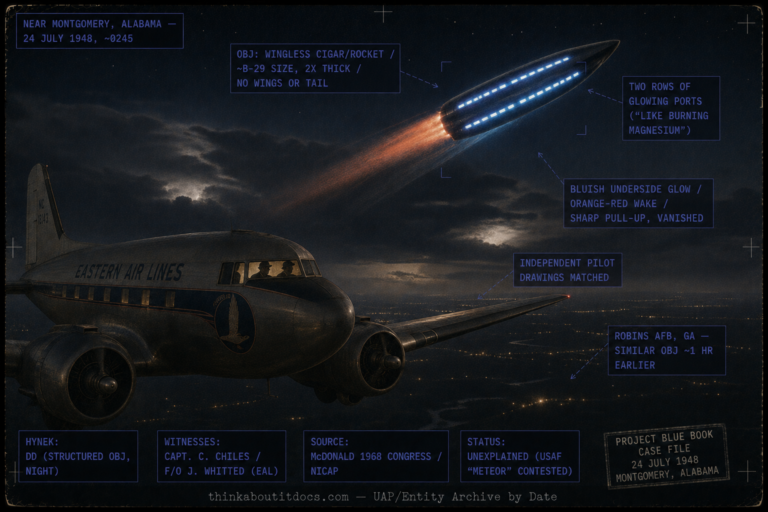
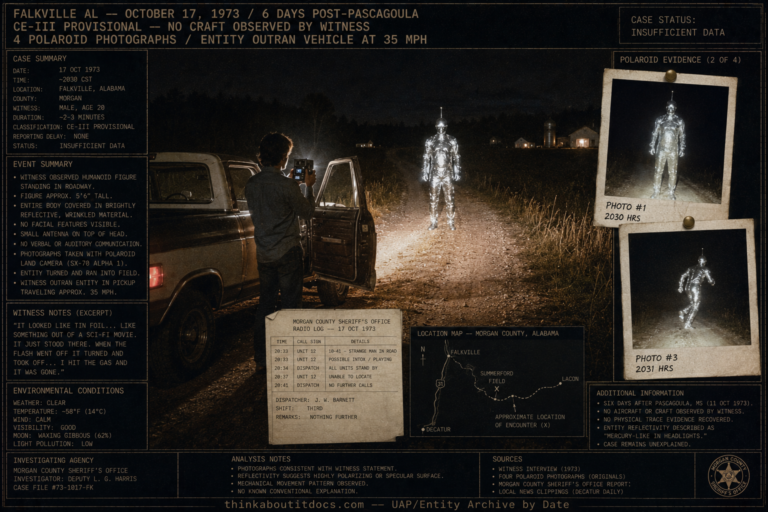
Related Cases: 1973: The Alabama Tinfoil Alien (Falkville) | 1970: Decatur, Alabama CE-II Sighting | the broader corpus of 1980s contactee-into-abductee narrative cases investigated by APRO before the organization’s 1988 dissolution
DETAILED REPORT
The chain of custody on this case is genuinely strong by 1980s standards, and that should be acknowledged before anything else is said about it. The lead came in to the Aerial Phenomena Research Organization (APRO) from Bob Gribble’s Phenomena Research Hot Line — both Gribble and his hotline were real, active resources of the period for collecting walk-in UFO reports nationwide. APRO assigned Field Investigator Ed O. Brown to the case, who conducted the interview and prepared the writeup. The result was published in APRO Bulletin Vol. 32 No. 2 in May 1984, which is a real and verifiable periodical of the era. APRO was, by the early 1980s, near the end of its long run (the organization dissolved in 1988 following the deaths of co-founders Jim and Coral Lorenzen), but it was still operating as a recognized investigation body. None of that is in dispute.
What is in dispute is what is in the report itself.
The witness, identified only as “Mrs. Pat Norris” (with her husband called “Carl” — these names are explicitly pseudonymous), reports that on the evening of February 3, 1983, she visited a friend in Mobile, then drove home alone on Highway 90 after the friend’s husband arrived from work. The exact timing matters: the page header says February 3 as the date, but the body refers to “the February 4 incident,” and the witness arrived home at 1:10 a.m.; the encounter therefore began the night of February 3 and crossed midnight into February 4. About 90 minutes from home, she reports hearing an explosion and her car beginning to vibrate, making steering difficult. She pulled off, checked the transmission (nothing wrong), continued, and the vibration stopped. After another turn, she saw woods ahead “brilliantly illuminated” and assumed a helicopter search was in progress. Then she stopped and saw the object.
The object’s external dimensions and the basic phenomenology she describes — a large illuminated craft, approaching at walking speed, with associated wind and sound effects — are not, by themselves, evidentially extraordinary. A 70-80 foot tall, 210 foot wide object slowly moving over woodland near Highway 90 at midnight in rural southwest Alabama is unusual but not impossible to imagine. The dimensions, in fact, are roughly consistent with a small commercial dirigible or blimp — a coincidence that is worth noting without claiming it as explanation.
What does not survive scrutiny is the level of internal detail the witness reports observing across half a mile of dark woodland at night. The page records that she observed: a 53-foot-long illuminated window with twenty to thirty humanoid figures inside; the figures’ chest proportions (larger than human); their head shape (more prominent on top); their hairlessness; their ear shape (only the lower half similar to human ears); the “great grace” of their movements; the absence of instruments behind them; the curved white wall behind them; the “sterile atmosphere” inside the craft; rivets across the entire craft surface; portholes “inside out”; an interior street made of asphalt or concrete; tubular rectangular equipment beside the street; “huge I-beams like they put ships together with”; beams holding the glass in place; four 6-8 foot pipes mounted in 3-4 foot square boxes with hollow flanges; one-foot-square mirrors making up a cross on the bottom; figures in a lower observation deck looking out; and an audible low-pitched announcement “almost like a growl” from the observation deck.
The unaided human eye, at half a mile (2,640 feet), at night, cannot resolve any of this. Twenty-twenty visual acuity gives a resolution of about one arc-minute at infinity. At 2,640 feet, one arc-minute corresponds to approximately 9.2 inches — the smallest detail that can theoretically be distinguished, under ideal lighting, by an exceptional observer. The figures the witness describes are, by her own account, about 5’10” tall; at half a mile they would subtend about 7 arc-minutes vertically — visible as figures but with no perceivable facial features, ear shape, head proportions, or chest dimensions. Counting 20-30 individual moving figures within a 53-foot window at that range, distinguishing their movement grace, observing their ear shapes — these are not difficult or marginal perceptions, they are physically impossible perceptions under the stated viewing conditions. The internal architectural details (rivets, I-beams, the asphalt-or-concrete texture of an interior surface) are similarly beyond what optical physics permits an unaided observer to perceive at the distance given.
This does not mean the witness was dishonest. It means the report, as recorded, mixes observable phenomena (a large illuminated object, sound effects, lights, motion) with imagined or visionary content presented as observation. The fact that the witness arrived home at 1:10 a.m. after a 90-minute drive following a 5-minute sighting suggests the encounter itself was relatively brief; the rich interior detail likely accumulated in her mind during and after the drive home, integrating with prior expectations.
And the prior expectations are explicit in the record. The investigator notes that “she told Mr. Brown she had prayed she might have such a sighting.” A witness who had prayed for the experience reports having the experience: this is not, by itself, evidence of fabrication, but it is exactly the priming structure under which sincere visionary experiences are most commonly generated. The investigator also notes that she “had extensive dream material both prior to and after the February 4 incident. The late dreams contain a detailed physical examination and scan of her emotions, which we expect to present later when prepared.” This is the developing architecture of an abduction narrative. By 1983-84, APRO had been investigating cases at the edge of contactee, abductee, and CE-III experience for nearly thirty years, and was — in retrospect, and consistent with the period — beginning to encounter the kind of inner-experience-presented-as-external-event case that the later 1980s and 1990s would see proliferate. The investigator’s framing here is supportive rather than skeptical of the dream material, with the implication that it will be developed into further reportable content.
The pre-sighting “explosion” and car vibration are worth honest treatment. They could be (1) a real mundane disturbance that primed the witness for the subsequent experience — a passing aircraft or helicopter overhead, a sonic boom from offshore military activity, a real but transient mechanical issue with the car; (2) reconstructed memory consistent with the visionary frame of the rest of the experience; or (3) the actual narrative anchor on which the rest of the experience was built. The record does not allow us to distinguish among these possibilities.
The honest verdict has to size all of this together. The case has a real source chain (APRO Bulletin, named investigator, named lead source) but pseudonymous witness (“identifying names changed”). It has plausible external phenomena (large illuminated object, sounds, lights, motion) layered with physically impossible perceptual claims (architectural and physiological detail at half a mile at night). It has the witness’s own disclosure of pre-sighting prayer for the experience and post-sighting dream-abduction material being prepared for later presentation. It is, in honest summary, a properly-investigated mid-1980s case whose content does not match the format of an external structural observation, and whose internal-experience markers — visionary detail, prayer disclosure, dream-abduction development — match the format of a sincere personal/spiritual experience the witness underwent. Insufficient Data is the proportionate verdict.
RESEARCHER’S NOTES
The “Pat Norris” Case — Real Investigation Channels, Impossible Perception
- Source chain credited honestly: APRO Bulletin Vol. 32 No. 2 (May 1984) is a real publication. Bob Gribble’s Phenomena Research Hot Line was a real period resource. Field Investigator Ed O. Brown is a real APRO name. This is not a fanzine or aggregator case. The investigative chain is legitimate and that deserves to be acknowledged before the content is analyzed.
- The pseudonym is a structural problem: “Pat Norris,” “Carl,” and the geographic specifics are all explicitly changed at the witness’s request. This is a normal accommodation in 1980s field investigation, but it has the practical effect of making the case unverifiable. No other witnesses can be located, no public records can be checked, no follow-up interview can be conducted with anyone except through APRO (which dissolved in 1988). The case can be evaluated only as the APRO writeup presents it.
- The optical-resolution problem is the central evidentiary issue: At half a mile (2,640 feet) at night, unaided 20/20 vision resolves details to approximately 9 inches at best, with ambient nighttime conditions degrading this substantially. The witness reports observing: individual humanoid figures (perceivable as figures but not as faces or proportions); ear shape (“lower half only of ears similar to our own” — anatomical detail requiring close-range observation); chest proportions (“larger than ours” — requires resolved torso proportions); head shape (“top of the head more prominent” — requires resolved facial silhouette); movement quality (“great grace of their movements” — requires resolved kinematic detail); the “sterile” atmosphere (an interior environmental quality not visible from outside); interior rivets, portholes seen from inside, asphalt-or-concrete textures, I-beam construction, glass-framing structures, one-foot-square mirrors arranged as a cross. None of this is observable from half a mile at night with the unaided eye. It is not a matter of acute vision or favorable lighting; it is a matter of optical physics. The level of detail described is incompatible with the stated viewing geometry.
- The pre-sighting prayer disclosure is the most diagnostic single detail: The investigator records that the witness told him “she had prayed she might have such a sighting.” This is the witness explicitly disclosing prior intention to experience a UFO encounter. It does not make her dishonest, but it places the case in a known category of personal/visionary experience cases where sincere expectation produces sincere experience. The same priming structure is well documented in religious-vision, mystical-experience, and prophetic-dream literature, none of which require external causation.
- The dream-abduction development is the second diagnostic detail: “Extensive dream material both prior to and after the February 4 incident. The late dreams contain a detailed physical examination and scan of her emotions, which we expect to present later when prepared.” This is the structure of a contactee experience evolving into an abductee experience over time, with APRO actively positioned to receive the developing material. By 1984, this template was well-established, and APRO — to its credit and to its weakness — was investigating such cases without strong skeptical filtering. The case is a period-typical example of investigative methodology that did not yet adequately filter for internal-experience content presented as external observation.
- Record corrections: The witness count is single, not multiple — only Mrs. Norris is described observing the craft. The location was rural (a country road in wooded area off Highway 90), not urban; the witness’s home was suburban but the sighting itself was on a rural road. The Hynek classification is reclassified from CE-I (the page’s choice) to CE-III provisional, because the witness describes interaction with humanoid entities and the entities are the bulk of what she reports — though the entity perception itself is at issue. The date should be recorded as February 3-4, 1983, since the sighting crossed midnight.
- Why Insufficient Data rather than Explained: A standard Explained verdict requires identification of a specific mundane cause for the entire report. Here, the report layers plausible external phenomena (a large illuminated object, sounds, lights, motion, a pre-event “explosion” and car vibration) with physically impossible perceptual content. The external layer might be a real phenomenon (an unusual blimp, a low-flying aircraft formation, a transient atmospheric event combined with a real car mechanical issue); the internal layer is consistent with a personal visionary experience the witness underwent. Without knowing how to separate the two with confidence, Insufficient Data is more honest than a flat Explained. The lean of the analysis is toward an internal/visionary experience with a possible mundane priming event, and that’s the way the case is recorded.
The “Pat Norris” case is a useful example of how the archive’s “stop the lie” discipline applies even to cases with real investigation chains. APRO did its job by the standards of 1984. Bob Gribble, Ed O. Brown, and the APRO Bulletin editors recorded what the witness told them, with appropriate caveats about the pseudonym and the developing dream content. What the post-investigation record needs now is the acknowledgment that the witness’s report describes perceptions impossible at the stated distance under the stated conditions, and that her own pre-event prayer and post-event dream-abduction disclosures place the case in the personal/visionary category. Sized to what it actually is — a sincere, properly-collected, structurally problematic single-witness account from the abductee era — it stands as Insufficient Data.