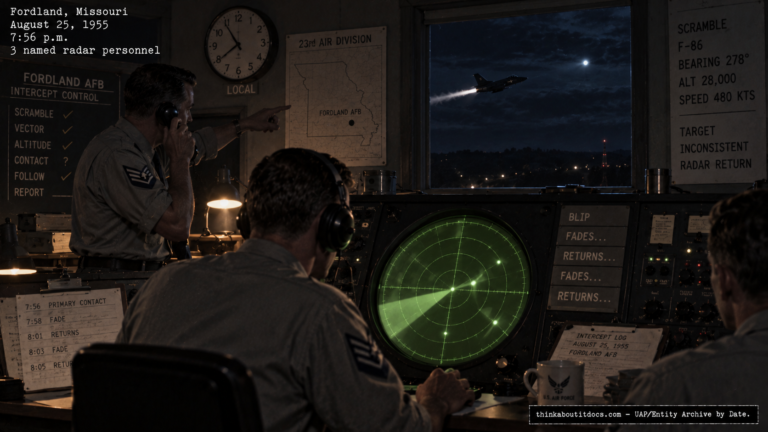
The August 25, 1955 Fordland, Missouri radar cat-and-mouse chase.
THINK ABOUTIT UFO|UAP SIGHTINGS REPORT
1955: Fordland, Missouri: An Hour-Long Radar Cat-and-Mouse Chase
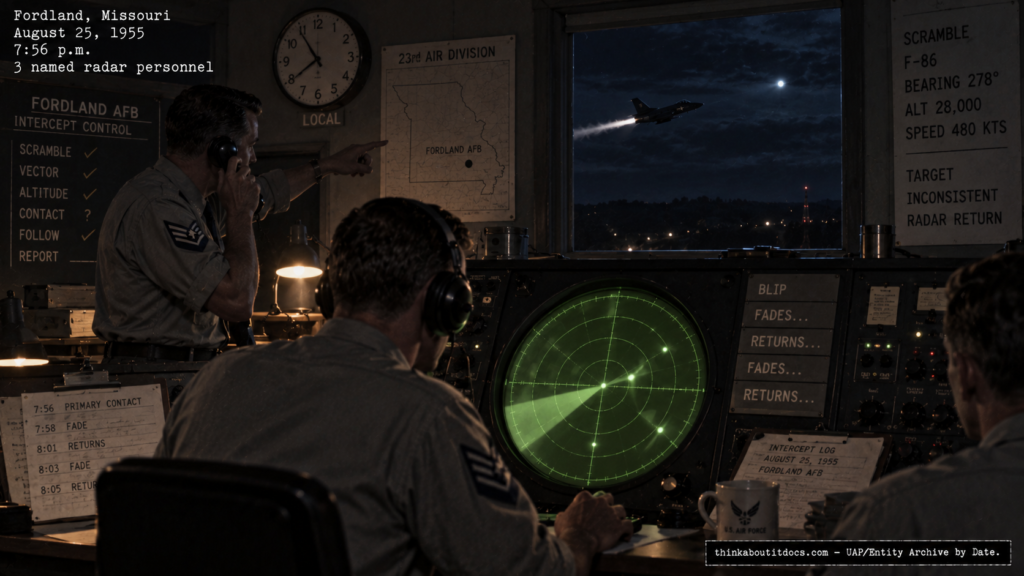
For the better part of an hour on August 25, 1955, a radar target over Missouri played a game of cat-and-mouse with an Air Force interceptor: fading from the scope every time the fighter closed within a few miles, then reappearing twenty miles ahead, over and over, until the pilot finally ran low on fuel and had to withdraw. Documented with three named radar personnel and a detailed sweep-by-sweep account, Fordland is one of the more procedurally well-recorded radar cases in the 1955 archive.
Date: August 25, 1955
Sighting Time: 7:56 PM CST onward
Day/Night: Night
Location: Fordland Air Force Station, Missouri
Urban or Rural: Rural (military radar installation)
No. of Entity(‘s): Not Applicable
Entity Type: Not Applicable
Entity Description: Not Applicable
Hynek Classification: RV (Radar/Visual) — though notably the visual (fighter intercept) component never achieved actual contact; this is closer to a pure radar case with a visual-pursuit attempt that failed each time
Duration: Approximately 50-60 minutes, until the fighter reported low fuel and withdrew
No. of Object(s): 1 (the target the fighter pursued); a second reading, once the fighter withdrew, showed the object painting like a stationary B-52
Description of the Object(s): A radar blip only — no visual contact was ever made by the pursuing fighter; radar signature reportedly changed character (from the original fast-moving target to one “painting like a B-52”) once the fighter withdrew
Shape/Size/Color of Object(s): Unknown — radar contact only, no visual
Distance to Object(s): The fighter closed to as near as half a mile from the tracked position on at least one approach, with the target fading from radar each time before any visual or closer contact could be confirmed
Height & Speed: Initial speed approximately 1,000 mph, slowing to roughly 320 mph before the intercept attempt began; behavior throughout the chase suggested repeated repositioning roughly 20 miles ahead of the fighter’s approach vector
Number of Witnesses: 3 named radar personnel at Fordland AFS: 1st Lt. John N. Oliver (Director), A/2C J.L. Bossom (radar operator), A/2C Isaac N. Young (radar operator); plus the unnamed pilot of interceptor “Dropkick 17”
Special Features/Characteristics: The target’s radar signature changed repeatedly and consistently just as the pursuing fighter closed distance — fading, then reappearing roughly 20 miles ahead, a pattern that repeated 10 to 15 times over the course of the pursuit; the target’s final radar signature, once pursuit ended, resembled that of a large, stationary aircraft (compared explicitly to a B-52) rather than the fast, erratic original contact
Case Status: Project Blue Book-era (BBU) case with named radar personnel and a detailed procedural account; unresolved — no visual confirmation was ever achieved despite an extended, repeated intercept attempt
Source: Dan Wilson; Brad Sparks; footnotes.com; Blue Book files
Summary/Description: At 7:56 PM CST on August 25, 1955, a blip appeared on the ground radar scope at Fordland Air Force Station, Missouri, moving at roughly 1,000 mph before slowing to about 320 mph. A fighter, callsign “Dropkick 17,” was scrambled and directed toward the target. Each time the fighter closed to within a few miles, the target faded from radar, then reappeared roughly 20 miles ahead on a new heading — a cycle that repeated 10 to 15 times over close to an hour, until the fighter pilot reported he was low on fuel and had to break off. Once the pursuit ended, the target’s radar signature shifted, now painting like a large, stationary aircraft comparable to a B-52. Radar personnel on duty were 1st Lt. John N. Oliver (Director) and radar operators A/2C J.L. Bossom and A/2C Isaac N. Young.
Related Cases: None identified
Detailed Report
At 7:56 PM CST on August 25, 1955, radar operators on duty at Fordland Air Force Station, Missouri, picked up an unidentified target moving at an estimated 1,000 mph — an extraordinary speed for any aircraft of the era. Within a few minutes, the target’s speed dropped to roughly 320 mph, a figure much more consistent with a conventional aircraft, though its behavior over the following hour would prove anything but conventional.
A fighter interceptor, radio callsign “Dropkick 17,” was scrambled and vectored toward the target’s position by the ground controller. What followed was an unusually well-documented pursuit sequence: each time the fighter closed to within a few miles of the tracked position — on at least one occasion to within half a mile — the target would fade from the radar scope entirely, only to reappear moments later roughly 20 miles away, on a new bearing that put it consistently ahead of the fighter’s approach. The controller would redirect the pilot toward the new position, the fighter would close in, and the cycle would repeat.
This pattern held for somewhere between 50 and 60 minutes, repeating an estimated 10 to 15 times, before Dropkick 17’s pilot reported he was running low on fuel and had to abandon the pursuit. What happened immediately afterward is, in its own way, as notable as the chase itself: once the fighter withdrew, the target’s radar return changed character. Rather than continuing to move and evade, it began painting on the scope in a manner the radar crew compared explicitly to a B-52 bomber — large and stationary — a marked shift from the fast, elusive signature that had defined the previous hour.
The radar personnel on station that night are individually named in the surviving case file: 1st Lt. John N. Oliver served as Director, with A/2C J.L. Bossom and A/2C Isaac N. Young operating the radar equipment. No visual contact with the target was ever achieved by the pursuing fighter at any point during the chase.
RESEARCHER’S NOTES
The Fordland Chase — 1955 Missouri and a Genuinely Documented Cat-and-Mouse Pattern
- Named Personnel, Not Anonymous Reporting. Unlike many radar cases in this archive, Fordland comes with three specifically named radar personnel and their roles, giving the account a stronger documentary anchor than an anonymous “radar detected an object” summary.
- A Genuinely Repeated Pattern, Not a Single Anomaly. Ten to fifteen repetitions of the same fade-and-reappear cycle over nearly an hour is a strong argument against a one-off equipment glitch or a single misread blip — whatever explains the pattern, it was consistent and sustained, exactly the kind of repeated behavior that is harder to dismiss than an isolated reading.
- The Post-Chase Signature Shift. The target’s radar return changing from erratic and fast to large and stationary immediately after the fighter withdrew is a striking detail that resists easy explanation — if it wasn’t simply a different, unrelated return appearing on the scope by coincidence, it suggests whatever was being tracked altered its own behavior once the pursuit ended.
- Pure Radar, No Visual Confirmation. The case’s central limitation is that despite an hour-long, repeated intercept attempt, no pilot ever visually confirmed anything at all — leaving open the possibility of a persistent radar propagation anomaly or equipment issue, though the specific, repeated, directional pattern of the fades and reappearances is not the signature typically associated with simple radar ducting or clutter.
Fordland stands as a well-documented, if ultimately unresolved, case: named personnel, a detailed and consistent behavioral pattern repeated over nearly an hour, and a curious signature shift once pursuit ended — all without the visual confirmation that would move it from “unexplained radar anomaly” to a fully corroborated sighting.
“From then on it was like a game, the target would pop up about 20 miles away and when the fighter would head toward it the target would fade away.”
— Case file, Fordland, Missouri, August 25, 1955