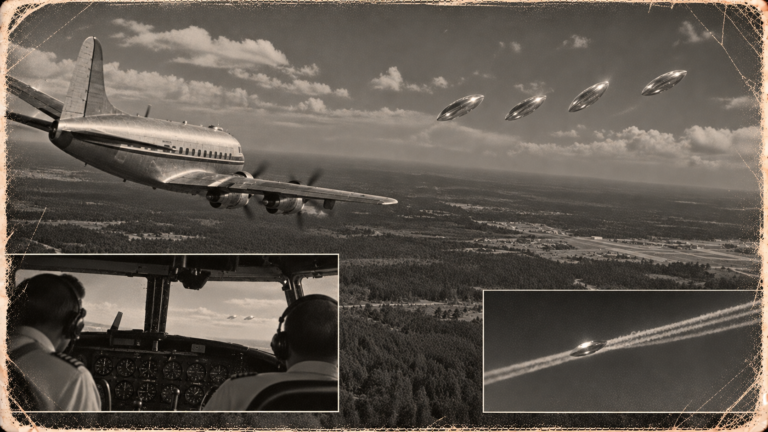
Capt. Dan Holland's encounter with a gold-ringed white sphere near Fort Lauderdale, Florida, March 25, 1954.
THINK ABOUTIT UFO|UAP SIGHTINGS REPORT
1954: The Holland Sighting — Fort Lauderdale, Florida
Marine Corps Captain Dan Holland was flying formation at 26,000 feet when a gleaming white ball twice the size of his own jet dropped out of the sky on a collision course straight at him. He broke hard, radioed the other two pilots to look, then banked back toward the thing and flipped on his gun camera — only for it to shoot away to the east and vanish in fifteen seconds flat. The two pilots flying just ahead of him never saw a thing.
Date: March 25, 1954 BBU
Sighting Time: 3:20 p.m.
Day/Night: Day
Location: Airspace near Fort Lauderdale, Florida
Urban or Rural: Air
No. of Entity(‘s): 0
Entity Type: Not Applicable
Entity Description: Not Applicable
Hynek Classification: DD (Daylight Disc — used broadly here for a daylight, non-conventional object; the object was ball-shaped rather than disc-shaped)
Duration: Approximately 15-30 seconds from closest approach to disappearance
No. of Object(s): 1
Description of the Object(s): A gleaming white, ball-shaped object with a gold-colored ring around its lower third
Shape/Size/Color of Object(s): Spherical, white, with a gold ring around the lower third; approximately twice the size of Holland’s jet fighter
Distance to Object(s): Descended to within 3,000-4,000 ft of Holland’s aircraft before stopping
Height & Speed: Holland’s formation was at approximately 26,000 ft and 400+ mph; the object descended vertically on a collision course, then accelerated away to the east at what Holland described as tremendous speed
Number of Witnesses: 1 direct (Capt. Dan Holland); two additional Marine pilots flying ahead of him in the same formation did not see the object
Special Features/Characteristics: The object descended vertically on a direct collision course before Holland took evasive action; it then stopped abruptly 3,000-4,000 ft above his new position; Holland banked toward it and activated his gun camera, but the object accelerated away before useful footage could be captured; the two other pilots in his three-jet formation, flying ahead of him, never saw the object despite being airborne in the same immediate area
Case Status: Officially logged by Project Blue Book (BBU); a credentialed military witness with an attempted but unsuccessful gun-camera capture
Source: Weinstein; NARCAP; BB files; UFOE, IV
Summary/Description: At 3:20 p.m. on March 25, 1954, USMC Capt. Dan Holland, flying one of three jets with the 3rd Marine Air Wing near Fort Lauderdale, Florida at about 26,000 ft and over 400 mph, saw a gleaming white, ball-shaped object with a gold ring around its lower third — roughly twice the size of his own aircraft — descend vertically on a collision course. He took evasive action and radioed the other two pilots to look. The object suddenly stopped 3,000-4,000 ft above his new position. Holland banked toward it and switched on his gun camera, but the object accelerated away to the east and disappeared in about fifteen seconds. The two other pilots, flying ahead of him in the same formation, never saw the object at all.
Related Cases: None known
Detailed Report
At 3:20 in the afternoon on March 25, 1954, Marine Corps Captain Dan Holland was flying one of three jets with the 3rd Marine Air Wing, heading east near Fort Lauderdale, Florida, cruising at roughly 26,000 feet and over 400 miles per hour. Nothing about the flight had been unusual until something appeared above and ahead of him: a gleaming white, ball-shaped object, marked with a gold-colored ring around its lower third, roughly twice the size of his own jet.
It wasn’t simply visible — it was descending directly toward him on what read, unmistakably, as a collision course. Holland broke away, taking evasive action, and got on the radio to alert the other two pilots in his formation to look for it themselves. The object, meanwhile, stopped its descent abruptly, coming to rest some 3,000 to 4,000 feet above Holland’s new position.
Rather than simply continue clear of it, Holland banked his aircraft back toward the object and switched on his gun camera, hoping to capture something concrete. He didn’t get the chance. The object accelerated away to the east at what he could only describe as tremendous speed, vanishing from sight in roughly fifteen seconds.
What makes the case stranger, rather than simpler, is what the other two pilots reported: flying just ahead of Holland in the same three-plane formation, neither of them saw the object at any point — not during its descent, not during its stationary hold, not during its departure.
RESEARCHER’S NOTES
Fort Lauderdale — 1954 and a Camera That Didn’t Get There in Time
- A credentialed single witness within a formation: Holland’s status as a named Marine Corps pilot lends this account real institutional weight, but the fact that his two formation-mates saw nothing at all is a genuine complication — it isn’t simply a case of “everyone saw it,” and this archive doesn’t smooth over that asymmetry.
- An attempted but unsuccessful gun-camera capture: Unlike the Thompson pursuit near Blythe, California (March 1953), where film was actually obtained, this case represents the far more common outcome: a pilot who tried to document the object and simply ran out of time before it departed.
- A collision-course approach followed by a dead stop: The specific behavior — a vertical descent aimed directly at the aircraft, then an abrupt halt at a safe distance — is a distinct flight profile from simple linear pursuit cases elsewhere in this archive, and reads as more deliberate than incidental.
- Multiple source citations converge on this case: Independent listing across Weinstein, NARCAP, Blue Book files, and UFOE suggests this case was considered noteworthy enough to be tracked by several separate research traditions rather than surfacing through a single compiler.
- No radar corroboration mentioned: This remains a purely visual account from the air, with no ground radar confirmation cited in the surviving record — a limitation worth noting even given the credentialed witness.
This is a solid, credentialed single-witness military case whose central complication — two nearby pilots seeing nothing at all — this archive states plainly rather than minimizes. Holland’s attempt to document the object on film, though unsuccessful, reflects a witness actively trying to produce evidence rather than simply reporting an impression.
“Object suddenly stopped 3,000-4,000 ft above, he banked toward it and activated gun camera but object then accelerated and disappeared to the E at tremendous speed in about 15 secs.”
— Case summary, on Capt. Dan Holland’s account, March 25, 1954