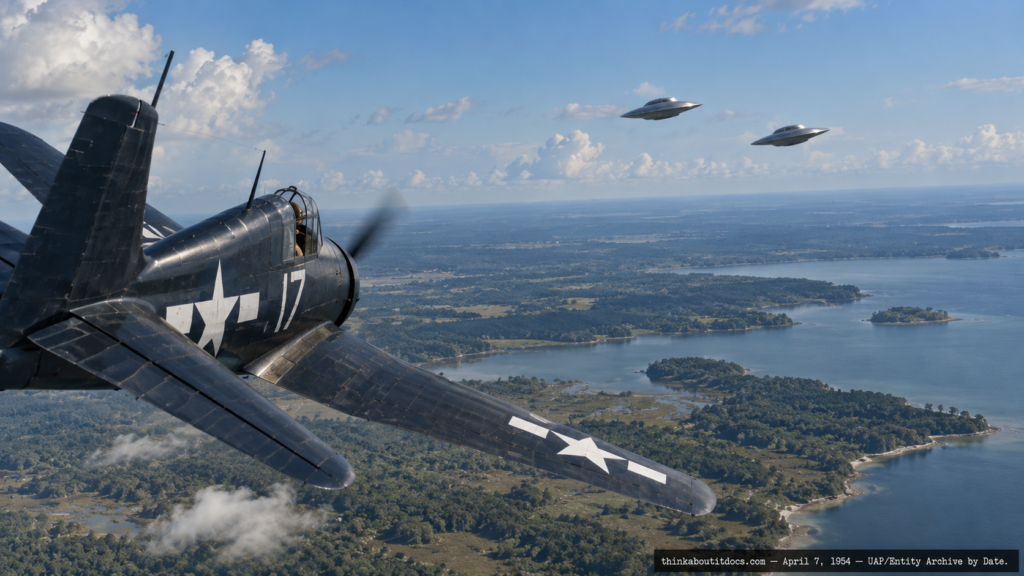
Navy pilot C.R. Allen's unsuccessful pursuit of two discs near Fentress, Virginia, April 7, 1954.
THINK ABOUTIT UFO|UAP SIGHTINGS REPORT
1954: The Fentress, Virginia Pursuit — C.R. Allen
Navy pilot C.R. Allen spotted two saucer-shaped discs flying in close formation near Fentress, Virginia and turned to follow — the beginning of a chase that covered thirty miles of sky in under thirty seconds. Whatever they were, they never let him gain an inch, holding formation and distance the entire way before vanishing near Cape Henry. The math afterward was almost as startling as the sighting itself: somewhere between 3,600 and 4,300 miles per hour.
Date: April 7, 1954 BBU
Sighting Time: 3:00 p.m.
Day/Night: Day
Location: Approximately 3 miles southwest of Fentress, Virginia, near Lake Drummond
Urban or Rural: Air
No. of Entity(‘s): 0
Entity Type: Not Applicable
Entity Description: Not Applicable
Hynek Classification: DD (Daylight Disc)
Duration: Approximately 25-30 seconds for the pursuit itself
No. of Object(s): 2
Description of the Object(s): Two saucer-shaped discs, flying in close formation
Shape/Size/Color of Object(s): Saucer/disc-shaped; further shape, size, and color detail not specified beyond the basic description
Distance to Object(s): First seen approximately 15 miles from Allen’s aircraft, at 3,500 ft altitude against a scattered cumulus cloud base
Height & Speed: Maintained approximately 3,500 ft throughout; covered roughly 30 miles total distance in about 25-30 seconds, calculated at an estimated 3,600-4,300 mph
Number of Witnesses: 1 (USN pilot C.R. Allen)
Special Features/Characteristics: The two objects maintained close formation and a consistent distance from Allen’s aircraft throughout the entire pursuit, covering approximately 140 degrees of arc as he turned to follow them; despite Allen’s F6F closing the distance as best it could, the objects’ calculated speed vastly exceeded any aircraft performance available in 1954; the objects disappeared near Cape Henry, roughly 20 miles northeast of the initial sighting point
Case Status: Officially logged by Project Blue Book (BBU); a credentialed military pilot’s account with a specific, calculated extreme speed derived from tracked positions and elapsed time
Source: Jan Aldrich
Summary/Description: At 3:00 p.m. on April 7, 1954, USN pilot C.R. Allen, flying an F6F for the Fleet Training Center at Norfolk, Virginia, was heading west at 3,000 ft near Fentress when he spotted two saucer-shaped discs in close formation at about 3,500 ft, roughly 15 miles away near Lake Drummond, heading northeast against a backdrop of scattered cumulus clouds. Allen turned right to follow, tracking the objects as they covered approximately 140 degrees of arc while maintaining the same relative distance from his aircraft. The two objects disappeared near Cape Henry, about 20 miles to the northeast of the initial sighting, having covered a total of roughly 30 miles in an estimated 25-30 seconds — implying a speed between 3,600 and 4,300 mph.
Related Cases: None known
Detailed Report
At three in the afternoon on April 7, 1954, U.S. Navy pilot C.R. Allen was flying an F6F for the Fleet Training Center at Norfolk, Virginia, heading west at 3,000 feet near Fentress. Something caught his attention off to the side: two saucer-shaped discs, flying in tight formation, roughly fifteen miles distant near Lake Drummond, holding at about the same altitude as his own aircraft — 3,500 feet — against the backdrop of a scattered cumulus cloud layer.
Allen turned right to pursue, tracking the pair as they held their heading toward the northeast. Over the course of the chase, he covered approximately 140 degrees of arc trying to close the distance — and never managed to gain on them. The two objects maintained essentially the same separation from his aircraft the entire time, as though his own speed simply didn’t factor into the equation.
The pursuit ended near Cape Henry, roughly twenty miles northeast of where Allen had first spotted the pair, where they disappeared from view. What made the case remarkable wasn’t just that Allen couldn’t catch them — it was the arithmetic afterward. The two discs had covered an estimated thirty miles total distance in only twenty-five to thirty seconds, a pace that worked out to somewhere between 3,600 and 4,300 miles per hour — a figure with no plausible match among any aircraft flying in 1954, military or otherwise.
RESEARCHER’S NOTES
Fentress — 1954 and Speed Calculated From a Failed Pursuit
- A calculated, not estimated, speed figure: The 3,600-4,300 mph range comes from dividing a tracked distance by an elapsed time, not from Allen’s own subjective impression of how fast the objects seemed to be moving — a meaningfully different kind of claim than a witness simply saying “it was incredibly fast.”
- A credentialed single witness: As with several other military pilot cases in this archive, Allen’s professional background lends the account institutional weight, though it remains, in the end, a single witness’s report with no independent corroboration.
- Consistent formation-keeping under pursuit: The two objects maintaining tight formation with each other while also maintaining constant separation from a pursuing aircraft describes coordinated, controlled flight behavior rather than an erratic natural phenomenon.
- No radar confirmation: This is a purely visual account from the cockpit, with no ground radar cited as having independently tracked the same objects — a limitation worth stating plainly alongside the credentialed witness and the calculated speed.
- A brief but data-rich sighting: Despite lasting under thirty seconds, this case yields more quantifiable detail — distance, arc covered, elapsed time — than many far longer sightings in this archive, a testament to Allen’s presumably trained aviator’s habit of tracking bearing and distance even under surprise.
This case’s evidentiary strength lies in its specific, calculable numbers rather than impressionistic description — a credentialed pilot’s tracked pursuit yielding a concrete, if extraordinary, speed figure. It remains a single-witness, visual-only account, and this archive presents the calculated speed with that limitation stated clearly.
“[Allen] turned right to follow objects as they covered about 140° of arc maintaining about the same distance, disappearing near Cape Henry… covering 30 miles total in about 25-30 secs [3,600-4,300 mph].”
— Jan Aldrich, on the April 7, 1954 Fentress, Virginia sighting