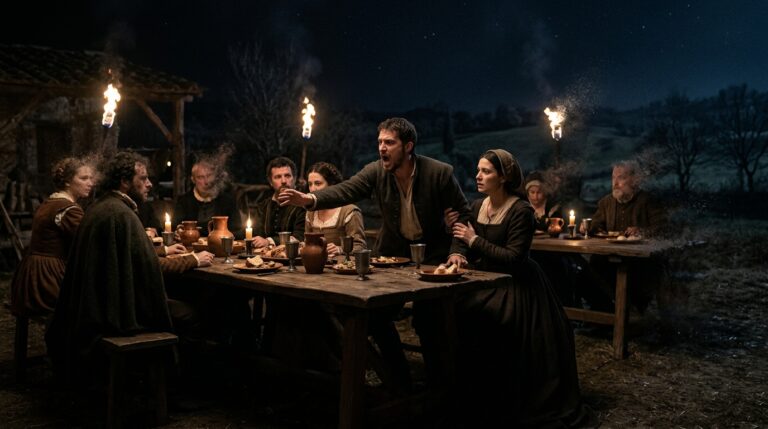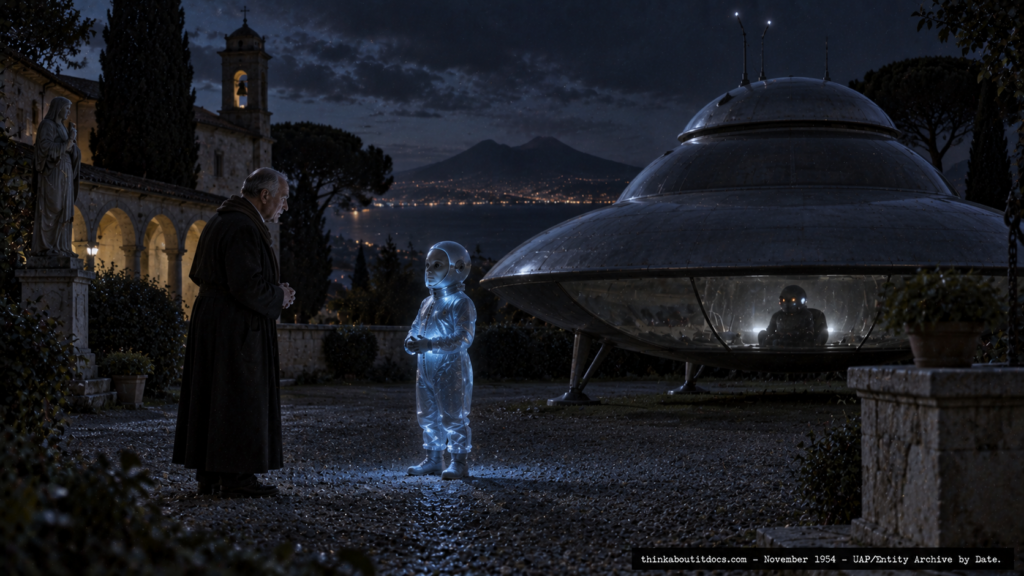
The convent grounds at Camaldoli, Naples, Italy, where Vincenzo Dattilo reported an extended Old Latin conversation with a saucer's occupant, November 1954.
THINK ABOUTIT
UFO|UAP & ENTITY ENCOUNTER REPORT
1954: The Camaldoli, Naples, Italy Encounter — Vincenzo Dattilo
A 67-year-old lawyer, journalist, and poet praying before a Naples convent watched a spinning “star” descend, hover, and land as a ten-meter saucer thirty feet away — and what emerged from it didn’t flee from conversation. It approached, made eye contact, and after a halting exchange of guttural sounds gave way to something neither of them expected: two educated men, one human and one not, finding enough common ground in Old Latin to talk.
A NOTE ON THIS CASE
This is a rare instance of an alleged verbal exchange conducted in a specific, identifiable human language, rather than an unintelligible or telepathic communication. The witness’s own professional background — a lawyer, journalist, and published writer — is directly relevant to assessing the account’s internal coherence, and this archive notes it accordingly.
Date: November 1954 (exact date not recorded)
Sighting Time: 02:00 (2:00 a.m.)
Day/Night: Night
Location: Camaldoli, Naples, Italy (before the main convent)
Urban or Rural: Urban (convent grounds)
No. of Entity(‘s): 2
Entity Type: Humanoid, claiming terrestrial (not extraterrestrial) origin
Entity Description: Approximately 1 m tall; wore a transparent outfit emitting a bluish light, described as “impermeable to anything coming into contact with it from the outside”; the second entity, seen seated inside the craft, appeared “fluffed up and ruffled like a doll” and had several small, bright, flashing lights on its face
Hynek Classification: CE-V (Close Encounter, Fifth Kind — voluntary, bilateral, sustained verbal contact)
Duration: An extended encounter, sufficient for a halting conversation to develop and conclude
No. of Object(s): 1
Description of the Object(s): A large saucer with two domes, one above and one beneath the central body; the upper dome had two long, thin antennae that moved slightly, as if in the wind; an oval hatch on the lower dome served as the entry point
Shape/Size/Color of Object(s): Saucer-shaped, approximately 10 m wide, with two domes; initially surrounded by intense illumination that extinguished once landed, revealing the craft’s structure clearly
Distance to Object(s): Landed approximately 20 m from the witness; the entity approached to within 4-5 m before stopping
Height & Speed: Descended vertically after hovering at approximately 100 m, landing smoothly and silently; on departure, illuminated, rose vertically with a slight rumbling sound, flew back and forth horizontally while spinning, then departed at great speed
Number of Witnesses: 1 (Vincenzo Dattilo, 67)
Special Features/Characteristics: Dattilo first observed the object as a rapidly spinning “star” descending from the sky, flying horizontally back and forth before stopping roughly 100 m above him and then descending vertically to land smoothly and silently; the first entity emerged through an oval hatch and gestured for Dattilo to stay still, stopping 4-5 m away and making eye contact; a second entity was visible seated inside the craft’s transparent lower dome, appearing “fluffed up and ruffled like a doll”; after initial guttural sounds Dattilo couldn’t understand, the two eventually communicated in Old Latin, with frequent errors on both sides; the entity claimed to be from a terrestrial nation (which it declined to name) that had made major scientific advances, including a form of propulsion based on immense natural forces intended to render other aircraft and weapons obsolete and “introduce the peace of heaven to the world”; asked why saucer pilots were consistently short in stature, the entity explained the technology remained imperfect and demonstrated by jumping roughly half a meter into the air and remaining stationary, unsupported, before landing; the entity stated that in its home country, “little men” were highly esteemed and specially trained as saucer pilots, but declined to name the country; the entity offered a hand gesture in farewell before re-boarding, assisted by an external force, and taking a seat beside the second entity at what appeared to be a steering mechanism
Case Status: Unresolved — a single-witness account distinguished by a specific claimed language of communication (Old Latin) and a stated terrestrial, rather than extraterrestrial, origin for the craft and its occupants
Source: Maurizio Verga, “When Saucers Came to Earth”
Summary/Description: At 2:00 a.m. in November 1954, Vincenzo Dattilo, a 67-year-old lawyer, journalist, and poet, was praying before the main convent at Camaldoli, Naples, Italy, when he saw a spinning “star” descend, hover at roughly 100 m, then land smoothly and silently about 20 m away, resolving into a 10-m, two-domed saucer. A meter-tall entity in a bluish-glowing transparent suit emerged and approached to within 4-5 m, gesturing for Dattilo to remain still; a second, oddly “fluffed and ruffled” entity was visible seated inside. After initial guttural sounds, the two managed a halting conversation in Old Latin. The entity claimed the craft was of terrestrial, not extraterrestrial, origin, from an unnamed nation with advanced propulsion technology intended to bring about world peace, and explained the pilots’ short stature by demonstrating an imperfect anti-gravity capability, jumping and hovering briefly unsupported. It described “little men” as highly esteemed, specially trained pilots in its home country. After a farewell gesture, it re-boarded, and the object departed vertically, maneuvering briefly before accelerating away at great speed.
Related Cases: None known
Detailed Report
Vincenzo Dattilo was, by any measure, an unusual witness for an encounter of this kind: sixty-seven years old, a lawyer by training, and also a journalist, writer, and poet — a man whose profession and personal interests both depended on precise use of language. He was praying before the main convent at Camaldoli, Naples, at two o’clock one morning in November 1954, when something in the sky pulled his attention upward: a “star,” spinning rapidly, descending from above.
The object didn’t simply fall toward him. It flew back and forth horizontally for a time, still spinning, before coming to a stop roughly a hundred meters directly above where Dattilo stood. Then it began a vertical descent, settling to the ground smoothly and silently, coming to rest some twenty meters from him.
The intense light surrounding the object went out once it landed, and what remained visible in the darkness was a large saucer, about ten meters across, built with two domes — one above the central body, one below. The upper dome carried two long, thin antennae that moved gently, as though stirred by wind. The craft appeared to hover just above the ground rather than settling fully onto it.
An oval hatch opened in the lower dome, and a small figure emerged. Through the transparent lower dome, Dattilo could also make out a second occupant, still seated inside — a figure that struck him as oddly “fluffed up and ruffled,” like a doll rather than a person. The first entity approached, made a clear gesture — stay where you are, don’t move — and stopped at a distance of four or five meters. The two of them, man and visitor, looked directly at one another.
The entity stood about a meter tall, dressed in a transparent suit that emitted its own bluish light, a material Dattilo would later describe as seeming impermeable to anything that might touch it from outside. It began to speak — guttural sounds, at first entirely meaningless to Dattilo. But something in what he was hearing eventually clicked with his own education, and the two of them, after some struggle, found a shared language: Old Latin, spoken by both with plenty of mistakes, but spoken nonetheless.
What the entity told him, communicated partly through words and partly through gesture — pointing at itself, at the craft — was that it came not from another world, but from a nation of this one, a country that had made extraordinary strides in science. Its craft, the entity explained, drew power from enormously powerful natural forces, a discovery capable of rendering every other aircraft and weapon obsolete, one it hoped would “introduce the peace of heaven to the entire world.”
Dattilo, characteristically curious, asked why the craft’s pilots were always so short. The entity’s answer came through both words and demonstration: the technology, it explained, remained imperfect. To illustrate, it jumped roughly half a meter off the ground and simply stayed there, hovering in place, unsupported, before coming back down. In the entity’s home nation — which it declined, despite Dattilo’s evident interest, to name — “little men” like itself were highly regarded and specially trained for exactly this role: piloting the saucers.
The entity glanced around once more. Dattilo offered a few more words in Latin. In response, the being extended a hand in a gesture of farewell before turning back toward its craft. Aided by some external force Dattilo couldn’t identify, it passed through the hatch into the transparent cabin and took its seat beside the other occupant, who had its hands resting on what looked like a steering mechanism and several small lights flashing across its face. The object lit up, lifted off vertically with a slight rumbling sound, maneuvered briefly back and forth while continuing to spin, and then accelerated away at great speed, vanishing from sight.
RESEARCHER’S NOTES
Camaldoli — 1954 and a Claim of Terrestrial, Not Alien, Origin
- A claimed terrestrial origin sets this case apart: Unlike the great majority of 1954 contact accounts, in which entities identify themselves as extraterrestrial, this entity specifically describes itself as coming from an unnamed nation of Earth — a genuinely unusual claim that reframes the entire encounter as a hidden-advanced-civilization narrative rather than a visitation story.
- Old Latin as the shared language is a specific, checkable detail: Dattilo’s professional background as a writer and journalist makes some working knowledge of Latin plausible, and the account’s own acknowledgment that both parties “made many mistakes” reads as a more believable claim than a suspiciously fluent, error-free exchange would.
- A demonstrated, rather than merely claimed, capability: The entity’s brief unsupported hover, offered specifically to illustrate a point about imperfect technology, is a demonstration embedded within the conversation’s logic rather than a random special effect — it directly answers the question Dattilo had just asked.
- A refusal to name the home nation: The entity’s declining to identify its country of origin, despite otherwise extensive conversation, is a convenient narrative gap that leaves the account’s central claim unfalsifiable — this archive notes that limitation plainly.
- A credentialed, articulate single witness: Dattilo’s occupation lends the account’s careful, detailed structure some plausibility as an accurately recorded narrative, though it remains, in the end, a single witness’s uncorroborated testimony.
This case stands out among this archive’s 1954 contact accounts for its claim of a hidden terrestrial, rather than extraterrestrial, origin, and for the specific, imperfect nature of its claimed shared language. It remains a single witness’s account, offered by a credentialed and educated narrator, with no independent corroboration of any part of the exchange.
“Dattilo and the creature finally managed to converse in Old Latin, although they made many mistakes.”
— Maurizio Verga, “When Saucers Came to Earth,” on the November 1954 Camaldoli, Naples, Italy case