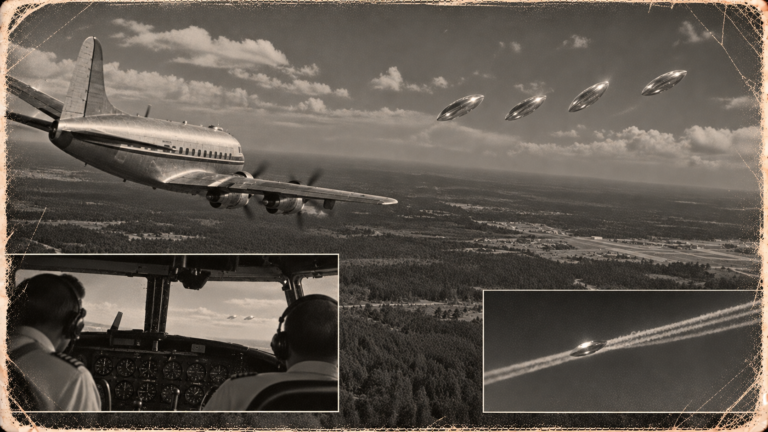
The April 20, 1952 Toronto Corridor Wave, independently observed by air traffic controllers, RCAF pilots, and airborne radar across southern Ontario.
THINK ABOUTIT UFO|UAP SIGHTINGS REPORT
1952: The Toronto Corridor Wave — Ontario, Canada
On the night of April 20, 1952, in the span of about ten minutes, unidentified objects crossing the sky over southern Ontario were independently reported by air traffic controllers in four separate cities, three RCAF aircrew members, roughly fifteen airborne RCAF fighters whose pilots mostly confirmed the sightings, Trans-Canada Airlines pilots, and at least one pilot who tracked eleven separate objects on his own aircraft’s radar. Nearly every account agreed on the same extraordinary detail: whatever these objects were, they crossed the sky from horizon to horizon in about three seconds. This is one of the most thoroughly multi-witnessed, multi-instrument UFO cases in the entire Canadian record, preserved directly in the country’s own Department of National Defence documents.
Date: April 20, 1952
Sighting Time: Approximately 11:00-11:28 p.m. local time
Day/Night: Night
Location: Southern Ontario, Canada, spanning a corridor from west of Toronto through Buffalo, London, and Centralia, extending toward Niagara
Urban or Rural: Mixed — multiple urban air traffic control towers and airborne military/civilian aircraft across the corridor
No. of Entity(‘s): Not applicable
Entity Type: Not applicable
Hynek Classification: RV (Radar/Visual) — combining ground and air traffic control visual observation, extensive military and civilian pilot visual confirmation, and at least one independent airborne radar track
Duration: Approximately 28 minutes overall (11:00-11:28 p.m.), though individual object transits were reported as lasting only about 3 seconds each, horizon to horizon
No. of Object(s): Multiple — at least four objects reported visually by RCAF aircrew, with one pilot’s radar independently tracking eleven separate objects
Description of the Object(s): Objects leaving visible vapor trails as they crossed the sky; no further shape or structural detail is recorded in the surviving sources beyond the trails themselves and their extraordinary speed
Shape of Object(s): Not specified beyond the vapor trails they produced
Size of Object(s): Not specified
Color of Object(s): Not specified beyond the visible vapor trails
Distance to Object(s): Observed from multiple ground towers and from roughly fifteen airborne RCAF aircraft actively in the same airspace
Height & Speed: Estimated at 30,000-35,000 feet altitude, crossing from horizon to horizon in approximately 3 seconds — a rate of travel implying extraordinary speed, far beyond any known aircraft of the period
Number of Witnesses: Numerous — air traffic controllers at Cleveland Hopkins Airport, Toronto, Buffalo, London, and Centralia towers; 3 named RCAF aircrew members; roughly 15 airborne RCAF F-51 and T-33 pilots, most of whom confirmed the sightings; Trans-Canada Airlines pilots; at least one pilot with independent radar confirmation
Special Features/Characteristics: The case unfolded as a rapidly cascading series of independent reports across multiple control towers and aircraft over roughly half an hour, beginning with a call from west of Toronto and spreading through a coordinated chain of air traffic control communications (Toronto ATC requesting Cleveland call Niagara for identification); a large number of RCAF fighters happened to already be airborne in the area at the time, providing an unusually dense concentration of trained military witnesses; one pilot’s onboard radar independently corroborated eleven separate objects, a rare instance of airborne radar confirmation for a case of this scale.
Case Status: Unexplained
Source: Canadian Department of National Defence documents; Dan Wilson
Summary/Description: At around 11:00 p.m. local time on April 20, 1952, air traffic control at Cleveland Hopkins Airport received calls reporting objects west of Toronto heading west and leaving vapor trails. Toronto ATC requested that Cleveland contact Niagara Aircraft Control and Warning for identification. At 11:18 p.m., three RCAF aircrew members reported seeing four objects traveling east to west. Three minutes later, Buffalo Tower observed vapor trails northwest of the tower heading southeast. At 11:28 p.m., the tower at London, Ontario spotted trails to the north, and the operator at Centralia Tower estimated the objects crossed from horizon to horizon in three seconds at an altitude of 30,000-35,000 feet. At this same time, approximately fifteen RCAF F-51 and T-33 aircraft were airborne in the region, and most of the pilots reported seeing the objects as well; Trans-Canada Airlines pilots also observed them. One pilot reported successfully tracking eleven separate objects on his own aircraft’s radar equipment, and confirmed they crossed from horizon to horizon in the same three-second span reported visually.
Related Cases: 1952: Several Groups of UFOs Fly Over Witnesses, Flint, Michigan (same month, comparable multi-group nighttime sighting) | 1951: The March Field Intercept, California
Detailed Report
The Toronto Corridor Wave is distinguished less by any single striking detail than by the sheer institutional and geographic breadth of its corroboration. Within a roughly half-hour window, the case moved through a genuine chain of independent verification: an initial civilian report, a formal request for identification routed through proper air traffic control channels, direct visual confirmation from military aircrew, further independent visual sightings from three additional control towers along the objects’ apparent flight path, and finally airborne radar confirmation from a pilot already in the sky. This is not a single witness’s account amplified through retelling; it is a genuinely cascading, multi-node confirmation across military and civilian aviation infrastructure spanning two countries’ airspace (the Toronto-Buffalo corridor straddles the U.S.-Canada border).
The presence of roughly fifteen airborne RCAF fighters at the exact moment of the sighting is a significant structural feature of this case, though its cause is unclear from the available sources — whether these aircraft happened to be conducting routine training or patrol operations that night, coincidentally providing an unusually dense array of trained aerial witnesses, or whether some of them were scrambled specifically in response to the initial reports. Either way, having a large number of professional military pilots simultaneously airborne and in a position to observe the same sky the objects crossed through gives this case a witness density that few other reports in this archive can match.
The consistent “horizon to horizon in three seconds” description, independently reported by multiple separate observers across different vantage points, deserves particular scrutiny. This is a remarkably specific and remarkably consistent detail for a phenomenon witnessed by a large, geographically dispersed group with no obvious means of coordinating their accounts in real time (given the era’s communication limitations). Independent witnesses converging on the same extraordinary performance figure — rather than producing a wide scatter of estimates, as is typical for witnesses estimating unfamiliar objects’ speed — suggests either a genuinely consistent, extreme-performance phenomenon, or some structural factor common to how multiple observers across the region would have perceived the same real but conventional event (such as a meteor or bolide, whose extreme apparent speed across the sky is well documented and could plausibly explain a three-second horizon-to-horizon transit).
The airborne radar confirmation — one pilot’s onboard radar independently tracking eleven objects — is the case’s strongest single piece of corroborating instrumentation, since radar returns are not subject to the same visual-perception biases as human eyewitness testimony. That the radar-tracked count (eleven) differs from the visually reported count (four, per the RCAF aircrew’s initial sighting) is worth noting rather than glossing over — it may reflect different observers seeing different subsets of a larger, dispersed group of objects, or it may reflect a genuine discrepancy between visual and radar detection capability that this archive cannot resolve from the available record.
RESEARCHER’S NOTES
The Toronto Corridor Wave — Ontario 1952 and the Value of Cascading Corroboration
- Classification issues: RV is squarely correct — the case combines extensive visual observation from multiple ground and airborne sources with at least one independent airborne radar track, one of the most thoroughly multi-instrument-corroborated cases in this archive’s entire collection.
- Source chain assessment: The case is preserved directly through official Canadian Department of National Defence documentation rather than a secondary compiler’s summary alone, giving it an unusually solid institutional documentary foundation for a 1952-era sighting.
- Pattern context: The case occurred in the same month as the Flint, Michigan drive-in sighting (also involving numerous groups of objects observed by multiple witnesses) — April 1952 appears, on the strength of these two cases alone, to have been an unusually active month for large-scale, multi-witness nighttime sightings across the northern United States and Canada, consistent with the broader escalation toward that summer’s Washington, D.C. flap.
- Physical evidence and evidentiary weight: No photograph or film survives, but the sheer number of independent visual witnesses across multiple control towers and aircraft, combined with genuine airborne radar corroboration, gives this case exceptionally strong multi-witness evidentiary weight even without physical artifacts.
- Geographic and historical context: The Toronto-Buffalo-London-Centralia corridor sits along the U.S.-Canada border in one of the most densely monitored airspace regions of North America in this period, making a coordinated, cross-border, multi-tower response to a genuine aerial anomaly both logistically plausible and historically well-documented through official channels.
The Toronto Corridor Wave stands as one of the most extensively, independently corroborated UFO sightings in the Canadian record — a cascading chain of confirmation running through civilian air traffic control, military aircrew, a dense concentration of airborne fighters, commercial airline pilots, and independent radar tracking, all within a single half-hour window and preserved directly in official government documentation. The consistent “horizon to horizon in three seconds” detail, reported independently across widely dispersed observers, remains this case’s most striking and most difficult-to-explain feature. It is catalogued here as Unexplained: a genuinely dense, multi-instrument, cross-border corroboration of an extraordinary aerial event.
They flew from horizon to horizon in three seconds.
— Multiple independent witnesses, on the April 20, 1952 Toronto Corridor Wave, Ontario, Canada