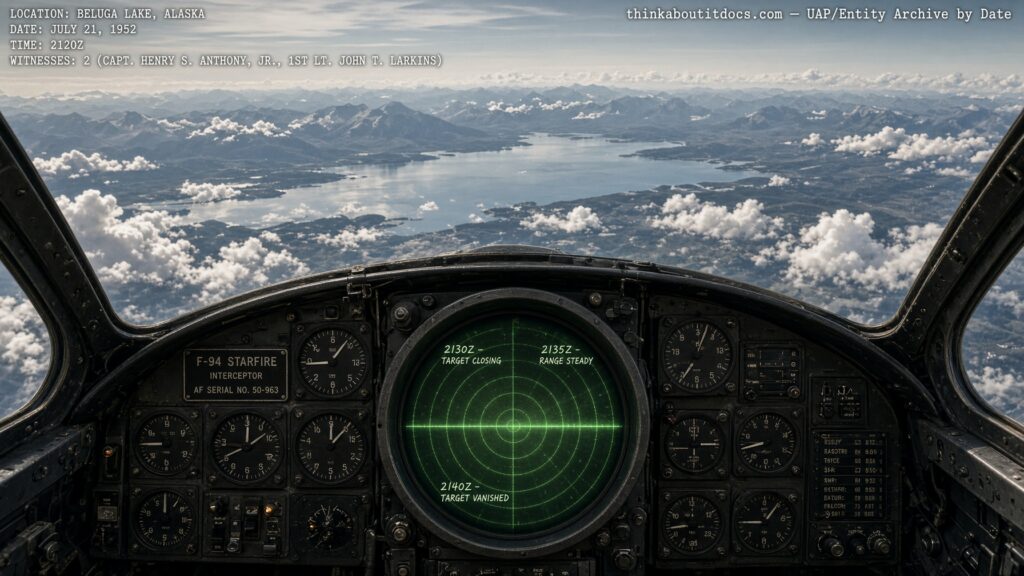
July 21, 1952 — Beluga Lake, Alaska
THINK ABOUTIT UFO|UAP SIGHTINGS REPORT
1952 Beluga Lake, Alaska Case: An F-94 Radar Intercept That Vanished Twice
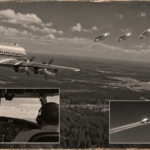
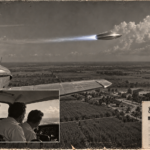
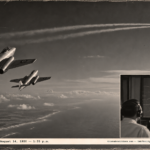
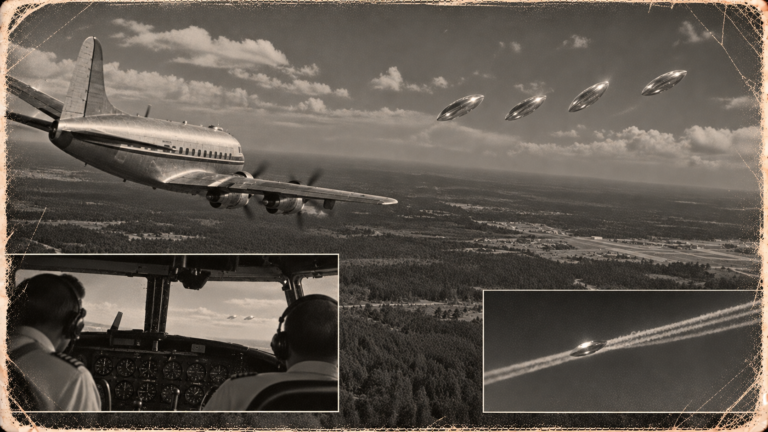
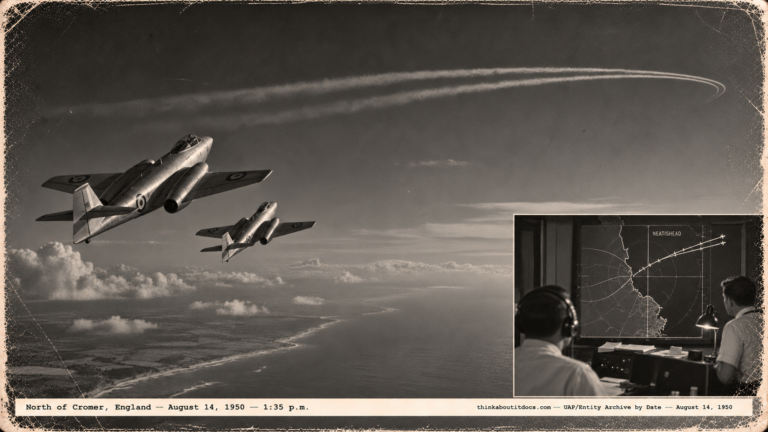
On July 21, 1952, an F-94 crew flying over the Beluga Lake area of Alaska picked up a radar target at 18,000 yards, achieved lock-on at 12,000 yards, and began a real intercept — only for the target to hold level with the aircraft, staying at a speed more than 100 knots faster than the interceptor, all the way in to 6,000 yards, before it simply vanished from the scope and could not be reacquired. The crew didn’t give up: less than an hour later, they returned to the same airspace and tried again, still without ever making visual contact with whatever they’d been chasing.
Date: July 21, 1952
Sighting Time: 2120Z
Day/Night: Unknown (time given only in Zulu; local Alaska time not specified in the source)
Location: Beluga Lake area, Alaska
Urban or Rural: Airborne, remote Alaskan interior
No. of Entity(‘s): Not Applicable
Entity Type: Not Applicable
Entity Description: Not Applicable
Hynek Classification: RV (Radar-Visual is the archive’s standard designation for this tier of case; strictly, no visual sighting was made here — this remains a radar-only contact, grouped alongside the archive’s other jet-intercept radar cases)
Duration: Initial intercept attempt, followed by a second attempt beginning just under an hour later
No. of Object(s): 1
Description of the Object(s): No visual description survives — the target was never visually acquired by the crew despite the extended pursuit
Shape/Size/Color of Object(s): Not Applicable (radar-only contact)
Distance to Object(s): First contact at 18,000 yards; lock-on achieved at 12,000 yards; target held level with the aircraft down to 6,000 yards before vanishing from the scope
Height & Speed: Target’s speed exceeded the F-94’s own speed by more than 100 knots throughout the closing pursuit
Number of Witnesses: 2 named (Captain Henry S. Anthony, Jr. and First Lieutenant John T. Larkins)
Special Features/Characteristics: Target maintained a speed advantage over the pursuing F-94 throughout the entire tracked approach, rather than simply outrunning the aircraft at the moment of closest approach; it vanished from radar entirely at 6,000 yards and could not be reacquired despite the crew remaining in the area and attempting a second contact less than an hour later; no visual sighting was made at any point
Case Status: Unresolved — documented in official Project Blue Book files as a brief statement, with named aircrew and a second, repeated intercept attempt lending it more institutional weight than a single passing radar contact
Source: Kevin Randle, citing Project Blue Book files
Summary/Description: On July 21, 1952, at 2120Z, Captain Henry S. Anthony, Jr. and First Lieutenant John T. Larkins were flying an F-94 in the Beluga Lake area of Alaska when they made radar contact with an unidentified target at 18,000 yards. Lock-on was achieved at 12,000 yards and an intercept began. The target remained level with the aircraft, holding a speed advantage of more than 100 knots, all the way down to 6,000 yards — at which point it disappeared from the scope and could not be re-established. No visual sighting was made. A little less than an hour later, the crew — who had remained in the area searching for the object — made a second attempt at contact.
Related Cases: Comparable in structure to other Alaska Air Command radar-intercept cases from this period, including the January 1958 Eielson AFB case and the 1955 Fairbanks, Alaska GCI pursuit later in this archive — all describing a radar-tracked target that outpaces a pursuing interceptor before vanishing from the scope
Detailed Report
The Beluga Lake case survives as a brief statement preserved in official Project Blue Book files, describing a genuine, named-crew air intercept mission over remote Alaska. On July 21, 1952, at 2120Z, Captain Henry S. Anthony, Jr. and First Lieutenant John T. Larkins were airborne in an F-94 in the Beluga Lake area when their radar picked up an unidentified target at a range of 18,000 yards.
The crew closed the distance and achieved a radar lock-on at 12,000 yards, formally beginning an intercept. What followed distinguishes this case from a simple fading contact: the target didn’t immediately flee or disappear. It held level with the F-94, maintaining a speed advantage of more than 100 knots over the interceptor throughout the pursuit, all the way down to a range of 6,000 yards. At that point, the target vanished from the radar scope entirely and could not be re-established despite the crew’s continued efforts.
No visual sighting was made at any point during this engagement — the entire case rests on the radar data alone. What lends the case additional weight is the crew’s persistence: rather than simply logging the lost contact and returning to base, Anthony and Larkins remained in the area, and less than an hour later made a second attempt to reestablish contact with the same or a similar target.
The available record doesn’t specify the outcome of that second attempt, nor does it provide further technical detail beyond what’s preserved in the brief Blue Book statement. Still, a named two-man crew, a formal radar lock-on with defined range figures, a sustained speed-differential pursuit, and a deliberate second attempt at contact together place this case well above the documentation floor of many single-witness reports from the same month.
RESEARCHER’S NOTES
The Beluga Lake Intercept — A Genuine Pursuit With No Visual Confirmation
- The sustained speed differential is the case’s most notable technical detail. The target didn’t simply outrun the F-94 at the last moment — it held a consistent speed advantage of over 100 knots across the entire tracked approach, a harder pattern to explain as a simple radar artifact or momentary glitch.
- The crew’s decision to attempt a second intercept less than an hour later is a meaningful behavioral detail. It suggests the crew themselves treated the first contact as significant enough to warrant a deliberate follow-up attempt, rather than dismissing it as routine radar clutter.
- The absence of any visual sighting is a genuine limitation. As a radar-only case, it remains open to the possibility of an equipment anomaly or misinterpretation that a visual confirmation could have ruled out — a caveat worth stating plainly rather than glossing over.
- The named crew and official Blue Book sourcing give this case solid institutional grounding despite its brevity. Unlike several of this month’s more elaborate but unsourced claims, this is a short, plainly documented military record rather than an embellished retelling.
- The case fits a recurring pattern across Alaska Air Command’s radar history in this era. Targets that hold a speed advantage over pursuing interceptors before vanishing from radar recur in several other Alaska-based cases across the 1950s, worth noting as regional context rather than treating this case in isolation.
The Beluga Lake case is a compact but genuinely solid radar-intercept record — a named crew, formal lock-on, sustained pursuit, and a deliberate second attempt, all without ever resolving into a visual sighting. It remains exactly what the source material shows: an honestly unresolved military radar contact, not padded into more than it is.
“At this point the target disappeared and could not be re-established.”
— Project Blue Book files, via Kevin Randlea F-94 radar intercept case.