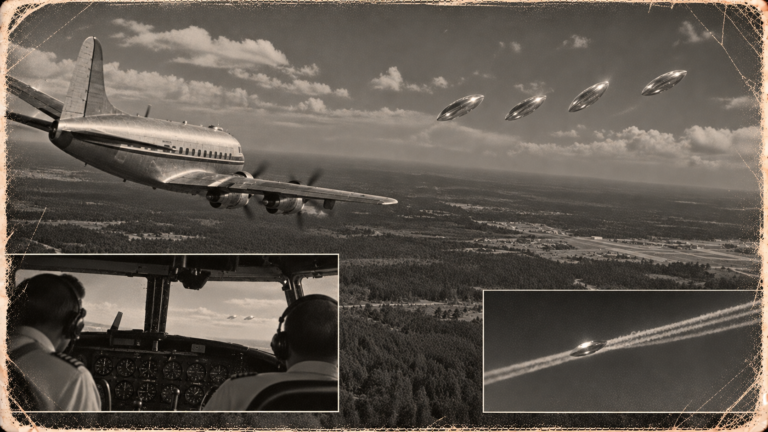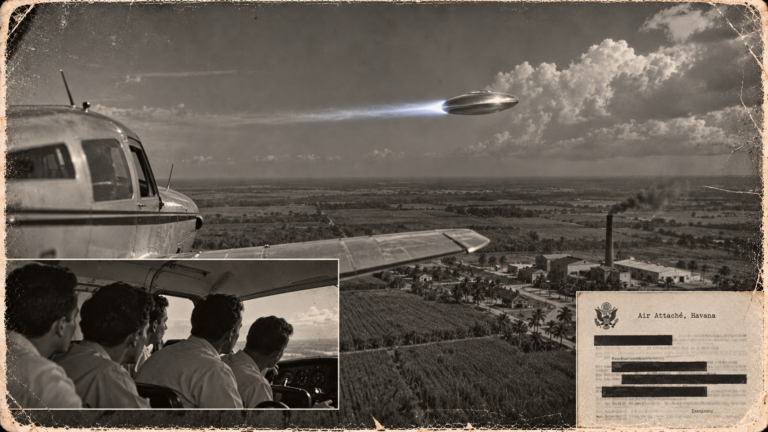
Captain Willis Sperry's May 29, 1950 near-collision with a glowing spindle-shaped object near Mt. Vernon, Virginia — one of the era's strongest airline UFO cases.
THINK ABOUTIT UFO|UAP SIGHTINGS REPORT
1950: The Mt. Vernon, Virginia DC-6 Near-Collision
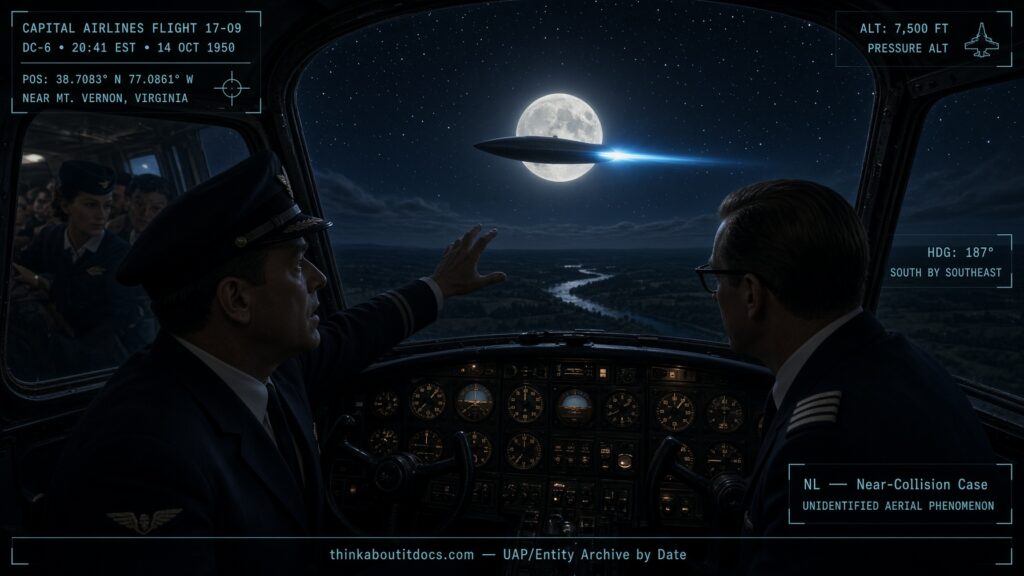
On the night of May 29, 1950, a Capital Airlines DC-6 out of Washington, D.C. was seconds from a head-on collision with a glowing, spindle-shaped object roughly 150 feet long before Captain Willis T. Sperry threw the airliner into an evasive turn. What followed was a close, sustained sighting by the entire flight crew: the object crossed directly in front of the nearly full moon, silhouetted clearly against it from five miles away, then circled back and paced the aircraft for half a minute before climbing away to the east at what the crew called a “fantastic” speed. With a captain carrying roughly 10,000 flying hours, a named copilot and flight engineer, a stewardess, and several passengers all in a position to see it, this is one of the best-corroborated airline near-miss cases of the early 1950s.
Date: May 29, 1950
Sighting Time: 9:20 p.m.
Day/Night: Night
Location: Approximately 7 miles west of Mt. Vernon, Virginia, over an airliner en route from Washington, D.C. to Nashville, Tennessee
Urban or Rural: Airborne, over the Virginia countryside near Washington, D.C.
No. of Entity(‘s): Not applicable
Entity Type: Not applicable
Entity Description: Not applicable
Hynek Classification: NL (Nocturnal Light) — a lit aerial object observed at a standoff distance from an aircraft, with its silhouette visible against the moon rather than resolved by daylight
Duration: Roughly one to two minutes across the full sequence (initial approach, evasive turn, moon transit, pacing, and departure)
No. of Object(s): 1
Description of the Object(s): A spindle-shaped metallic object approximately 150 feet long, with an intense blue light (estimated at roughly magnitude -6, comparable in brilliance to Venus at its brightest) on its tail. When it crossed in front of the moon at close range, the crew clearly saw a submarine-like silhouette.
Shape of Object(s): Spindle / submarine-shaped, elongated
Size of Object(s): Approximately 150 feet in length, per crew estimate
Color of Object(s): Intense blue light at the tail; body silhouetted dark against the moon at closest approach
Distance to Object(s): Approximately 5 miles at the point it crossed in front of the moon; considerably closer during the initial near-collision approach
Height & Speed: The DC-6 was cruising at 7,500 feet and 250 mph on a heading of 230°; the object approached on a near-collision course, then paced the airliner for 20-30 seconds before climbing away to the east at a 30° angle at what the crew described as “fantastic” speed
Number of Witnesses: At least 5 named or described crew — Captain Willis T. Sperry, copilot Bill Gates, flight engineer Robert Arnholt, a stewardess, and passengers (accounts vary between 2-3 and 8)
Special Features/Characteristics: The object’s silhouette was seen clearly against the moon’s disc at 5 miles’ distance — an unusually strong opportunity for a precise visual fix. The object appeared to remain briefly stationary after the moon transit, then circled to pace the aircraft before departing at high speed on a steep climb.
Case Status: Unexplained
Source: Sparks Database of Bluebook Unknowns
Summary/Description: At 9:20 p.m. on May 29, 1950, a DC-6 airliner captained by Willis T. Sperry — a pilot with roughly 10,000 flying hours — was cruising at 7,500 feet and 250 mph on a heading of 230° out of Washington, D.C., bound for Nashville. Copilot Bill Gates first spotted an intense blue light on a head-on collision course with the aircraft. Sperry immediately made an evasive 45-degree turn to the right, bringing the airliner to a 275° heading. The object then passed to the left of the aircraft, from the 11 o’clock to the 7 o’clock position, at slightly higher altitude, crossing directly in front of the upper part of the nearly full moon to the south. At that moment, with the object roughly 5 miles away, the crew clearly saw a submarine-like silhouette against the lunar disc: a spindle-shaped, metallic body approximately 150 feet long. Sperry turned the aircraft back onto its original course to keep the object in view; it appeared to remain briefly stationary. Gates then noticed the object circling around to the aircraft’s right side, and Sperry banked right again as the object paced the DC-6 for roughly 20 to 30 seconds before climbing away to the east at a 30-degree angle and disappearing at what the crew described as “fantastic” speed.
Related Cases: 1950: The TWA Flight 117 Pursuit, Indiana (same year, same airline-pacing structure) | The Chiles-Whitted UFO Encounter, 1948 (an earlier airline-crew sighting of a glowing aerial object)
Detailed Report
The Mt. Vernon case shares its basic shape with the TWA Flight 117 sighting documented elsewhere in this archive from just a month earlier — a commercial airliner, a glowing object that paces the aircraft, and a crew of trained aviation professionals who never wavered from their account — but it adds two elements that make it, in some respects, an even stronger case. The first is the near-collision itself: this was not a distant light spotted off to the side, but an object on a genuine head-on collision course that forced Captain Sperry into an immediate evasive maneuver. A pilot’s trained, instantaneous reaction to a perceived collision threat is a different order of evidence than a leisurely, curious observation — it reflects an in-the-moment judgment made under real operational pressure, not a considered account assembled after the fact.
The second, and arguably more valuable, element is the lunar transit. When the object crossed in front of the nearly full moon at a range the crew estimated at five miles, it briefly became a solid silhouette against a bright, fixed, and precisely locatable background — described by multiple crew members as distinctly submarine-shaped. Comparing an unknown object’s silhouette against a natural reference point of known position and brightness is about as good a naked-eye fix as a 1950s aircrew could hope to obtain without instrumentation, and it is the detail that most clearly separates this case from a simple “bright light” report: a light source can be almost anything, but a resolved, elongated, submarine-like silhouette blocking lunar light is a specific physical claim that is much harder to explain as a star, planet, or lens artifact.
The object’s subsequent behavior — appearing to hold position briefly, then circling to the aircraft’s other side to resume pacing before finally breaking away in a steep, high-speed climb — describes a flight profile inconsistent with a passive object like a balloon or a meteor, both routinely proposed as explanations for a great many 1950-era sightings. A meteor does not circle back after crossing in front of the moon; a balloon does not climb away at a controlled 30-degree angle. Whatever accounts for the Mt. Vernon object, the maneuvering profile as recorded is difficult to reconcile with either of the era’s two most common mundane explanations.
As with the TWA case, the source here is a compiled Blue Book Unknown rather than a raw contemporaneous file directly available to this archive, and the passenger count is given inconsistently across the surviving summary (two to three, or as many as eight) — a minor but real gap that should be resolved if the underlying Blue Book file can be examined directly.
RESEARCHER’S NOTES
The Mt. Vernon DC-6 Case — Virginia 1950 and the Value of a Celestial Reference Point
- Classification issues: NL fits the case’s nighttime, standoff-distance observation, though the lunar-silhouette detail gives it an unusually strong visual resolution for that category — closer to what a Daylight Disc case would offer than the typical vague nocturnal light.
- Source chain assessment: The case is preserved through the Sparks Database of Bluebook Unknowns, a respected compilation of Project Blue Book’s officially unresolved cases, but this archive does not have direct access to the underlying Air Force case file. The inconsistent passenger count (2-3 vs. 8) in the surviving summary likely reflects a compilation ambiguity rather than witness disagreement and should be checked against the primary Blue Book record if it becomes available.
- Pattern context: This is the second strong airline-crew pacing case in this archive within a five-week span, following the April 27 TWA Flight 117 sighting over Goshen, Indiana — together they form a notable short-term cluster of professionally witnessed airline encounters in the spring of 1950, a period that also produced dense military radar and visual activity in the American Southwest.
- Physical evidence and evidentiary weight: No photograph or radar data is recorded, but the case’s evidentiary strength rests on the number and quality of witnesses (an experienced captain, named copilot and flight engineer, a stewardess, and passengers) and on the lunar-transit silhouette, which functions as an informal but meaningful visual measurement absent any instrumented tracking.
- Geographic and historical context: The sighting occurred on a busy commercial corridor out of Washington, D.C., within the same general period of heightened Cold War-era aerial vigilance that produced dense UFO reporting around the capital in the years immediately following — a pattern that would culminate more dramatically in the well-known 1952 Washington, D.C. radar-visual incidents two years later.
The Mt. Vernon case stands alongside the TWA Flight 117 sighting as one of the two strongest airline-crew encounters in this archive’s 1950 record — an experienced captain’s collision-avoidance maneuver, a full crew of consistent witnesses, and the rare, evidentially valuable detail of the object’s silhouette crossing the face of the moon at a measured distance. No conventional explanation accounts cleanly for an object that forces an evasive turn, holds briefly stationary, circles to re-approach, and then climbs away at high speed. It is catalogued here as Unexplained: a case whose combination of witness quality and a genuine near-collision gives it real evidentiary weight.
“A submarine-like silhouette clearly seen… about 5 miles away.”
— Flight crew account, DC-6 near Mt. Vernon, Virginia, May 29, 1950