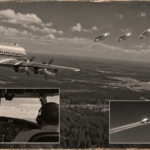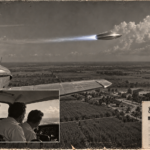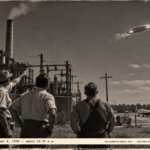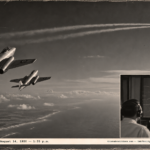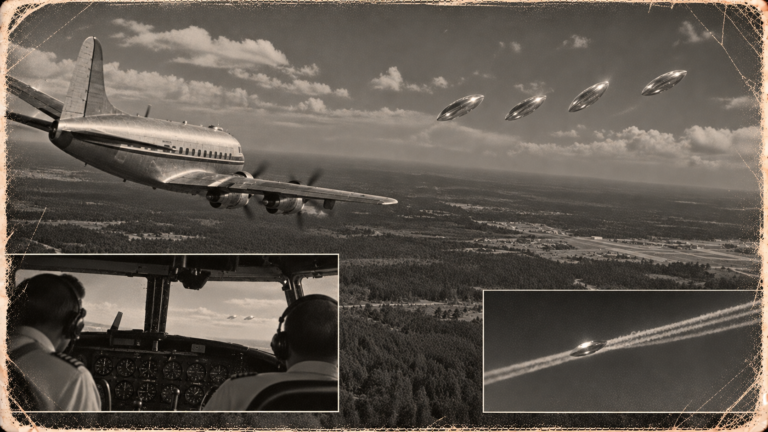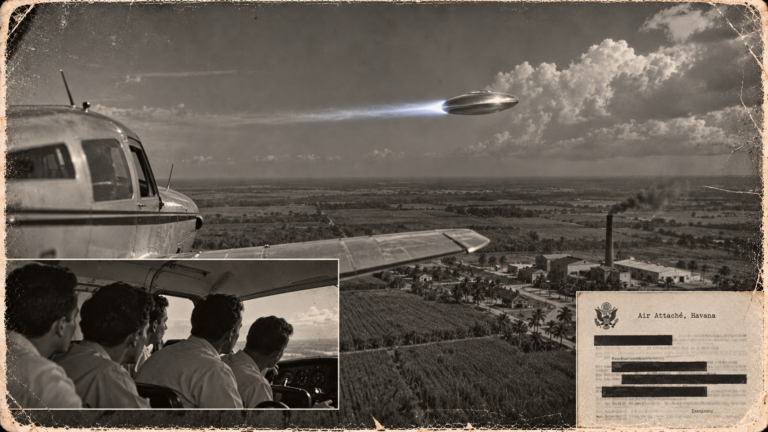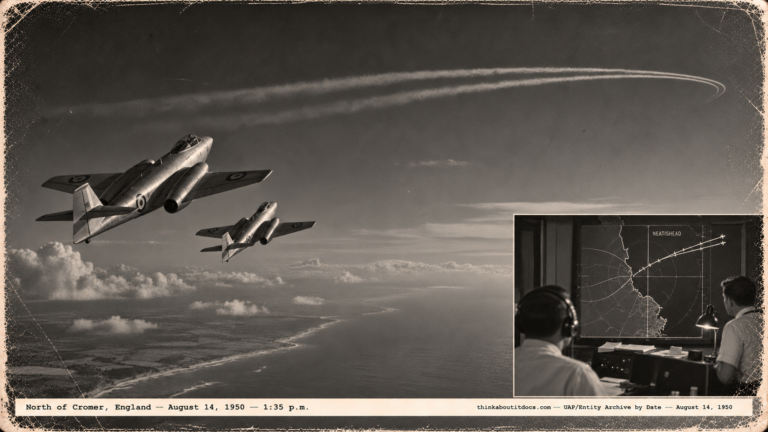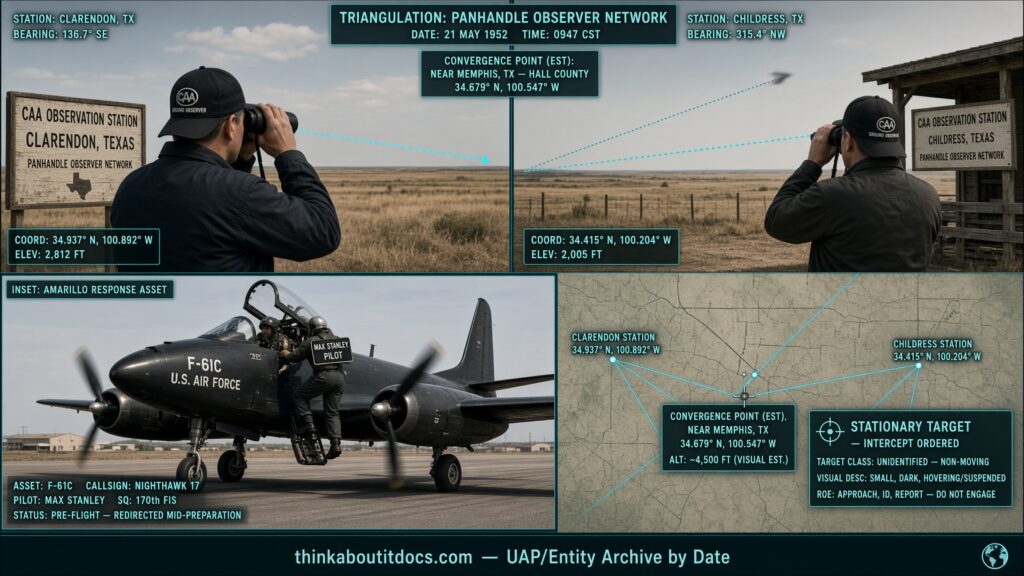
Two CAA posts triangulated a stationary object near Memphis, Texas on April 18, 1950, prompting an active military and contractor intercept attempt.
THINK ABOUTIT UFO|UAP SIGHTINGS REPORT
1950: The Memphis, Texas Triangulation and Intercept Attempt
For more than three hours on the morning of April 18, 1950, two separate CAA observation posts fifty miles apart — one at Clarendon, Texas, one at Childress — each tracked an unidentified object bearing toward the other’s position, and when their sightings were triangulated, both pointed to the same stationary object hanging in the sky near Memphis, Texas, refusing to drift despite winds aloft. The case escalated further than almost any other sighting in this archive’s 1950 record: a Northrop test pilot already fueled and ready for a classified missile-guidance test flight was diverted to intercept it, and a B-36 bomber scrambled from Fort Worth to do the same.
Date: April 18, 1950
Sighting Time: 9:00 a.m. – 12:40 p.m. (CST)
Day/Night: Day
Location: Near Memphis, Texas, triangulated from CAA observation posts at Clarendon and Childress, roughly 50 miles apart
Urban or Rural: Rural (Texas Panhandle)
No. of Entity(‘s): Not applicable
Entity Type: Not applicable
Entity Description: Not applicable
Hynek Classification: DD (Daylight Disc) — though the case is better described by its triangulation and intercept-attempt structure than by object shape, which was not clearly resolved
Duration: Over three hours (roughly 9:00 a.m. to 12:40 p.m.)
No. of Object(s): 1
Description of the Object(s): Not resolved in visual detail from either observation post; the case rests on directional bearings rather than a close physical description
Shape of Object(s): Not established
Size of Object(s): Not established
Color of Object(s): Not recorded
Distance to Object(s): Triangulated to a position roughly midway between the two observation posts, near Memphis, Texas — approximately 25 miles from each
Height & Speed: Effectively stationary for the full observation period, holding position despite winds aloft that should have drifted a passive object such as a balloon
Number of Witnesses: Multiple CAA observers at two separate posts (Clarendon and Childress), plus the flight crews dispatched to intercept
Special Features/Characteristics: Independently triangulated from two ground stations to the same fixed point in the sky; remained stationary against prevailing winds for over three hours; prompted an actual military and contractor intercept response rather than routine follow-up.
Case Status: Insufficient Data
Source: Jan Aldrich
Summary/Description: Beginning around 9:00 a.m. on April 18, 1950, CAA observers at Clarendon, Texas reported an unidentified object to their southeast, while observers at Childress, roughly 50 miles to the southeast of Clarendon, independently reported an object to their northwest. When the two bearings were plotted together, they triangulated to a single stationary object near the town of Memphis, Texas, positioned roughly midway between the two posts. The object held its position for more than three hours despite winds aloft that should have moved a free-floating object such as a balloon. The persistence and apparent fixed nature of the target was serious enough to prompt an active response: Northrop engineering test pilot Max Stanley, along with observers Lloyd Balsam and Sam F. West, were preparing to take off from Amarillo in an F-61C (Air Force serial 8357) to conduct an MX-775 test — a celestial-guidance test flight for the Navaho cruise missile program — and were instead asked to divert and attempt to intercept the object. Separately, a B-36 bomber took off from Fort Worth with the same intent. The surviving record does not describe the outcome of either intercept attempt or whether the object was ever visually resolved at close range.
Related Cases: 1950: The TWA Flight 117 Pursuit, Indiana (same month, another case combining trained observers with an active pursuit) | The Mantell UFO Incident, 1948 (an earlier case involving a military intercept attempt on an unidentified aerial object)
Detailed Report
What sets the Memphis, Texas case apart from the great majority of 1950 sightings in this archive is not the object’s description — which is essentially absent from the record — but the seriousness of the institutional response it triggered. Most sightings in this period, however striking, ended with a newspaper mention or a Blue Book file entry. This one ended with an active-duty test pilot’s mission being altered mid-preparation and a strategic bomber leaving the ground specifically to investigate.
The triangulation method itself deserves attention. Two CAA posts fifty miles apart, each reporting a bearing toward the other’s general direction, is a meaningfully different kind of evidence than a single ground witness describing a light in the sky. Independent bearings converging on the same fixed point is the same basic technique used in legitimate aerial navigation and artillery spotting, and it substantially reduces the likelihood that either post was simply describing a star, planet, or distant aircraft with no fixed position. The detail that the object did not drift despite winds aloft is the second load-bearing fact in the case: a free balloon, the most common mundane explanation reached for for stationary aerial phenomena in this era, would ordinarily be expected to move with the prevailing wind over a three-hour observation window.
That said, the case is frustratingly incomplete exactly where a resolution would matter most. There is no description of the object’s shape, size, or color from either observation post — the entire case is built on directional bearings and duration, not visual detail. And critically, the available record breaks off at the moment of maximum interest: neither Max Stanley’s F-61C nor the B-36 from Fort Worth is recorded as having reached the target, sighted it directly, or reported what became of it. Whether the intercepting aircraft found nothing, found a mundane explanation not preserved in this file, or never got close enough to resolve the question, the documentary trail available to this archive simply ends.
The involvement of Max Stanley is itself a detail worth flagging for its own historical texture: Stanley was a Northrop test pilot connected to the MX-775 program, an early phase of what would become the Navaho intercontinental cruise missile project — placing this sighting squarely within the same Cold War-era guided-missile testing infrastructure that produced a disproportionate number of the period’s most credible-seeming UFO reports, simply because that infrastructure had trained observers, precision tracking equipment, and restricted airspace to notice things other people would not have been positioned to see.
RESEARCHER’S NOTES
The Memphis, Texas Triangulation — 1950 and the Unresolved Intercept
- Classification issues: DD is applied cautiously here — the case lacks the confirmed disc shape that classification typically implies, and is better understood as a triangulated stationary-target case with an attempted intercept than as a conventional daylight-disc sighting. No stronger Hynek category fits given the absence of resolved visual detail.
- Source chain assessment: The case traces to researcher Jan Aldrich, a respected compiler of military and CAA-sourced UFO case files, but the underlying CAA and Air Force documentation itself is not reproduced in full in the material available to this archive. The absence of an intercept outcome may reflect either a genuine gap in the surviving record or a limitation in the secondary compilation — this distinction cannot be resolved without access to Aldrich’s original source documents.
- Pattern context: Active military or contractor intercept attempts are rare enough in this archive’s 1950 record to stand out — the 1948 Mantell case is the best-known precedent for a UFO sighting escalating to an actual airborne pursuit, though Mantell’s case ended in tragedy and extensive follow-up investigation, while this one simply trails off undocumented.
- Physical evidence and evidentiary weight: No photograph, wreckage, or radar data is recorded. The case’s evidentiary weight rests entirely on the triangulation methodology and the fact that it was taken seriously enough to divert a classified test flight and scramble a bomber — an institutional response that is itself a form of corroboration, even without a resolved visual description.
- Geographic and historical context: The Texas Panhandle in 1950 sat within a dense corridor of guided-missile and strategic-bomber testing infrastructure — Amarillo’s MX-775/Navaho program and Fort Worth’s B-36 operations both feature directly in this single case — making the region a natural hotspot for well-documented, professionally observed aerial anomalies during this period.
The Memphis, Texas case stands as one of this archive’s clearest examples of an investigation that escalated exactly as one would hope a serious anomaly would — independent triangulation, a persistent stationary target, and an actual scrambled response from both a military bomber and a missile-program test pilot — only for the surviving documentary trail to go silent at the moment of closest approach. Without a recorded outcome, the case cannot be called resolved in either direction, and it is catalogued honestly as Insufficient Data: not because the initial observation was weak, but because the record of what happened next has not survived, or has not yet been found.
“A stationary object… which did not move significantly despite winds aloft.”
— CAA triangulation summary, as recorded by Jan Aldrich