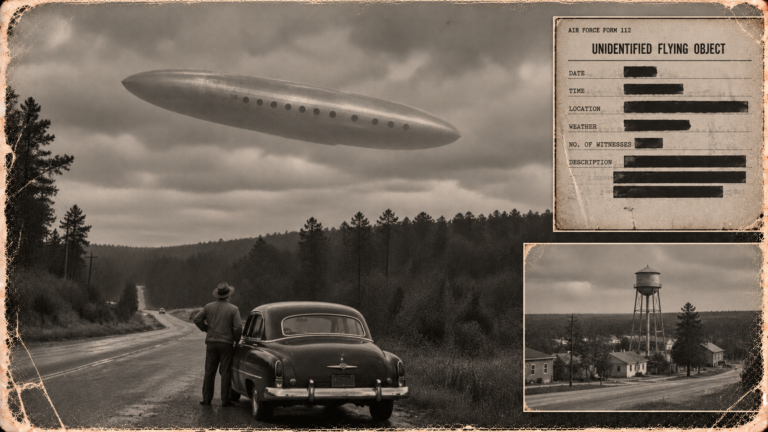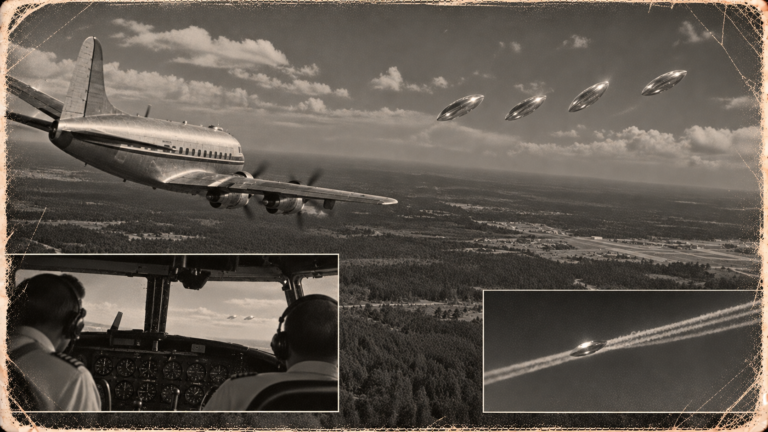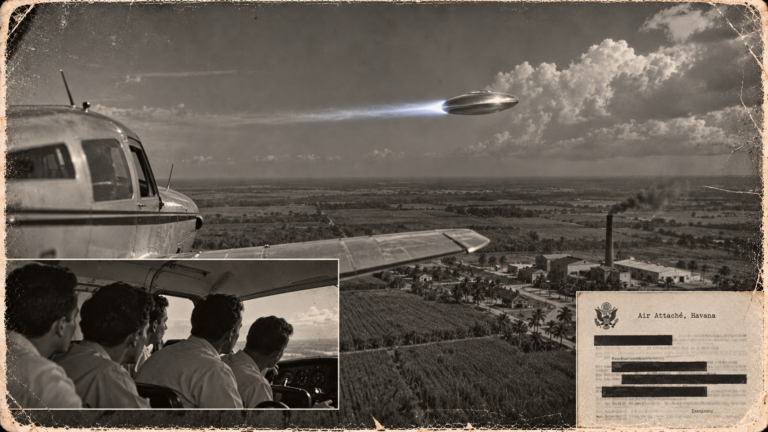
An unnamed laborer's April 17, 1950 account of a descending disc with visible occupants in Santiago del Estero Province, Argentina
THINK ABOUTIT UFO|UAP & ENTITY ENCOUNTER REPORT
1950: The Santiago del Estero Descent — Argentina
A field laborer working in Argentina’s Santiago del Estero Province in the late afternoon of April 17, 1950 watched a huge metallic disc descend slowly overhead, its rotating central flange throwing off flashing multi-colored light — and, through whatever opening or transparency let him see inside, made out several tall, silver-suited figures apparently working controls before the craft flashed and shot skyward out of sight. It is one of the earliest detailed entity-occupant reports from South America in this archive’s record, though it survives only in a single secondary humanoid-catalog entry with no named witness.
Date: April 17, 1950
Sighting Time: 17:00 (5:00 p.m.)
Day/Night: Day (late afternoon)
Location: Santiago del Estero Province, Argentina (precise location within the province not recorded)
Urban or Rural: Rural (agricultural fields)
No. of Entity(‘s): Several (exact number not specified)
Entity Type: Humanoid
Entity Description: Tall, man-like figures wearing tight-fitting, silvery outfits, seen apparently operating controls inside the craft
Hynek Classification: CE-III (Close Encounter of the Third Kind — occupants observed, though at a distance and through the craft itself rather than at close personal range)
Duration: Not recorded
No. of Object(s): 1
Description of the Object(s): A huge, metallic, disc-shaped craft with a rotating metallic flange around its middle, displaying flashing, multi-colored lights
Shape of Object(s): Disc
Size of Object(s): Described only as “huge”; no measured or estimated dimension survives in the record
Color of Object(s): Metallic body with flashing multi-colored lights
Distance to Object(s): Not recorded, though close enough for the witness to make out individual figures and their clothing
Height & Speed: Descended slowly, then ascended at very high speed following a bright flash
Number of Witnesses: One (an unnamed field laborer)
Special Features/Characteristics: A rotating metallic flange encircling the craft’s midsection; flashing multi-colored lighting; occupants visible apparently operating controls; a bright flash of light immediately preceding the craft’s high-speed departure
Case Status: Insufficient Data
Source: Banchs, Roberto & Heiden, Richard, as catalogued in Albert Rosales, Humanoid Sighting Reports, HC addition #5
Summary/Description: At approximately 5:00 p.m. on April 17, 1950, a laborer working in fields in Argentina’s Santiago del Estero Province watched a huge, metallic, disc-shaped craft slowly descend over the area. The craft carried a rotating metallic flange around its middle and displayed flashing, multi-colored lights. The witness reported being able to see several tall, man-like figures inside the object, apparently operating controls, dressed in tight-fitting silvery outfits. The craft suddenly gave off a bright flash of light and ascended at very high speed, disappearing from sight. No further named witnesses, physical evidence, or contemporary press coverage of the event have been located.
Related Cases: 1950: The Lago Argentino Landing, Argentina (same country, same year, comparable occupant-visibility structure) | 1950: The Veghenza (Vicenza), Italy close encounter with dwarf entities, March 14 (same broader wave, entity presence)
Detailed Report
The Santiago del Estero case is, in evidentiary terms, close to the opposite of the TWA Flight 117 case documented elsewhere in this archive: where that sighting rests on the strength of many corroborating, professionally credentialed witnesses, this one rests entirely on a single, unnamed laborer’s account, filtered through a secondary humanoid-report compilation rather than a primary investigative file. That does not make the account false, but it does mean the case cannot be weighed the way a multi-witness sighting can — there is no second account to check the first against, no name to trace, and no contemporary newspaper report located to confirm even that something was seen that day.
What can be said is that the account is internally coherent and stylistically consistent with other entity reports of the period: a large metallic disc, a rotating band or flange (a detail that recurs across several 1950-era Argentine and European disc reports, including the rotating upper section described in the Lago Argentino landing the previous month), flashing colored lights, and human-like occupants in form-fitting silver suits visible through some transparent or open section of the craft. The witness’s report of a bright flash immediately preceding a high-speed vertical departure is likewise a recurring motif in contact and close-encounter accounts from this era, appearing in broadly similar form in the Lago Argentino case as well.
The absence of a named witness is the case’s central weakness. Humanoid-report catalogs compiled decades after the fact, drawing on earlier researchers’ files, sometimes preserve cases exactly as they were originally recorded — without a name, because the original source never recorded one, rather than because a name was later withheld. Roberto Banchs, a foundational figure in Argentine ufology whose later work helped establish the country’s formal UFO research tradition, is a credible original compiler, but the specific investigative trail behind this entry — who first interviewed the laborer, when, and under what circumstances — is not preserved in the material available to this archive.
RESEARCHER’S NOTES
The Santiago del Estero Descent — Argentina 1950 and the Anonymous Witness Problem
- Classification issues: CE-III fits the description of occupants observed operating controls inside the craft, though the case lacks the close personal proximity typical of the strongest CE-III reports — the witness appears to have observed from some distance in an open field rather than at close range to the craft itself.
- Source chain assessment: The case traces to a Banchs and Heiden attribution preserved in Albert Rosales’s humanoid-report compilation as “HC addition #5” — a secondary catalog entry rather than a primary investigative document. No named witness, contemporary press account, or original case file has been located independently of this citation chain.
- Pattern context: The rotating flange, flashing multi-colored lighting, and flash-then-high-speed-departure sequence recur closely enough across this archive’s other 1950 South American entries — most notably the Lago Argentino landing eleven days earlier — to suggest either a genuinely shared phenomenon during this period’s wave or a shared narrative vocabulary circulating among regional witnesses and early investigators.
- Physical evidence and evidentiary weight: None. No photograph, trace evidence, or second witness is recorded. The evidentiary weight rests entirely on the credibility assigned to the original, unnamed source and to Banchs and Heiden as compilers — credibility that cannot be independently assessed without access to their original files.
- Geographic and historical context: Santiago del Estero, Argentina’s oldest colonial city and an agricultural province, sits far from Buenos Aires and the coastal centers where Argentina’s later, more organized ufology movement would take shape starting in the 1960s — a reminder that this archive’s earliest South American entity reports predate any formal investigative infrastructure in the region by more than a decade.
The Santiago del Estero case is preserved here as exactly what it is: a striking but thinly documented single-witness account, recorded only through a later secondary compilation with no name, no corroboration, and no surviving primary file. It shares enough structural detail with other 1950 South American entity reports to be worth keeping in the record, but it cannot be verified beyond the credibility of its original, unidentified source. It is catalogued honestly as Insufficient Data.
“Several tall men-like figures inside the object appeared to be operating some controls.”
— As recorded by Roberto Banchs & Richard Heiden