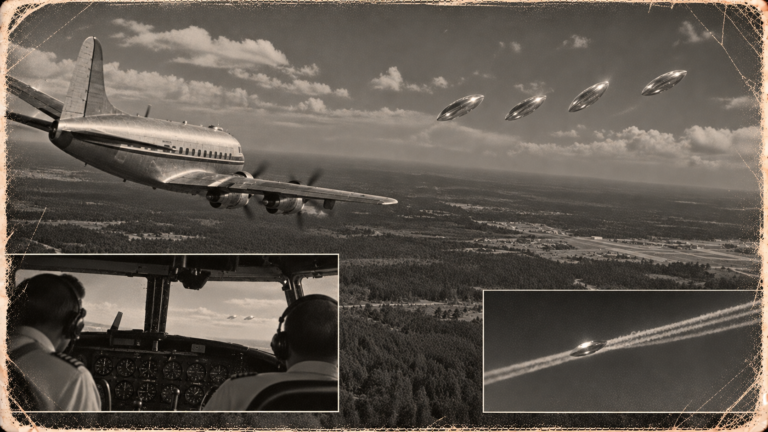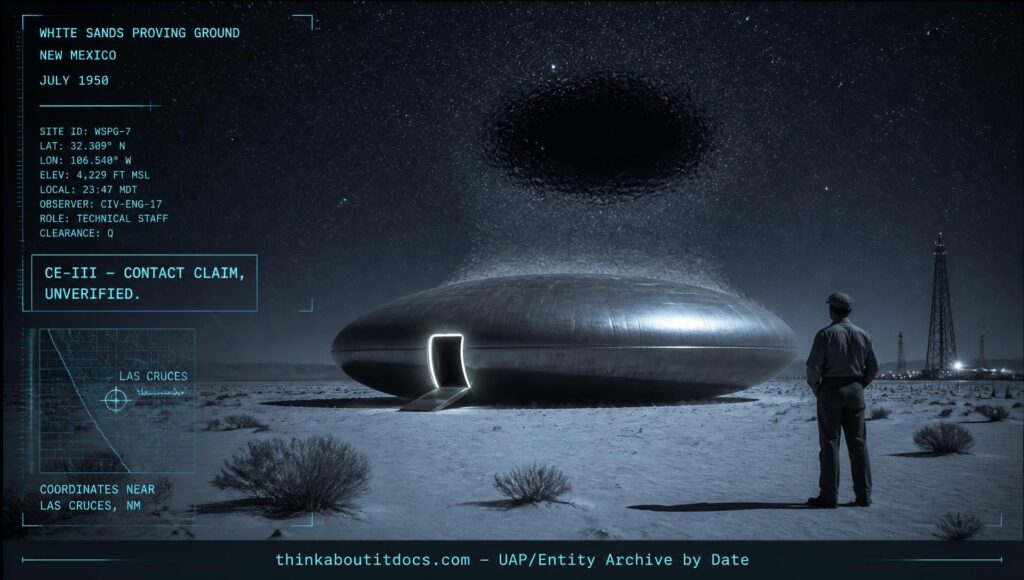
Daniel Fry's July 4, 1950 claimed contact with the entity "A-lan" at White Sands Proving Ground, New Mexico — one of the contactee movement's founding accounts.
THINK ABOUTIT
UFO|UAP & ENTITY ENCOUNTER REPORT
1950: The Daniel Fry White Sands Incident — New Mexico
On the evening of July 4, 1950, a White Sands Proving Ground technician named Daniel Fry missed the last bus into Las Cruces for the Independence Day fireworks and took a walk into the desert instead — a small, ordinary disappointment that became, in his telling, the opening scene of one of the contactee movement’s most influential accounts. Fry claimed he watched an oval craft settle onto the sand seventy feet away, was warned by an unseen voice not to touch its still-hot hull, and was invited aboard for a thirty-minute, eight-thousand-mile round trip to New York City and back, guided by a pilot who identified himself only as A-lan. Unlike the showier, face-to-face contactee narratives that would follow, Fry’s account leaned on technical detail and calm, engineer’s language — qualities that led some later researchers to call him the most credible witness of the entire contactee era, even as his own shifting dates and disputed credentials gave skeptics plenty to work with.
Date: July 4, 1950 (as originally published in 1954; Fry later revised the date to July 4, 1949 in retellings decades afterward)
Sighting Time: Evening, approximately 8:30 p.m.
Day/Night: Night
Location: White Sands Proving Ground, near Las Cruces, New Mexico
Urban or Rural: Rural (desert testing range)
No. of Entity(‘s): 1 (unseen — communicated by voice only)
Entity Type: Humanoid, described as a descendant of the lost continent of Lemuria; never physically seen by Fry, who reported the pilot’s compartment was separated from the passenger area
Entity Description: Not physically described — communicated entirely by voice, identifying himself as “A-lan”
Hynek Classification: CE-III (Close Encounter of the Third Kind), sometimes described in later, unofficial extensions of Hynek’s scale as CE-4 given the voluntary boarding and extended communication involved; this archive uses CE-III as the closest Hynek-defined category, while noting the case’s contact-narrative structure
Duration: Approximately 30 minutes for the flight itself; the full encounter, including the initial approach and conversation, somewhat longer
No. of Object(s): 1 (with Fry later describing it as a smaller vessel launched from a larger “mothership”)
Description of the Object(s): An oval, or oblate spheroid, craft that Fry approached closely enough to touch, though he was warned off by A-lan’s voice, who explained the hull was still hot
Shape of Object(s): Oblate spheroid / oval
Size of Object(s): Approximately 30 feet in diameter
Color of Object(s): Not specified in surviving summaries
Distance to Object(s): Landed approximately 70 feet from Fry; he then approached and boarded it
Height & Speed: Fry claimed a round-trip flight of roughly 8,000 miles (White Sands to New York City and back) in about 30 minutes, implying an average speed on the order of 8,000 mph; he was told the craft’s occupants experienced no g-force effects because the accelerating force acted on passengers’ bodies the same way gravity does
Number of Witnesses: 1 (Daniel Fry)
Special Features/Characteristics: The initial approach was marked by stars appearing to be blotted out before the craft’s arrival; Fry reported being warned by the disembodied voice not to touch the hot hull; he was told he had been selected for contact specifically because of his scientific background and open-mindedness; A-lan identified himself as a descendant of Lemuria, a lost continent said to have destroyed itself in an ancient atomic war with Atlantis; Fry reported several further contacts with A-lan between 1950 and 1954.
Case Status: Insufficient Data (widely regarded by mainstream researchers as unverifiable or fabricated, but never definitively disproven as a claim)
Source: Fry, Daniel W., The White Sands Incident (originally published 1954 as To Men of Earth); Klass, Philip J., UFOs Explained, 1974 (skeptical assessment)
Summary/Description: On the evening of July 4, 1950, Daniel Fry, a technician working on rocket motor testing at White Sands Proving Ground, missed the last bus to that evening’s Independence Day fireworks in Las Cruces. Finding his quarters uncomfortably hot, he went for a walk into the desert. He reported seeing what first looked like an unusually behaving star, which resolved into an oblate spheroid craft roughly 30 feet across, settling to the ground about 70 feet away. As he approached and reached to touch the hull, a voice warned him it was still hot from the descent. The voice, identifying itself as A-lan, explained that Fry had been chosen for contact because of his scientific background and open mind, and invited him aboard for a ride. Fry accepted, and reported being taken on a round trip of roughly 8,000 miles to New York City and back in about 30 minutes — a speed A-lan explained was tolerable because the accelerating force acted uniformly on the passenger’s body, much like gravity. A-lan told Fry that his people were descendants of the sunken continent of Lemuria, destroyed in a prehistoric atomic war with Atlantis, and warned that humanity risked a similar fate through nuclear weapons. Fry reported several further contacts with A-lan over the following years and published his account in 1954. Decades later, Fry revised the date of the initial contact to July 4, 1949, a change skeptics have cited as evidence of the account’s unreliability; Philip J. Klass also challenged the legitimacy of Fry’s claimed doctorate, which appears to have come from an unaccredited mail-order institution.
Related Cases: 1950: The Samuel Eaton Thompson Venusian Contact, Washington (an earlier 1950 contactee narrative, generally less publicized) | George Adamski’s 1952 Venusian contact claim (the contactee movement’s best-known figure, active two years after Fry’s initial claimed contact)
Detailed Report
Daniel Fry’s account holds an unusual position within the contactee genre precisely because of what it lacks: no face-to-face meeting with a benevolent, human-looking alien in flowing robes, no lengthy philosophical audience with a physically present being, none of the visual drama that made George Adamski’s later claims so widely reproduced in magazines and lecture halls. Fry’s central image is comparatively spare — an unseen voice, a warning about a hot hull, a fast flight described in engineering terms. That restraint is part of why some researchers, including within the ufological community itself, have described Fry as the contactee era’s most credible figure: his account reads less like religious testimony and more like a field report, consistent with his stated profession as a technician and self-described engineer working on rocket motor instrumentation at one of the country’s most sensitive test ranges.
That professional framing was also central to Fry’s own claimed authority. He described himself as an internationally recognized scientist and the best-informed person in the world on space travel, and he went on, by his own account, to develop guidance-system components for the Atlas missile program. Independent verification of the more sweeping of these claims has proven difficult, and Philip J. Klass’s investigation found that Fry’s doctorate traced to a non-accredited, mail-order “Doctorate of Cosmism” from a UK correspondence institution rather than any conventional academic credential — a finding that meaningfully undercuts the professional-authority framing Fry built his story’s credibility around, even if it does not by itself disprove the sighting claim.
The changed date is the case’s second major complication. Fry’s original 1954 book fixes the event to July 4, 1950, in specific and vivid terms — he describes the particular frustration of missing a bus to Independence Day fireworks that year. Decades later, in later retellings, Fry moved the date back to July 4, 1949. A one-year shift in the memory of an event a witness describes as the most significant of his life is a substantial inconsistency, and it is the kind of detail that, fairly or not, tends to erode confidence in an account’s overall reliability far more than its most fantastical elements do — audiences are often more forgiving of an extraordinary central claim than of an ordinary factual detail changing without clear explanation.
Fry’s later career, founding the Understanding, Inc. organization and publishing a long-running newsletter promoting peace, science, and eventual human-extraterrestrial dialogue, situates the White Sands account as the founding narrative of a durable, decades-long personal and organizational project — a pattern common among the era’s leading contactees, whose claimed encounters typically became the basis for ongoing public careers rather than isolated incidents.
RESEARCHER’S NOTES
The Daniel Fry White Sands Incident — 1950 and the Credibility of a “Credible” Contactee
- Classification issues: CE-III is used here as the closest fit within Hynek’s original scale, though the case’s voluntary-boarding, extended-communication structure is better described by the unofficial “CE-4” or contact-case extensions some later researchers have proposed; this archive does not treat those extensions as canonical but records the distinction for clarity.
- Source chain assessment: The only source for this case is Fry’s own 1954 book and his subsequent public statements and organizational literature — there is no independent witness, no physical evidence, and no contemporaneous 1950 documentation. The one-year date revision decades later is a significant, self-introduced inconsistency in the primary source itself, distinct from the kind of secondary-compilation date confusion seen in many other cases in this archive.
- Pattern context: Fry’s account, alongside the Samuel Eaton Thompson case from earlier in 1950, represents one of the two earliest fully developed North American contactee narratives, predating George Adamski’s far more publicized 1952 claim. Fry’s technical, restrained narrative style stands in useful contrast to Thompson’s and Adamski’s more overtly visual and communal encounters, illustrating the stylistic range the contactee genre would take even in its earliest years.
- Physical evidence and evidentiary weight: None whatsoever — no photograph, no physical trace, no second witness, and no verification of the extraordinary 8,000-mile round-trip claim. Fry’s professional credentials, central to his claimed credibility, include at least one demonstrably unaccredited “doctorate,” which weakens rather than strengthens the account’s authority.
- Geographic and historical context: White Sands Proving Ground’s dense concentration of missile and rocket testing activity in this period produced numerous legitimate radar and visual UFO reports from trained military and civilian personnel; Fry’s contactee narrative, emerging from the same facility and workforce, illustrates how the same high-security, technically sophisticated environment that generated credible sighting reports could also produce the era’s more elaborate contact claims.
Daniel Fry’s account endures as one of the contactee movement’s founding texts, prized by some for its comparatively restrained, technically framed narration and dismissed by others for its unverifiable claims, a self-revised date, and a fabricated academic credential. It predates George Adamski’s far more famous contact claim by two years and helped establish a narrative template — a chosen human intermediary, a benevolent advanced civilization, a warning about humanity’s self-destructive tendencies — that would recur across the genre for the following decade. It is catalogued here as Insufficient Data: an influential and carefully told story resting entirely on one man’s uncorroborated word.
“Tonight I joined the ranks of the F.S.B. — Flying Saucer Believers.”
— Daniel Fry, The White Sands Incident, on the night of July 4, 1950