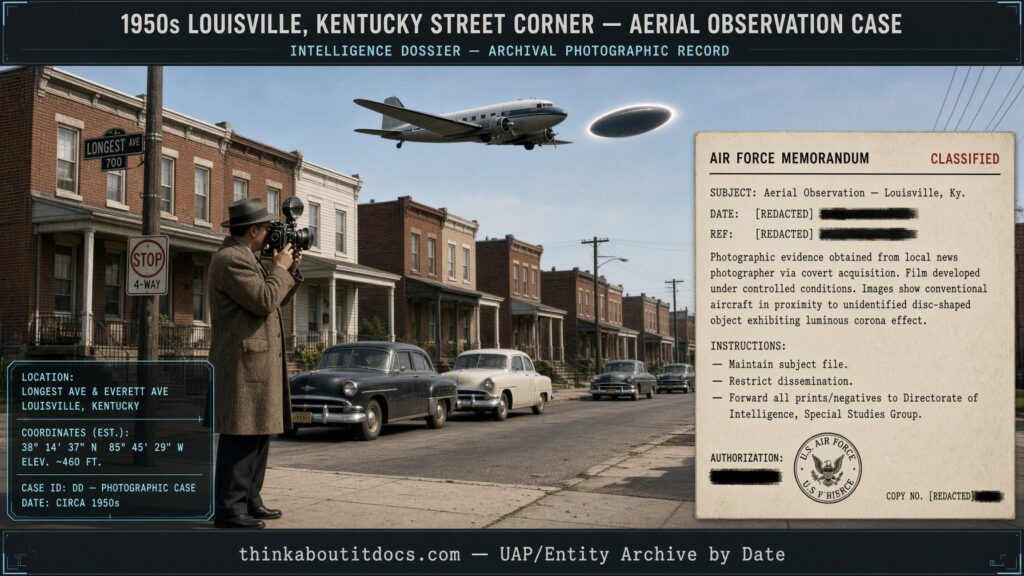
Al Hixenbaugh's June 27, 1950 film of a disc-shaped object over Louisville, Kentucky, which quietly drew covert Air Force intelligence interest.
THINK ABOUTIT UFO|UAP SIGHTINGS REPORT
1950: The Al Hixenbaugh Film — Louisville, Kentucky
On a summer afternoon in 1950, a Louisville newspaper photographer heard a plane overhead, looked up out of habit, and found his camera pointed not just at the aircraft but at a large, corona-ringed disc apparently flying alongside it. The resulting movie film became, within weeks, one of the most quietly consequential pieces of UFO evidence of the year — not because the public made it famous, but because the U.S. Air Force’s own intelligence and counterintelligence branches began exchanging memos on how to covertly obtain a copy and question the photographer without revealing that the military was interested at all.
Date: June 27, 1950
Sighting Time: 4:15 p.m.
Day/Night: Day
Location: Corner of Longest and Everett Avenues, Louisville, Kentucky
Urban or Rural: Urban
No. of Entity(‘s): Not applicable
Entity Type: Not applicable
Hynek Classification: DD (Daylight Disc)
Duration: Brief — the length of the filmed sequence, likely on the order of seconds to a minute
No. of Object(s): 1
Description of the Object(s): A dark, disc-shaped object with a visible corona or glowing halo effect around its edge, filmed alongside a passing DC-3 airliner, providing a size and distance reference against the known aircraft
Shape of Object(s): Disc
Size of Object(s): Not independently established
Color of Object(s): Dark/black body with a lighter, glowing corona around its perimeter
Distance to Object(s): Not established
Height & Speed: Not established, though the object appeared close enough in the frame to the DC-3 to be filmed in the same shot
Number of Witnesses: 1 (Al Hixenbaugh, a professional newspaper photographer)
Special Features/Characteristics: Captured on motion-picture film by a trained press photographer, alongside a conventional aircraft in the same frame; prompted a documented U.S. Air Force intelligence and counterintelligence effort to covertly obtain the footage and interview the photographer without disclosing military interest.
Case Status: Insufficient Data
Source: Sparks Database of Bluebook Unknowns; FUFOR Index; declassified USAF/AFOSI intelligence memoranda; NICAP case file 500627louisville
Summary/Description: At 4:15 p.m. on June 27, 1950, Al Hixenbaugh, a photographer for a Louisville newspaper, was standing at the corner of Longest and Everett Avenues when he heard a DC-3 airliner overhead. Looking up out of habit, he saw not only the plane but a large, dark, disc-shaped object with a visible glowing corona around its edge, apparently flying in proximity to the aircraft. He filmed the scene on movie film, capturing both the known airliner and the unidentified disc together in the same shots — a detail that gave the footage an unusual built-in scale and distance reference compared to most contemporary UFO photographs. Word of the film reached the Louisville newspapers, and from there to U.S. Air Force intelligence circles. Internal Air Force memoranda — later declassified — reveal officers at the Office of Special Investigations (AFOSI) and Air Force intelligence discussing how best to acquire a copy of the film and interview Hixenbaugh without revealing that the military was interested, at one point considering and then rejecting the use of the FBI as an intermediary, and discussing whether an Air Force scientist might need to approach the newspaper directly. The film was subsequently featured, alongside the Trent (McMinnville, Oregon) photographs, as one of the best pieces of new UFO evidence from 1950 in an early UFO documentary film that circulated in theaters that year.
Related Cases: 1950: The McMinnville (Trent) UFO Photographs, Oregon (same year, comparable photographic evidence and government scrutiny) | Mariana UFO film, Great Falls, Montana, August 1950 (another analyzed 1950 motion-picture case)
Detailed Report
The Hixenbaugh film’s significance rests less on the object it depicts than on the reaction it provoked. A professional photographer capturing an unidentified object on film in the same frame as a known, identifiable aircraft is a genuinely useful piece of evidence in principle — the airliner provides scale, distance, and speed references that a lone UFO image lacks. That structural strength is likely exactly why the Air Force took quiet but serious interest: unlike a witness’s verbal account, a film with a built-in reference object is something that can, in principle, be measured and analyzed the way the McMinnville photographs eventually were.
The declassified internal memoranda are the most historically interesting part of the case file. Air Force officers debated multiple approaches to acquiring the footage without tipping off the public that the military cared — floating the idea of using the FBI as a cutout, then explicitly deciding against involving the Bureau, and considering whether a scientist working with Air Force intelligence might simply negotiate with the newspaper directly for access. This kind of covert-acquisition planning, preserved in the government’s own paper trail, is a rare window into how seriously certain 1950 sightings were handled behind the scenes, regardless of how the case was eventually characterized to the public.
Set against that institutional seriousness is a specific credibility complication that later researchers have raised: Hixenbaugh went on, in the years following the sighting, to a side career as a performing hypnotist and stage magician, a detail some investigators have pointed to as suggestive of a showman’s instinct that might have colored his account or led him to embellish a more mundane sighting. This is a fair point of caution rather than a decisive refutation — a photographer’s later career choices do not retroactively prove what he did or did not see and film in 1950 — but it is a detail that belongs in any honest assessment of the case’s reliability, and it is part of why this archive does not treat the film as confirmed evidence of anything beyond an unidentified aerial phenomenon captured on film.
No technical analysis of the Hixenbaugh footage comparable to Hartmann’s Condon-era study of the McMinnville photographs appears to have been conducted or preserved in the sources available to this archive, which limits how far the case can be assessed on its physical merits alone.
RESEARCHER’S NOTES
The Hixenbaugh Film — Louisville 1950 and the Weight of a Witness’s Later Life
- Classification issues: DD is straightforward here — a disc-shaped object filmed in daylight, at a distance, with no close approach or occupant claim.
- Source chain assessment: The case is unusually well documented on the government-response side, via declassified Air Force intelligence and counterintelligence memoranda, but poorly documented on the technical-analysis side — no equivalent of the McMinnville photogrammetric study is known to survive for this footage, and the film’s ultimate fate and current whereabouts, if it survives at all, are not established in the sources available to this archive.
- Pattern context: The case belongs to the small cluster of 1950 motion-picture and photographic UFO evidence — alongside the Trent photographs from May and the Mariana film from August — that together represented, in the contemporary press and in an early UFO documentary, the strongest visual evidence the field had yet produced. Of the three, Hixenbaugh’s has received markedly less independent technical scrutiny than the other two.
- Physical evidence and evidentiary weight: A film exists, or existed, with a built-in aircraft reference — structurally a stronger form of evidence than an unaccompanied photograph — but the absence of any known technical analysis, combined with later-raised credibility questions about the witness’s showmanship career, meaningfully limits how much weight this archive can place on the case pending further research.
- Geographic and historical context: Louisville had already produced an earlier disc-shaped-object photography claim in July 1947 from a different Louisville newspaper photographer, making this the city’s second notable photographic UFO claim within three years — a detail worth noting for pattern purposes without implying any connection between the two events.
The Hixenbaugh film is remembered today more for the government’s reaction to it than for its own visual content — a rare, documented instance of Air Force intelligence quietly maneuvering to acquire private UFO footage while avoiding public acknowledgment of its interest. Whatever the film actually shows, that institutional response is itself a durable piece of 1950 UFO history. Absent a surviving technical analysis of the footage and with legitimate, unresolved questions about the witness’s later career as a showman, the case is catalogued honestly as Insufficient Data.
“It would be nice if OSI could arrange to secure a copy of the film in some covert manner.”
— Internal USAF intelligence memorandum, on the Hixenbaugh film, 1950