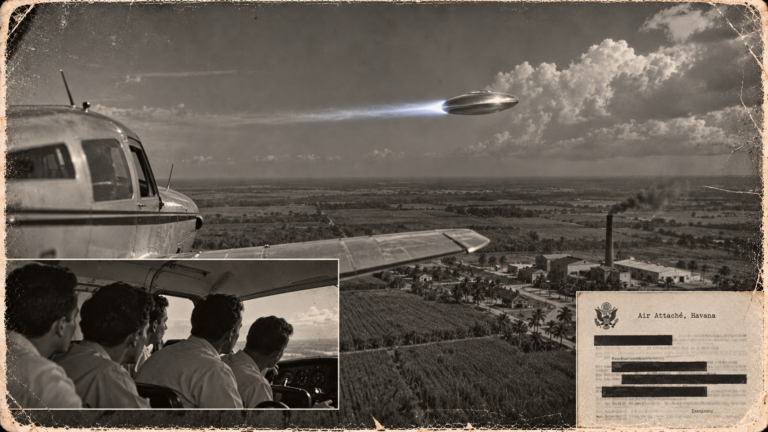
February 24, 1950 — a theodolite set up to track a weather balloon instead recorded 1.5 minutes of precise data on an unidentified object over Albuquerque.
THINK ABOUTIT UFO|UAP SIGHTINGS REPORT
1950: The Albuquerque Theodolite Case
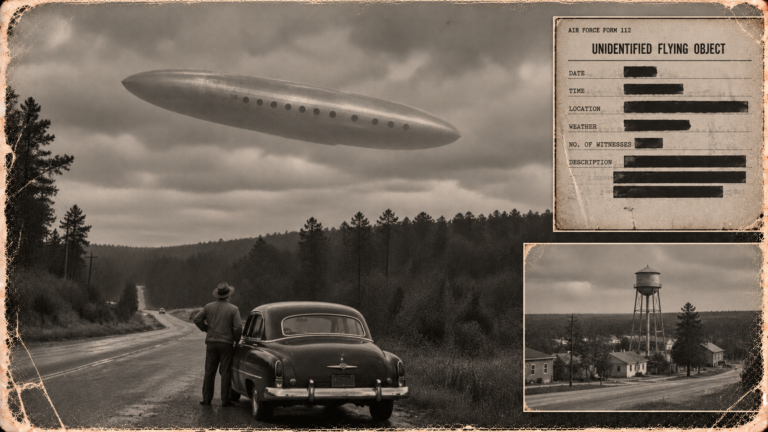
At about 1:55 on the afternoon of February 24, 1950, Luther B. McDonald was on the roof of the TWA Building at Albuquerque Municipal Airport, following a weather balloon through a theodolite, when a white, slightly egg-like object crossed the instrument’s field of view. It was darkened on its upper left side, and it moved in a straight line, covering 2 degrees of sky in about a minute and a half at, in his words, a crawl next to a shooting star. A second weather observer, alerted when McDonald called attention to it, saw a brilliant white object without the instrument for 20 to 30 seconds, and a third man standing there could see nothing but told OSI that both were entirely trustworthy.
The Albuquerque theodolite UFO sighting came to the Air Force through Dr. Lincoln LaPaz of the University of New Mexico, who told OSI at Kirtland AFB about it, and Special Agent Cristino B. Griego interviewed the observers in late February and early March. The Project Blue Book card that summarizes the case concludes UNIDENTIFIED. The case’s strength is the instrument: an angular track logged, however briefly, by a device built for precision.
Date: February 24, 1950, BBU 642
Sighting Time: About 1:55 p.m. MST (Blue Book card: 1355; OSI synopsis: about 1358; second observer: 1400)
Day/Night: Day
Location: Roof of the TWA Building at the west end of the terminal building, Albuquerque Municipal Airport, New Mexico, USA, where the weather theodolite is situated
Urban or Rural: Urban
No. of Entity(‘s): Not Applicable
Entity Type: Not Applicable
Entity Description: Not Applicable
Hynek Classification: DD (Daylight Disc)
Duration: Approximately 1.5 minutes through the theodolite; roughly 20-30 seconds for the separate naked-eye observation
No. of Object(s): 1
Description of the Object(s): Round but not spherical, not quite as elongated as an egg, darkened on the top-left side as seen through the theodolite; to the naked eye, bright white, as metal reflects light. No apparent construction, support, projections, trail, sound or odor; sky cloudless.
Shape of Object(s): Round, slightly egg-shaped
Size of Object(s): Angular size roughly matching the upper part of the moon as seen through the theodolite’s telescope sight; to the naked eye, about the apparent size of a weather balloon
Color of Object(s): White, darkened on the top-left side; brilliant white/metallic to the naked eye
Distance to Object(s): Not independently determined; only angular position was recorded
Height & Speed: Elevation 20 to 23 degrees at a bearing of about 110 degrees; straight flight to the west-southwest between 240 and 270 degrees (McDonald), while the second observer gave east by southeast; about 1.5 minutes to cover 2 degrees in the theodolite, “just a crawl” compared with a shooting star; very slow to the naked eye
Number of Witnesses: 2 who saw it: Luther B. McDonald, weather observer (theodolite and naked eye), and a second weather observer, named Harrison S. Manson by NICAP, who saw it with the naked eye after McDonald called attention to it. A third weather observer present could not see the object but told OSI that both men were entirely trustworthy.
Special Features/Characteristics: Precision Instrument Tracking (Theodolite), Two Independent Observation Methods (Instrumented and Naked-Eye), Professional Weather Bureau Observers, Straight-Line Measurable Trajectory
Case Status: Unexplained. Project Blue Book’s record card concludes UNIDENTIFIED (NICAP: BBU 642).
Source: AFOSI 17th District Report of Investigation (file 24-8-21, S/A Cristino B. Griego, 9 March 1950; interviews of 28 February and 1 and 7 March; forwarded 22 March 1950 by Lt. Col. Doyle Rees); Project Blue Book (Project 10073) record card; NICAP 1950 UFO Chronology (Berliner; Jan Aldrich); Loren E. Gross, UFOs: A History, 1950: January–March
Summary/Description: While tracking a weather balloon from atop the TWA Building at Albuquerque Municipal Airport, Weather Observer Luther B. McDonald was using a David White pibal theodolite (with an approximately 21x telescope sight) when a white, round object — not quite as elongated as an egg and darkened on its top-left side — crossed his field of view. Over about 1.5 minutes, the object moved from roughly 20° to 23° elevation at about 110° azimuth, flying straight and level on an apparent heading of 240°-270° — a trajectory that, projected onward, pointed toward Los Alamos. Its angular size roughly matched the upper portion of the moon as seen through the theodolite’s telescope. McDonald lost sight of the object when he had to shift his attention back to the weather balloon. A second Weather Observer, Harrison S. Manson, separately saw the object with the naked eye for about 20-30 seconds, describing it as brilliant white, like metal reflecting sunlight, roughly the apparent size of a weather balloon about to disappear into the distance, with an impression of flight heading toward the east-southeast (consistent with the object actually having come from that direction). Blue Book’s card concludes UNIDENTIFIED.
Related Cases: Datil, New Mexico, photographed light (February 24 and 25, 1950); Los Alamos AESS cylinder case (February 25, 1950); Los Alamos tower sighting (February 24, 1950, per Gross); Kirtland/Albuquerque fireball (February 7, 1950)
Detailed Report
The Instrument
The observation point was the roof of the TWA Building at Albuquerque Municipal Airport, where the weather theodolite stands. NICAP’s annotation suggests the instrument was a David White pibal theodolite with a telescope sight of about 21 power. McDonald was watching a weather balloon through it when, at about 1:55 p.m., a round object crossed the field of view. It was not spherical and not quite as elongated as an egg, and the top-left side looked darkened. Through the theodolite it compared in size to the upper dark portion of the moon as it rises in the east. He put its elevation between 20 and 23 degrees at a bearing of about 110 degrees, and its flight to the west-southwest, between 240 and 270 degrees, in a straight line. It took about a minute and a half to cover 2 degrees, which McDonald described as a crawl next to the speed of a shooting star. He watched it with the naked eye for the same minute and a half, and lost it after shifting his attention back to the weather balloon.
The Second Observer
A second weather observer, a weather forecaster for seven years, had his attention drawn to the object when McDonald called it out. He described it as bright white, as metal reflects light, very brilliant, more than a white weather balloon, about the size of a weather balloon about to disappear in the distance, round, very far off, at about 20 degrees elevation and about 110 degrees, moving very slowly toward the east by southeast, for 20 to 30 seconds before it faded out of sight. He had never seen an unknown aerial object before. NICAP reads his heading of east by southeast as the direction the object came from.
The Third Observer
A third weather observer was present when the other two saw the object but could not see it himself. He told OSI that the two men were entirely trustworthy and believed they saw the object as they described it.
The Investigation
Dr. Lincoln LaPaz, who was advising the Air Force on the New Mexico fireballs, told the OSI office at Kirtland AFB of the sighting. Special Agent Cristino B. Griego interviewed McDonald on February 28 and the other two men on March 7, with the report dated March 9 and forwarded to Air Materiel Command on March 22. McDonald had observed weather for five years, had never studied astrology or astronomy and had never before seen anything resembling the object. OSI closed the case with all logical leads exhausted. The Project 10073 record card gives the observers as civilian weather observers, the time as 1355 MST, the course as 240 to 270 degrees, the observation as made from a building roof, and the conclusion as UNIDENTIFIED.
Los Alamos on the Same Afternoon
The Los Alamos in this case’s title belongs to a separate report. Loren Gross records that two Atomic Energy Security Service inspectors in the Los Alamos airport tower watched an aluminum-colored, round object gyrate high over the town at 1:15 p.m. on February 24 for about 20 minutes, circling slowly and then fast with an intermittent vapor trail, and that a chemical operator near “M” Building in the Tech Area saw a silver-white object at about 1:40 p.m. that hovered and then went practically straight up. Los Alamos lies north-northwest of Albuquerque, and a west-southwest heading does not point toward it, so the OSI file gives no link between the two sightings other than the day.
RESEARCHER’S NOTES
A Slow Track Through an Eyepiece
- Three Times for One Sighting: The Blue Book card gives 1355 MST, the OSI synopsis about 1358, and the second observer 1400. NICAP’s 1:55 p.m. matches the card. The Los Alamos tower sighting at 1:15 p.m. is a separate report.
- A Prompted Second Sighting: The second observer saw the object because McDonald called attention to it. That makes his account a compatible confirmation, not an independent one. The third observer’s inability to see it is recorded in the file without comment.
- An Instrument Without a Log: The angular figures (20 to 23 degrees, 110 degrees azimuth, 2 degrees in about 90 seconds) come from McDonald’s interview, and no theodolite record survives in the file. They are still more precise than most eyewitness estimates.
- Why It Isn’t a Meteor: McDonald compared the object’s motion to a crawl next to a shooting star, and the second observer called its movement very slow. The OSI report lists no planet or celestial phenomenon as an explanation, and the card concludes UNIDENTIFIED.
- Witness Credentials: McDonald had observed weather for five years and the second observer had been a forecaster for seven. Neither had seen anything like it, and the OSI report calls the third man’s assessment of both unquestionable. The file blacks out the names, and NICAP supplies Manson as the naked-eye observer.
- A Tie to Datil: Later that evening, at Datil, a Holloman AFB airman photographed a round white, red and green light that Blue Book’s card, in a 1965 evaluation, concluded was a comet. The Albuquerque daytime object has no such evaluation.
The Albuquerque theodolite case is a small, careful report: an experienced weather observer with an instrument in his eye, a slow, straight track measured in degrees, a second observer who confirmed it when prompted, and a third who vouched for both. It is filed here as Unexplained, in line with Blue Book’s UNIDENTIFIED card, with the caution that the file preserves McDonald’s readings but not the instrument’s log, and that nothing in the record links it to Los Alamos.
“Bright white, as metal reflects light.”
Second weather observer, AFOSI report on the February 24, 1950 Albuquerque sighting.