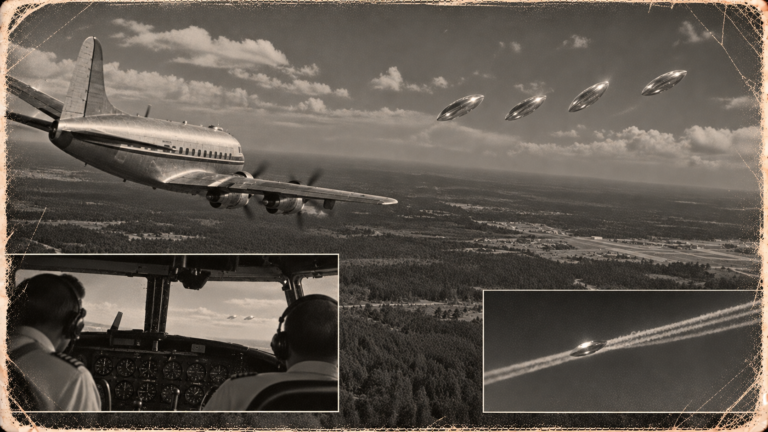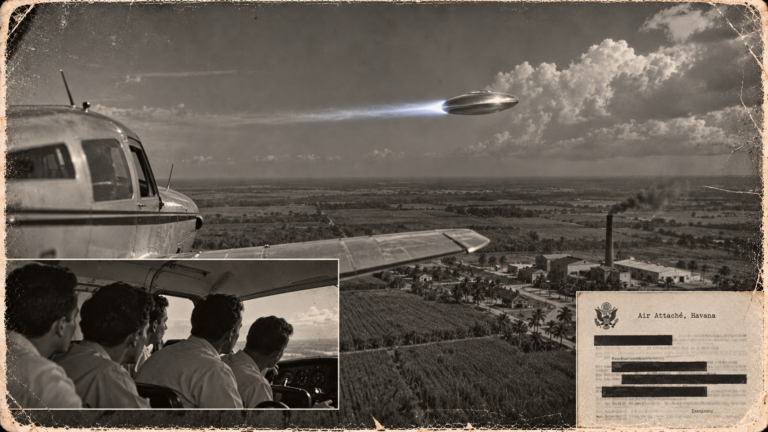
A Holloman AFB airman photographed a brilliant round light near Datil, New Mexico, on February 24, 1950; Blue Book later concluded it compared with a comet.
THINK ABOUTIT UFO|UAP SIGHTINGS REPORT
1950: Datil, New Mexico Photographed Light
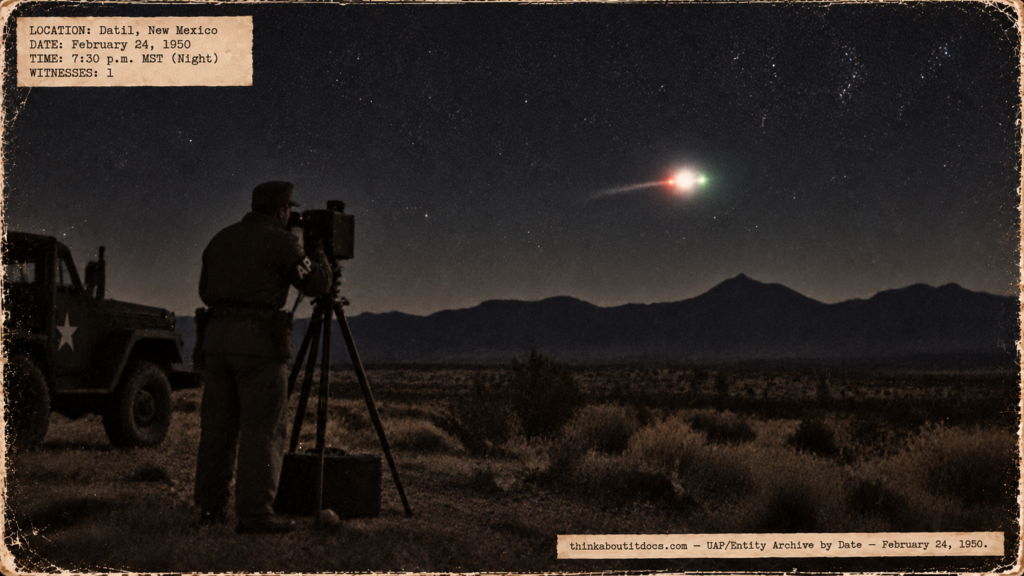
On the evening of February 24, 1950, at a remote Air Force observation post near Datil, New Mexico, an airman with a camera watched a brilliant round light hang in the southern sky for about two and a half hours. Cpl. Lertis E. Stanfield of Holloman AFB’s 3024th Air Police Squadron saw it blink between white, red and green, drift west and then northwest, and fade from view at 10:00 p.m. It returned at 2:00 a.m., almost where it had been, and slid behind a mountain about half an hour later. Stanfield photographed it, and the Datil, New Mexico photographed light became one of the best-documented lights in the early files of the Southwest fireball inquiry.
The post existed because the Air Force had finally decided to collect instrumented evidence on the lights and green fireballs that kept turning up around Holloman and the atomic installations of New Mexico. The photographs traveled up the chain to Air Materiel Command, were reused in Holloman’s own report and in the OSI’s May 1950 summary, and were still being requested by Washington in 1952. This report preserves the file: the OSI investigation, the Holloman explanation of the program, the photographs and the Blue Book card, which concludes, in a 1965 evaluation, that the pictures compare with photographs of a comet.
Date: February 24, 1950 (with a second appearance early on February 25, 1950)
Sighting Time: 7:30 p.m. MST (1930) on February 24; reappearance about 2:00 a.m. MST (0200) on February 25
Day/Night: Night
Location: Datil, New Mexico, USA (34°08′ N, 107°45′ W), at an observation post manned by Holloman AFB personnel; the light was due south of the observer
Urban or Rural: Rural
No. of Entity’s: Not Applicable
Entity Type: Not Applicable
Entity Description: Not Applicable
Hynek Classification: NL (Nocturnal Light)
Duration: About two and a half hours on the 24th (1930 to 2200) and about 30 minutes on the 25th (0200 to about 0230); the Blue Book card records 1 hour 30 minutes
No. of Object(s): 1
Description of the Object(s): A perfectly round, very brilliant light that blinked red and green and moved slowly without following a straight line; no exhaust was visible to the naked eye, but the photographs show a trail-like feature
Shape/Size/Color of Object(s): Round; size not estimated; white, changing to red and green
Distance to Object(s): Unable to determine
Height & Speed: About 30 degrees above the horizon, due south at first; it moved west, then northwest; movement was not erratic but never in a straight line; the OSI report gives speed as a small angle of azimuth per two minutes (the figure is illegible in the scan). Brad Sparks cites Dr. Lincoln LaPaz’s calculation of about 0.5 degrees per minute for the February 25 appearance.
Number of Witnesses: 1 (Cpl. Lertis E. Stanfield, 3024th Air Police Squadron). The OSI report states that there was no other witness. NICAP’s chronology speaks of Stanfield and other Holloman photographic staff.
Special Features/Characteristics: Five photographs of the light plus a comparison photograph (No. 6); trail visible on film but not to the eye; reappearance four hours later in nearly the same place; disappearance behind a mountain; observation post set up under a program to gather instrumented data on aerial phenomena
Case Status: Explained. Project Blue Book’s record card concludes “Astro (Comet),” from a 1965 evaluation that compared the photographs with comet photographs. NICAP lists the case as a Blue Book unknown, and the 1950 OSI report names no celestial candidate.
Source: AFOSI 17th District Report of Investigation (file 24-8-25, S/A Robert R. Johns, 7 March 1950, forwarded 14 March 1950); Project Blue Book (Project 10073) record card; Headquarters USAF/6540th Missile Test Wing correspondence of July–August 1952; Holloman AFB report on aerial phenomena (July 25, 1951); Brad Sparks, cited in the NICAP 1950 UFO Chronology; Loren E. Gross, UFOs: A History, 1950: January–March
Summary/Description: Cpl. Lertis E. Stanfield, at a Holloman AFB observation post at Datil, New Mexico, photographed a brilliant round light in the south at 7:30 p.m. on February 24, 1950. It blinked white, red and green, moved west and then northwest, and faded at 10:00 p.m., then reappeared at about 2:00 a.m. and slid behind a mountain around 2:30. Holloman checks found no explanation, and Blue Book’s card concludes the photographs compare with a comet.
Related Cases: Albuquerque theodolite case (February 24, 1950); Kirtland/Albuquerque fireball (February 7, 1950); Holloman AFB lights (January 6, 12 and 13, 1950); Corona, New Mexico, fireball (January 7, 1950); Los Alamos AESS cylinder case (February 25, 1950)
Detailed Report
The Observation Post
Holloman AFB’s commanding officer decided in February 1950 that the number of unexplained aerial phenomena reported by reliable people around the base justified a scientific system of observation, intended to gather enough factual data to persuade Headquarters USAF to fund manpower and equipment. Two colonels, Major Haynor, Captains McGovern and Feagin and Lt. John G. Albert took part in the conferences (the scan and Gross give one colonel’s name differently, so it is omitted here). An outpost with a theodolite, telescope and camera, manned by Air Police sergeants, went into operation on February 21, and the Photographic Branch supplied cameras to Air Police personnel at Datil and Vaughn, New Mexico. One of the best pictures, in the Holloman report’s judgment, was taken at Datil at 1930 hours on February 24.
February 24: The Light in the South
Cpl. Stanfield, on detached service at Datil, was not interviewed in person by OSI. Special Agent Robert R. Johns obtained his account in writing. Stanfield first saw the light at 1930 hours due south of his position, about 30 degrees above the horizon, and photographed it at once. At 2000 hours it looked much brighter, had moved west some distance and seemed much closer. By 2130 it had stopped moving but kept blinking red and green. At 2200 it faded from view while still high in the sky. Stanfield described a perfectly round, very brilliant light, white and changing to red and green, that moved without erratic jumps but never in a straight line. It made no sound and left no visible exhaust to the naked eye, although the photographs seemed to show some sort of trail.
February 25: It Comes Back
At 0200 hours on February 25 the light reappeared in almost the same position where it had faded at 2200 and began a slight movement to the northwest. It disappeared behind a mountain at about 0230 hours. Brad Sparks records that Dr. Lincoln LaPaz, the meteoriticist advising the Air Force on the New Mexico fireballs, calculated the light’s angular speed at about half a degree per minute, and that this was the second sighting of the night from the same Holloman observation post.
The Checks and the Photographs
Holloman’s Electronics and Atmospheric Branch and its Weather Detachment could offer nothing to explain the object. OSI’s report lists observable celestial phenomena or planets that could account for the sighting as none. The report encloses six photographs: five of the object in the order taken, and a sixth made by the Holloman Photo Lab for comparison, using the same camera, lens and film on a round object 3-25/32 inches in diameter, with its data written on the back. The file describes the case as including six 4 x 5 inch photographs, one 8 x 6 inch photograph and one 8 x 10 inch photograph.
The Card: Comet, Evaluated in 1965
The Project 10073 record card lists one military-source object, observed on the ground and visually, for one and a half hours, white and changing color, moving northwest and disappearing behind mountains, with an elevation of 30 degrees, no azimuth reported, photographs in the file and no physical evidence. Its conclusion reads “Astro (Comet),” adding that the photograph compares with comet photographs, an evaluation made in 1965, and referring to the Blue Book case of a comet photographed on April 10, 1962. The card notes that the tail, not visible to the naked eye, showed on the camera.
The Negative in 1952
In July 1952 the Director of Intelligence at Headquarters USAF asked Holloman for the negative of the 1930-hour Datil picture. The 6540th Missile Test Wing sent it as a confidential negative and asked for its return, noting that a print had already served as an enclosure to a Holloman report of July 25, 1951 and to the OSI’s May 25, 1950 summary of observations of aerial phenomena in the New Mexico area from December 1948 to May 1950, sent to Brig. Gen. Joseph F. Carroll. Air Force Intelligence forwarded it to the Air Technical Intelligence Center on August 1, 1952.
RESEARCHER’S NOTES
A Camera, a Corporal and a Comet Verdict
- Two Different Conclusions, Fifteen Years Apart: In 1950 the OSI agent recorded no celestial phenomenon or planet that could account for the sighting. In 1965 Blue Book compared the pictures with comet photographs and concluded the object was a comet. The file does not say who made the 1965 comparison or how, and the card cites a separate comet case from April 1962 as the reference.
- A Light That Behaves Like the Holloman Lights: Holloman airmen reported similar color-changing lights in January 1950, a bright star-like light in the north blinking white, green and red on January 6, 12 and 13, and Blue Book assigned those to Canopus, Venus and Capella. The Datil light shows the same white, red and green changes and the same return to nearly the same place hours later.
- One Witness or Several?: The OSI report says Stanfield had no other witness. NICAP’s chronology speaks of Stanfield and other Holloman photographic staff at the Datil post, and Holloman’s report describes personnel and cameras supplied to Air Police posts. Either the observer was alone when he saw the light or the summary compresses the staffing.
- What the Film Shows: The OSI report says the photographs indicate a trail the eye could not see, and the card says the tail showed on the camera. Sparks quotes a diameter of 0.2552 degrees and a trail 3.785 degrees long from the film. Those measurements come from Sparks, and the OSI file gives only the comparison-object diameter.
- The Program Behind It: The Datil post was one of the first products of Holloman’s observation program. That program grew out of the fireball worries voiced by LaPaz, whose February 20 letter divided the fireballs into meteorites and guided missiles, and it led into the Air Force’s Project Twinkle, authorized that March.
- Provenance: The file traveled: the print went into Holloman’s report of July 25, 1951 and the OSI’s May 1950 summary to General Carroll, and the negative was still being requested in 1952, which shows officers in Washington considered the pictures worth keeping.
The Datil light is a well-documented case with a modest answer. One airman with a camera, at an observation post built to catch exactly this sort of thing, photographed a round white-red-green light on the night of February 24, 1950, and the light reappeared four hours later. It is filed here as Explained, on the strength of Blue Book’s card, with the caution that the card’s 1965 comet evaluation came fifteen years after an OSI investigation that could find no celestial explanation, and that the photographs themselves are not reproduced here.
“Photo compares with Comet photographs.”
From the Project Blue Book record card for the February 24, 1950 Datil, New Mexico sighting (evaluation made 1965).