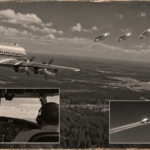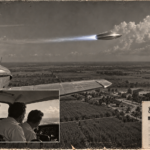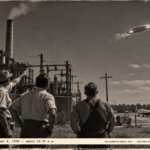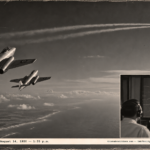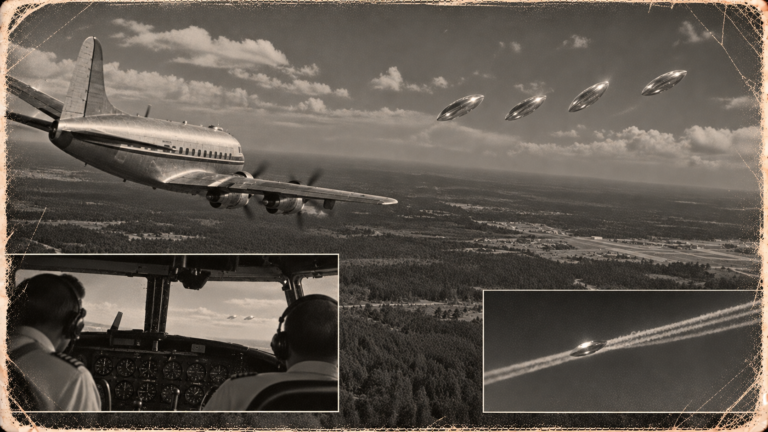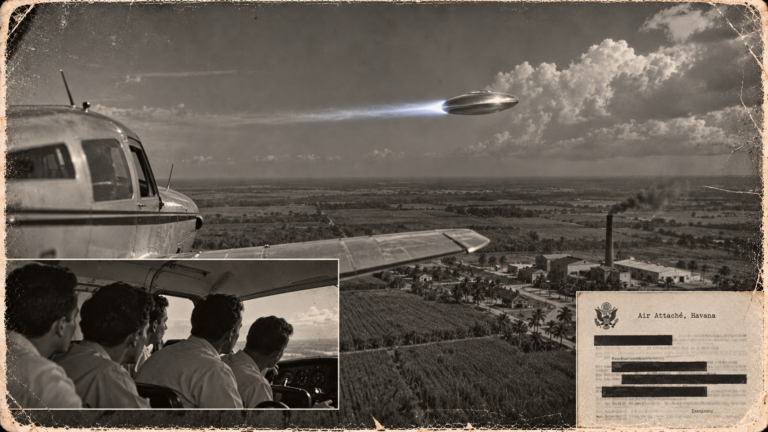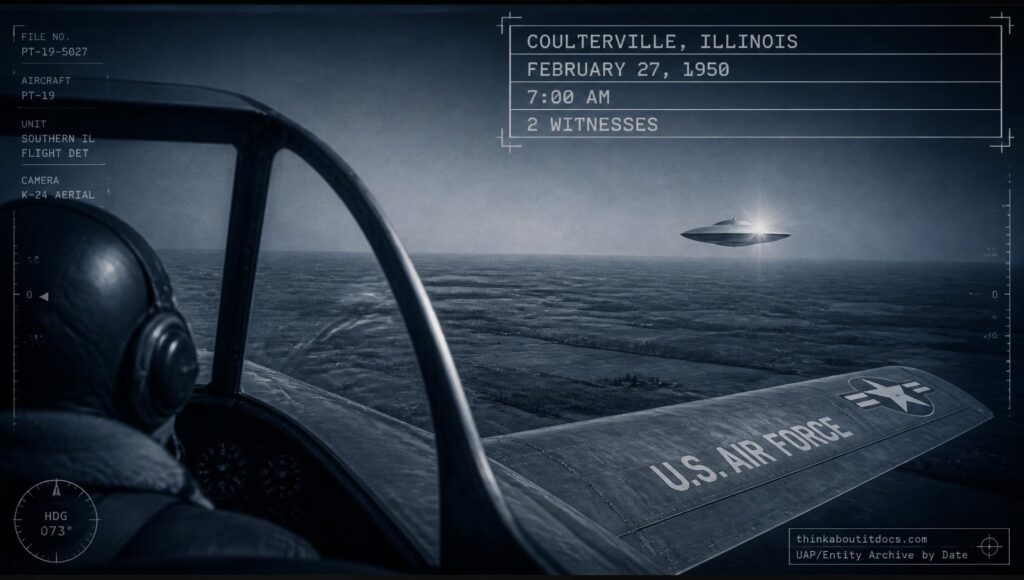
February 27, 1950 — a private pilot's 15-minute, close-range observation of a discus-shaped object near Coulterville, Illinois.
THINK ABOUTIT UFO|UAP SIGHTINGS REPORT
1950: Coulterville, Illinois Pilot UFO Sighting
At about 7:00 on the morning of February 27, 1950, a DuQuoin, Illinois pilot flying his wife home from Wood River in a PT-19 trainer noticed what he took for another aircraft near Coulterville. He climbed from 2,000 to 5,000 feet to reach its level and closed to about half a mile, and for about 15 minutes he watched a discus roughly 60 feet across and 10 feet thick, with a high metallic shine and no windows, rotors, flames or trails, make sharp turns right and left and up and down. He flew above it, below it and beside it to be sure he wasn’t looking at a reflection. Then it picked up speed and left, heading south toward Carbondale.
He told no one for more than two weeks because he expected to be ridiculed. The Coulterville, Illinois pilot sighting reached the Air Force when the 12th District Office of Special Investigations at Scott AFB interviewed him on March 15, and its Spot Intelligence Report of March 16 survives in the National Archives among the Project Blue Book records. A shorter version of the story, dated February 22 and placed at Pinckneyville, circulated in newspapers, and NICAP lists the Blue Book case as unidentified.
Date: February 27, 1950 (a newspaper version dates the same encounter February 22 at Pinckneyville, Illinois)
Sighting Time: About 7:00 a.m. (0700 hours)
Day/Night: Day
Location: Near Coulterville, Illinois, USA; the witness was flying a PT-19 from Wood River to DuQuoin, and the object left heading south from DuQuoin toward Carbondale
Urban or Rural: Rural (airborne over southern Illinois)
No. of Entity’s: Not Applicable
Entity Type: Not Applicable
Entity Description: Not Applicable
Hynek Classification: DD (Daylight Disc)
Duration: About 15 minutes
No. of Object(s): 1
Description of the Object(s): A discus with a high metallic shine; no visible markings or breaks in the metal for windows or rotors; no flames, smoke or vapor trails; no visible sign of how it was powered; highly maneuverable, making several turns right and left and moving up and down; it tilted in the direction it intended to move, with no distinguishable front or rear
Shape/Size/Color of Object(s): Discus-shaped; about 60 feet in diameter and 10 feet thick in the middle, thin at the edges; high metallic shine; the surface gave the impression of being cut in sections, wide at the edge and narrow in the middle, like the cuts of a piece of pie
Distance to Object(s): As close as about one-half mile
Height & Speed: The pilot climbed from 2,000 to 5,000 feet to reach the object’s level; he was flying at 140 to 150 mph when the object picked up speed and disappeared, heading south from DuQuoin toward Carbondale at better than 150 mph
Number of Witnesses: 2 (the pilot and his wife). The OSI report records only the pilot’s account; NICAP adds that his wife saw the object after he alerted her.
Special Features/Characteristics: Pilot actively matched the object’s altitude and flew above, below and beside it to rule out an illusion or reflection; clear sky and smooth air, which ruled out cloud reflection and air currents; pilot believed the object moved under its own power; no other reports from the area; reported late for fear of ridicule
Case Status: Unexplained. NICAP lists the case as a Project Blue Book unknown (BBU); the OSI report rates the source F-6 (reliability unknown, truth not judged).
Source: Headquarters USAF, 12th District Office of Special Investigations, Scott AFB, Illinois: Intelligence Report and Spot Intelligence Report, “Unconventional Aircraft,” 16 March 1950 (interview of 15 March 1950), signed by Maj. Owen L. Colaw, Acting District Commander (NARA Project Blue Book microfilm, PBB90, frames 1159-1160); NICAP 1950 UFO Chronology (Brad Sparks; BBU); Loren E. Gross, UFOs: A History, 1950: January–March, pp. 26 and 93; Weinstein, Dominique. Aircraft UFO Encounters, Project ACUFOE, Paris, 1999
Summary/Description: A DuQuoin pilot flying a PT-19 with his wife saw a discus about 60 feet across near Coulterville at about 7:00 a.m. on February 27, 1950. He climbed to 5,000 feet, closed to about half a mile and watched it maneuver for 15 minutes, flying around it to rule out an illusion, before it left at high speed toward Carbondale. He first reported it to Air Force investigators in mid-March, saying he had feared ridicule.
Related Cases: Blackstone, Virginia, C-45 encounter (January 24, 1950); Denver, Colorado, eight-pilot flame sighting (January 18, 1950); Howard, Kansas, C-47 sighting (January 6, 1950); Alameda, California, “flying ice cream cone” (February 7, 1950)
Detailed Report
The Flight
According to the OSI report, the pilot was returning to DuQuoin from Wood River, Illinois, in a PT-19 with his wife at about 0700 hours on February 27, 1950 when he noticed an object near Coulterville that appeared to be an aircraft. He gained altitude to 5,000 feet, where he appeared to be level with it. NICAP, citing Brad Sparks, puts him at 2,000 feet when he first saw it and adds that he alerted his wife, who then saw it too.
The Object
He described a discus, about 60 feet across and 10 feet thick in the middle and thin at the edges, with a high metallic shine. He could not make out any markings or any breaks in the metal for windows or rotors, and saw no flames, smoke or vapor trails. It appeared highly maneuverable, making several turns both left and right and moving up and down. It tilted in the direction it intended to move, but he could not distinguish any front or rear, and there was no visible indication of how it was powered. He kept it in view for about 15 minutes and at one point was as close as half a mile. The surface, he said, gave him the impression of being cut in sections, wide at the edge and narrow in the middle, like the cuts of a piece of pie.
Ruling Out an Illusion
The pilot said that he flew above, below and to either side of the object to be certain he was not experiencing an illusion or viewing a reflection. The sky was clear, which he took to eliminate cloud reflection, and the air was smooth, so he believed the object moved up and down under its own power and not as a result of an air current. NICAP adds that he tried to buzz people on the ground to make them look up.
The Departure
The object picked up speed and disappeared, heading directly south from DuQuoin toward Carbondale, at a speed the report puts at better than 150 miles per hour. The pilot was flying at 140 to 150 miles per hour at the time.
The Report
The OSI interviewed the pilot at DuQuoin on March 15, 1950, and the 12th District at Scott AFB wrote its Intelligence Report and Spot Intelligence Report on March 16, signed by Maj. Owen L. Colaw as Acting District Commander. The pilot gave as his reason for not reporting earlier that he thought he would be ridiculed if he claimed to have sighted a flying disk. The report adds that no further reports about the object had come from people living in the area and that no newspaper articles had described anyone else in the area seeing such an object. It promises that any further reports would be furnished immediately and records that copies went to the Continental Air Command at Mitchel AFB, the Air Training Command and the commander of Chanute AFB.
The February 22 Version
Loren Gross quotes a St. Louis Post-Dispatch account of a Mr. R. Lemmon, piloting a private plane with his wife 2,000 feet over Pinckneyville, Illinois, on February 22. He saw a strange shape about 3,000 feet above, nudged his wife, gunned the engine to climb, and as he drew near saw a disc about 60 feet across and 10 feet thick. Before he got close, it tilted and left in a hurry. NICAP’s chronology and Dominique Weinstein’s catalog list the same pilot’s sighting, with NICAP citing a UP dispatch from Du Quoin dated March 14, 1950.
RESEARCHER’S NOTES
A Pilot Who Flew Toward It, and a Report That Waited Two Weeks
- Two Dates: The OSI report, taken from the pilot at DuQuoin on March 15, gives February 27 near Coulterville. Newspaper and catalog versions place a Lemmon sighting at Pinckneyville on February 22. The sources do not reconcile the dates. This page follows the OSI report because it comes from the pilot’s own interview.
- Two Versions of the Encounter: The newspaper account has the disc 3,000 feet above the plane and gone before he got close. The OSI report has him level with it at 5,000 feet, within half a mile, for 15 minutes, and NICAP has him climbing from 2,000 feet.
- Why He Waited: The pilot told OSI he did not report earlier because he thought he would be ridiculed. The UP dispatch that NICAP cites is dated March 14, and the OSI interview was on March 15.
- A Summary, Not a Statement: The surviving document is an OSI intelligence report summarizing an interview in the third person. It is not the pilot’s own written statement, and the OSI rated the source F-6, meaning his reliability could not be judged.
- The Pilot’s Own Checks: He tried to rule out illusion by flying around the object, and he reasoned that the clear sky excluded cloud reflection and the smooth air excluded air currents. The report offers no conventional explanation of its own.
- No Other Witnesses: OSI found no other reports from people in the area and no newspaper articles about anyone else seeing such an object, so the account rests on the pilot, with his wife as a second observer in NICAP’s account.
The Coulterville sighting is a first-hand report from a pilot who did what few witnesses do: he flew toward the object and around it, and told the Air Force what he saw, though only after two weeks of silence. It is filed here as Unexplained, with the caution that the date is contested between the OSI file and the newspaper versions, and that the file is an interview summary and not the pilot’s own statement.
“…could not distinguish any front or rear of the object.”
From the AFOSI 12th District report on the pilot’s March 15, 1950 interview about the February 27 Coulterville sighting.