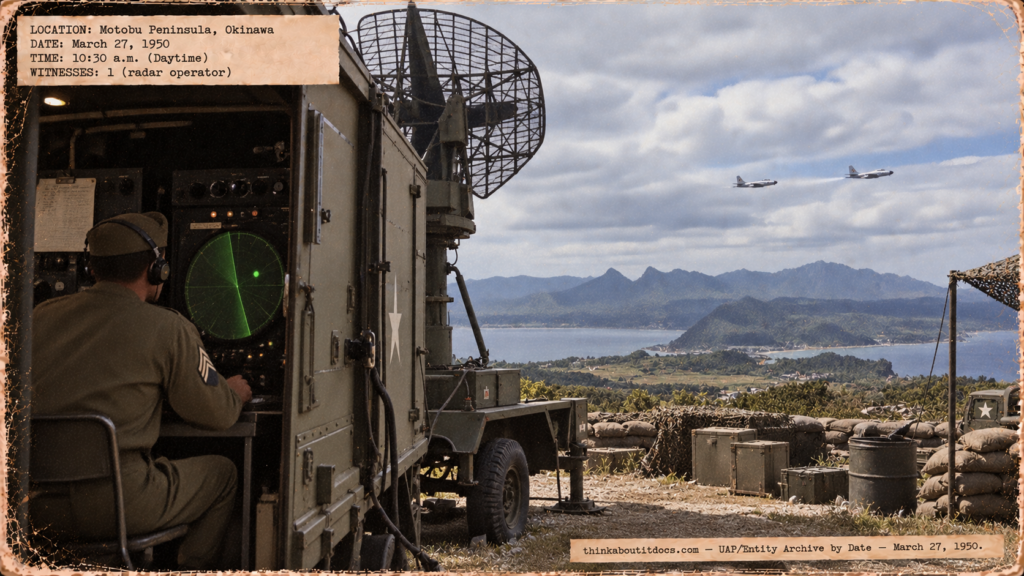
An Army radar operator on Okinawa tracked a stationary target, then a fast southwest run, on March 27, 1950.
THINK ABOUTIT UFO|UAP SIGHTINGS REPORT
1950: Motobu Peninsula, Okinawa Radar UFO, (Blue Book 678)
At 10:30 on the morning of March 27, 1950, an Army radar operator on Okinawa’s Motobu Peninsula picked up a target at 13,000 feet, about 15 to 18 miles away, that did not move. It stayed put for ten minutes. Then it started off on a heading of 220 degrees and covered 16.9 miles in two minutes, about 500 mph, over a mountain, where he lost it. Nothing else on the island’s radar picked it up. The Twentieth Air Force intelligence report notes that one F-80C and four F-80s were flying that morning and could have been seen on the set.
The operator, Cpl. Bolfango of the 65th Antiaircraft Artillery Gun Battalion, was described by his commanding officer as a superior soldier and radar mechanic and “outstandingly reliable and trustworthy.” The Motobu Peninsula, Okinawa radar sighting went to Air Materiel Command in April 1950, and Project Blue Book’s card, written years later, is blunt: UNIDENTIFIED, track not consistent with aircraft, weather and malfunction not considered causes, and, in a parenthesis, the case was never submitted to radar analysts in 1950.
Date: March 27, 1950
Sighting Time: About 10:30 a.m. local (1030 hours; card time group 27/0130Z)
Day/Night: Day
Location: Over the Motobu Peninsula, Okinawa, Ryukyu Islands (first pickup at 26°37′ N, 127°57′ E), observed from a gun park about 15 miles away
Urban or Rural: Rural (military radar site)
No. of Entity’s: Not Applicable
Entity Type: Not Applicable
Entity Description: Not Applicable
Hynek Classification: RV (Radar-Visual; radar tracking with a ten-minute observation period, no separate visual description)
Duration: About 10 minutes observed (stationary, then moving) and about 2 minutes tracked in motion
No. of Object(s): 1
Description of the Object(s): A single radar target that stayed stationary at 13,000 feet for about ten minutes, then moved on a 220-degree heading to a point over a mountain and was lost; speed faster than the operator could track, about 500 mph by the report’s arithmetic
Shape/Size/Color of Object(s): Not described; the observation was by radar; the card lists ground-visual and ground-radar observation
Distance to Object(s): About 15 miles (report) or 18 miles (card) from the radar to the first pickup; the target moved 16.9 miles
Height & Speed: 13,000 feet; stationary for about 10 minutes, then about 500 mph on 220 degrees for 2 minutes over 16.9 miles; last seen at about 26°25′ N at 1040 hours
Number of Witnesses: 1 (Cpl. Bolfango, radar operator, 65th AAA Gun Battalion; other witnesses are not recorded; the spelling of his name follows the file’s enclosure list and NICAP)
Special Features/Characteristics: SCR-584B gun-laying radar (serial No. 754) in good condition; reliable and highly rated operator; stationary target followed by rapid motion; Yontan Mountain radar was out of service and the Motobu radar station did not pick it up; aircraft flying at the time could have appeared on the set; cloud deck at 3,000 to 4,500 feet with nothing near 13,000 feet; enclosures included the operator’s affidavit and statements from an operations officer and a weather officer
Case Status: Unexplained. Project Blue Book’s record card concludes UNIDENTIFIED (NICAP: BBU 678).
Source: Air Intelligence Information Report IR-1-50, Deputy for Intelligence, Twentieth Air Force, Okinawa, 8 April 1950 (Parts I and II), forwarded to Air Materiel Command; Project Blue Book (Project 10073) record card; Berliner; Jan Aldrich
Summary/Description: An Army radar operator on Okinawa tracked a stationary target at 13,000 feet for about ten minutes on March 27, 1950, then watched it move southwest on 220 degrees for 16.9 miles in two minutes, about 500 mph, over a mountain before it was lost. No other radar in the area saw it. Blue Book’s card concludes UNIDENTIFIED: the track was not consistent with aircraft, and weather and malfunction were not considered causes.
Related Cases: Gulf of Mexico B-29 radar case (January 12, 1950); Knoxville, Tennessee, radar returns (March 1-3, 1950); Tampa, Florida, B-29 (February 8, 1950); Holloman AFB radar and photographic program (March 1950)
Detailed Report
The Sighting
Part II of the Twentieth Air Force report gives the detail. At about 1030 hours on March 27, 1950, a radar sighting was made over the Motobu Peninsula at 26°37′ N, 127°57′ E. The weather was 8/10 stratocumulus with bases at 3,000 feet and tops at 4,500 feet, visibility 20 miles, no precipitation, and no clouds at or near 13,000 feet. The sighting station was in a gun park about 15 miles from the point where the object was first sighted. When first sighted the object was stationary. When it started to move its heading was 220 degrees, and its speed after it started moving was about 500 mph, computed from 16.9 miles covered in two minutes. The altitude at first sighting was about 13,000 feet. Only one object was sighted. It was last observed at about 26°25′ N at 1040 hours. It was observed for about ten minutes and tracked by radar for about two minutes after it started to move.
The Operator
Cpl. Bolfango of the 65th AAA Gun Battalion, APO 331, was the radar operator. His commanding officer considered him a superior soldier and radar mechanic and found him at all times outstandingly reliable and trustworthy. He was 36 and had about 15 years of military service, and had been a radar technician for a period that is hard to read in the scan. The set was an SCR-584B, serial No. 754, in good condition. No photographs were taken.
The Checks
The report says one F-80C and four F-80s were flying at the time and could have been picked up by radar. It adds that the Twentieth Air Force radar station on Yontan Mountain was inoperative and that the radar station on the Motobu Peninsula did not pick up the object. The enclosures were the operator’s affidavit and statements from an operations officer and a weather officer, and the report went to Air Materiel Command at Wright-Patterson AFB.
The Card
The Project 10073 card lists a military source, one object, 10 minutes of ground observation and 2 minutes of ground radar, ground-visual and ground-radar observation, and gives the conclusion UNIDENTIFIED. It adds, in parentheses, that the case was not submitted to radar analysts at the time of receipt in 1950, and summarizes: the track was not consistent with aircraft, weather and other causes were not considered as anomalous propagation or malfunction, and the operator was considered reliable. The gun radar picked up an object at 13,000 feet, tracked it southwest to a point over a mountain, and could not track it beyond. The initial pickup remained stationary for ten minutes, the range to that point was 18 miles, the object moved on a heading of 220 degrees for two minutes covering 16.9 miles, additional radar in the area did not pick it up, and its speed was faster than the operator could track.
RESEARCHER’S NOTES
A Target That Sat for Ten Minutes and Then Ran
- Stationary, Then Fast: The oddest feature is the ten-minute stationary phase followed by a fast southwest run. A stationary return that then moves is the pattern the operator used to rule out ground clutter.
- 15 or 18 Miles: The report places the station about 15 miles from the first pickup, and the card says the range was 18 miles. The difference doesn’t change the computed speed, which comes from 16.9 miles in two minutes.
- No Second Radar: The Motobu station’s own radar did not see the target, and Yontan’s was down. The other radar near the site saw nothing, so the track rests on one set.
- A Card Written Later: The card was prepared years after the event, on a 1960s-era form, and notes the case was never sent to radar analysts in 1950. The Air Force’s own reviewers thus reached UNIDENTIFIED without a technical radar evaluation.
- Aircraft Were Flying: The report lists five F-80s as aircraft that could have been detected. It does not say they were ruled out by position or timing, so the card’s statement that the track was inconsistent with aircraft rests on the speed and the stationary phase.
- Army, Not Air Force: The operator served in an Army antiaircraft gun battalion, and the report came through Twentieth Air Force intelligence.
The Okinawa radar case is a clean, single-operator track with a long stationary phase and a fast departure, written up by Air Force intelligence and never sent to radar specialists at the time. It is filed here as Unexplained, in line with Blue Book’s UNIDENTIFIED card, with the caution that it rests on one radar set and one operator.
“Track not consistent with A/C.”
From the Project Blue Book record card for the March 27, 1950 Motobu Peninsula, Okinawa radar sighting.