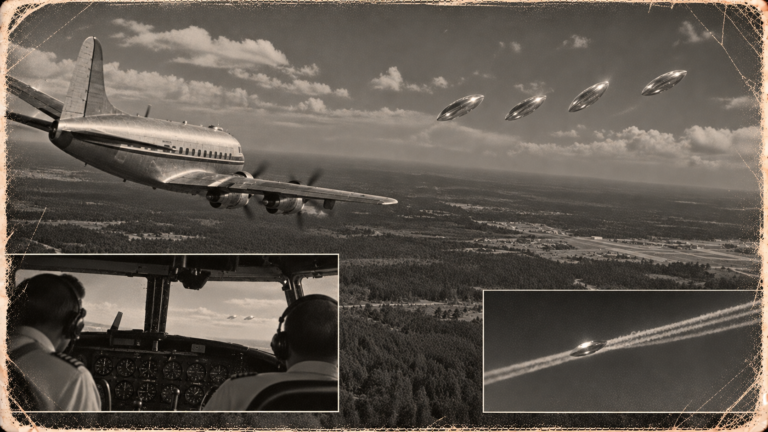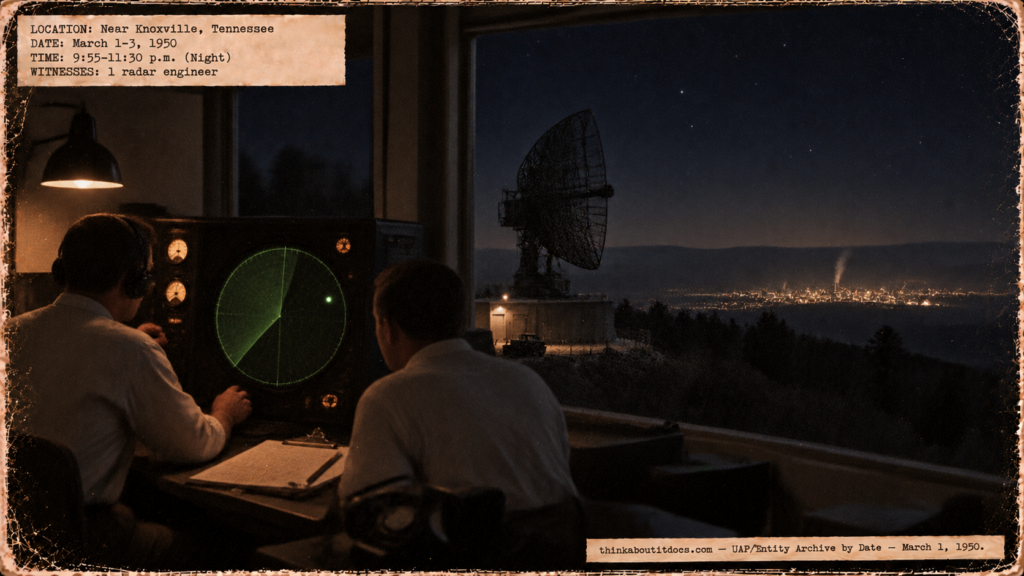
A radar station near Knoxville reported unidentified returns at about 40,000 feet on three successive nights in March 1950.
THINK ABOUTIT UFO|UAP SIGHTINGS REPORT
1950: Knoxville, Tennessee Radar Returns Near Oak Ridge
On the night of March 1, 1950, a radar station near Knoxville, Tennessee, picked up a target at about 40,000 feet to the north-northwest that stayed on the scope for hours. It came back the next night and again on March 3, and the man who reported it, the chief of engineers at the station, told the Atomic Energy Commission’s security chief at Oak Ridge. The AEC was worried enough to ask Smyrna AFB whether any aircraft could explain it and to ask the Army and the Air Force for a qualified radar operator to check the equipment.
The Air Force’s Office of Special Investigations wrote it up on March 6 as a memorandum headed “Radar Equipment in Knoxville, Tennessee Indicates Unidentified Objects in Vicinity of Oak Ridge.” Project Blue Book’s card is less dramatic. It lists the Knoxville, Tennessee radar returns as probable ground returns from a temperature inversion, plus a third-night report of an aircraft, and notes that no weather data was included.
Date: March 1, 2 and 3, 1950
Sighting Time: March 1, 2155 to 2330 hours; March 2, about 1155 hours and 2000 hours; March 3, 1035 hours (the card gives 1 hour 55 minutes for the first night)
Day/Night: Night (first two reports) and day (third)
Location: Near Knoxville, Tennessee, USA, on a radar set at a radar station apparently operated by a local radio station (call letters partly illegible in the scan); targets north-northwest of Knoxville, in the direction of Oak Ridge
Urban or Rural: Urban (radar station near a city)
No. of Entity’s: Not Applicable
Entity Type: Not Applicable
Entity Description: Not Applicable
Hynek Classification: RV (radar only; no visual sighting)
Duration: 1 hour 55 minutes on the first night per the card (2155 to 2330 is 1 hour 35 minutes); duration not stated for the other reports
No. of Object(s): 1 on March 1, 1 (then 2) on March 2, 1 on March 3
Description of the Object(s): Radar returns, stationary on the first two nights and moving slowly on the third, at 40,000 feet or higher
Shape/Size/Color of Object(s): Not described; on March 3 the return was judged about the size of a C-47 aircraft
Distance to Object(s): About 16 miles (scan partly illegible)
Height & Speed: About 40,000 feet on March 1 and 3, and given as 80,000 feet for two objects on March 2 (the figure is unclear in the scan); bearings from about 344 to 352 degrees on March 1, 310 degrees on March 2, 320 degrees on March 3; about 200 mph on March 3; no speed or direction on the first two nights
Number of Witnesses: 1 radar station engineer (name partly illegible in the scan), described as highly dependable with a local reputation and a radar experimentation background from before and during World War II, reporting to the AEC Security chief at Oak Ridge
Special Features/Characteristics: Radar sightings on three successive nights from the same quadrant; report relayed through the AEC Security Division at Oak Ridge; no flight plans that would account for aircraft (Smyrna AFB, 14th Air Force); doubts about the radar set’s efficiency; AEC asked for a qualified operator and equipment
Case Status: Explained. Project Blue Book’s card concludes A/C (third report) and “Probable Ground Returns.”
Source: Memorandum, Headquarters USAF, Office of Special Investigations, Washington, 6 March 1950, “Radar Equipment in Knoxville, Tennessee Indicates Unidentified Objects in Vicinity of Oak Ridge”; Project Blue Book (Project 10073) record card; Project Blue Book summaries
Summary/Description: A radar station near Knoxville reported unidentified targets at about 40,000 feet on the nights of March 1, 2 and 3, 1950, in a direction toward Oak Ridge. The AEC Security chief could find no aircraft to account for them and doubted the set’s efficiency, and the Army and Air Force discussed sending a qualified operator. Blue Book’s card concludes probable ground returns from an inversion, plus an aircraft on March 3.
Related Cases: Oak Ridge, Tennessee, fireball (January 14, 1950); Selfridge AFB, Michigan, radar case (March 3 and 9, 1950); Okinawa radar case (March 27, 1950); Gulf of Mexico B-29 radar case (January 12, 1950)
Detailed Report
The First Report
According to the OSI memorandum, information reached the Air Force through the G-2 of the Third Army at Fort McPherson and the CIC district commander at Maxwell AFB. The chief of engineers of a radar station near Knoxville, apparently operated by a local radio station (the call letters are partly illegible), reported to the AEC’s Security Division chief at Oak Ridge that, between about 2155 and 2330 on March 1, the station’s radar had picked up an unidentified object at about 40,000 feet, bearing approximately 344 to 352 degrees from Knoxville at a distance of about 16 miles. The radar ran on a frequency of roughly 19,000 megacycles (the scan is partly illegible). Its speed and direction were undetermined.
The Checks
The AEC Security Division chief checked with Smyrna AFB, which reported no flight plans that would indicate a plane at that location and altitude. The Third Army checked with the Fourteenth Air Force with negative results.
March 2 and 3
A report on March 2 indicated the station had picked up an object in approximately the same location at about 1155 hours, and another indicated that at 2000 hours the same day two unidentified objects had appeared at an altitude given as 80,000 feet (the scan is unclear) on a bearing of 310 degrees from Knoxville, with no speed or direction and no flight plans reported. At 1035 on March 3 the same source reported one object at about 40,000 feet, 320 degrees from Knoxville, on the same frequency, at about 200 mph, size approximately that of a C-47, without a determined direction.
The Doubt About the Set
The AEC Security chief was not certain of the radar unit’s operating efficiency and asked Smyrna AFB for a qualified radar operator. Smyrna had none, but the CIC suggested the Third Army send one to check the equipment. An Air Force liaison officer asked Wright-Patterson AFB for an adequate radar set to be sent to Knoxville, and was told it would not send radar sets if they could be supplied locally. The Third Army reported it had no qualified radar operators. The memo adds that the station engineer who made the sightings had a local reputation in Knoxville for being highly dependable, having been an engineer in radar experimentation before and during World War II.
The Card
The Project 10073 card covers March 1, 2 and 3 and lists an Army radar source, several objects, 1 hour 55 minutes of observation, and a course of stationary on the first night, not reported on the second, and moving on the third. Its conclusion is A/C (third report) and “Probable Ground Returns,” with the remark that returns on three successive nights from the same quadrant were probably ground returns from an inversion, and that the March 3 report was probably an aircraft. It says the first two nights’ stationary returns were likely ground targets because of their long duration, that no weather data was included, and that there should have been an inversion in the area for this to be the cause.
RESEARCHER’S NOTES
Three Nights on the Scope, and a Set Nobody Could Check
- Two Explanations, Two Nights: Blue Book splits the case: the March 1 and 2 returns were probably ground clutter from an inversion, and the March 3 return was probably an aircraft. The file contains no weather data to check the first.
- A Doubted Instrument: The AEC Security chief questioned the radar’s efficiency, and no qualified operator was available from Smyrna or the Army. The memo shows the Air Force and the AEC had trouble finding someone to check the set, which is part of why Blue Book settled on ground returns.
- Oak Ridge Context: The AEC’s interest came from Oak Ridge’s security role. Bearings north-northwest of Knoxville do not point at the plant itself, but the memo’s subject line ties the targets to the Oak Ridge vicinity.
- Altitude Figures: The scan makes the March 2 altitude hard to read, and the Air Force’s own summaries give 40,000 to 80,000 feet overall.
- Duration Discrepancy: The card gives 1 hour 55 minutes for the first night, while the memo’s times of 2155 to 2330 add up to 1 hour 35 minutes.
- A Civilian Station: The station appears to have been a civilian operation run by a local radio station, and the memo does not say what it was used for. That leaves the nature of the radar, and its calibration, unknown.
The Knoxville radar returns are an early example of the Air Force’s pattern of weighing a radar report against the radar itself: three nights of returns, a doubted set, no qualified operator and no weather data, and a Blue Book conclusion of probable ground returns and aircraft. It is filed here as Explained, with the plain note that the explanation could not be tested from the file.
“Returns on 3 successive nights from same quadrant.”
From the Project Blue Book record card for the March 1-3, 1950 Knoxville, Tennessee radar reports.