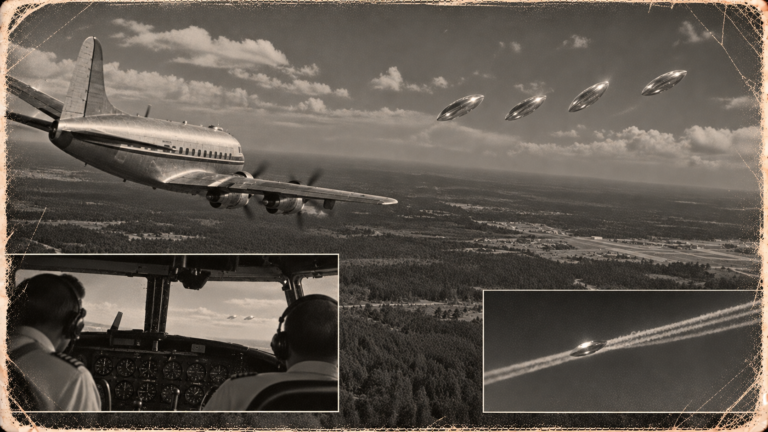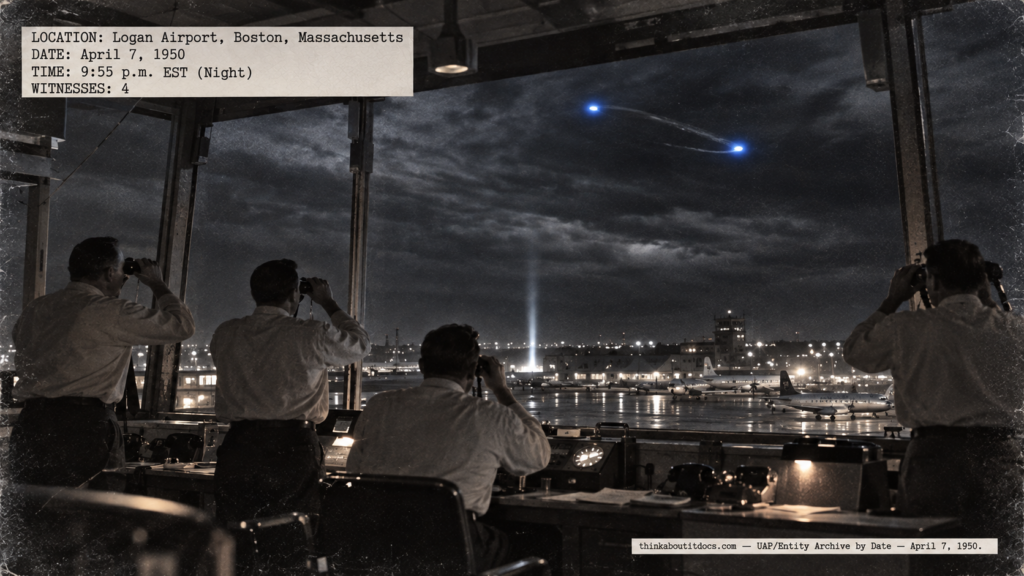
Four Logan Airport controllers watched a blue light split into two and revolve on the night of April 7, 1950.
THINK ABOUTIT UFO|UAP SIGHTINGS REPORT
1950: Logan Airport, Boston UFO, Blue Lights That Split
At 9:55 on a windy night, April 7, 1950, the watch supervisor in the CAA control tower at Boston’s Logan Airport noticed a light due west that was the wrong color for any aircraft: a deep, unconventional blue. Through binoculars it was a blurred, elliptical pattern of light with no definable body, moving southwest to northeast at about the speed of an airplane. It turned sharply white, went back to blue, and then split into two blue lights that revolved around each other like two small searchlights at play, climbing from 15 to 45 degrees. Three other controllers confirmed it. Before it finished, an object he described as having definite mass glowed red like a molten mass of metal for 10 to 15 seconds.
The supervisor was no novice. He had learned to fly in 1936, served as a squadron commander in the Southwest Pacific and was an Air National Guard lieutenant colonel. He went through the explanations in his written statement and found none that fully satisfied him, and he submitted the Logan Airport, Boston UFO sighting despite the risk of ridicule. Project Blue Book’s card gives the answer as inversion effects, with ice clouds and thin cirrus distorting lights of unknown source. NICAP, citing Hynek’s UFO Report, lists the case as a Blue Book unknown, which the card does not support.
Date: April 7, 1950
Sighting Time: About 9:55 p.m. EST (2155) to about 10:15 p.m. (2215)
Day/Night: Night
Location: CAA control tower, Logan International Airport, Boston, Massachusetts, USA; the lights were west of the tower and moved to the northeast
Urban or Rural: Urban
No. of Entity’s: Not Applicable
Entity Type: Not Applicable
Entity Description: Not Applicable
Hynek Classification: NL (Nocturnal Light)
Duration: About 20 minutes (the card; the statement gives 2155 to 2215)
No. of Object(s): 1, dividing into 2; a separate red object later
Description of the Object(s): A deep-blue, elliptical pattern of light with blurred edges and no definable mass, which turned sharply white, returned to blue, divided into two blue lights revolving around each other, climbed from 15 to 45 degrees elevation, then went white and passed a ceilometer light on a horizontal course; later an object glowing red like molten metal for 10 to 15 seconds
Shape/Size/Color of Object(s): No shape visible, only a light with blurred edges; size not estimated; blue, white and cherry red
Distance to Object(s): Not determined
Height & Speed: About 15 degrees above the horizon at first and 45 degrees later; altitude undetermined; moved southwest to northeast at about the speed of a conventional aircraft
Number of Witnesses: 4 CAA tower controllers, all holders of Senior Airport Traffic Controller ratings (the watch supervisor and three others; the names are blacked out; NICAP names the supervisor Connelly)
Special Features/Characteristics: Experienced military and civil aviation observers; binoculars; ceilometer used as a fixed reference; Squantum and Bedford towers checked for traffic; an inbound Northeast Airlines flight asked to look and saw nothing; weather 16,000-foot overcast, visibility 15-plus, temperature 38, dew point 13, northeast wind 29 with gusts to 43 mph; a Pan American Clipper had reported heavy icing through the overcast an hour earlier
Case Status: Explained. Project Blue Book’s card concludes Other (Inversion effects). The reporting supervisor called the meteorological explanation not completely satisfactory.
Source: Statement of the CAA watch supervisor, Logan Tower (sworn account in the Project Blue Book file); Project Blue Book (Project 10073) record card; NICAP 1950 UFO Chronology (Hynek, The UFO Report, pp. 65-68)
Summary/Description: At about 9:55 p.m. on April 7, 1950, four controllers in the Logan Airport tower watched a deep-blue elliptical light change to white and back, split into two blue lights revolving around each other, and later saw an object glow red like molten metal. Blue Book’s card attributes it to inversion effects and ice clouds.
Related Cases: Kokomo, Indiana (April 8, 1950); Fort Monmouth, New Jersey (April 14, 1950); Teaticket, Massachusetts (February 5, 1950); Westover AFB, Massachusetts (December 6, 1950)
Detailed Report
The Tower
The watch supervisor wrote that he was on duty at Logan on the night of April 7 with three other controllers, all holding senior ratings. The weather at 2130 EST was a 16,000-foot overcast, visibility more than 15 miles, temperature 38 and dew point 13, with a northeast wind of 29 mph and gusts to 43. At about 2155 he noticed a light due west of the tower that caught his attention because of its deep blue color, and he put binoculars on it to see what aircraft would show so unorthodox a light. Even through the glasses it had no clearly definable mass and seemed to be an elliptical pattern of light, blurred at the edges. It moved from southwest to northeast at what seemed a conventional speed, about 15 degrees above the horizon at first.
The Changes
As he watched, the light changed from deep blue to a sharply distinct white. He called the other controllers, who confirmed what he saw. By then it had returned to deep blue. The single blue light then appeared to dissolve into two blue lights that began to revolve around each other like two small searchlights at play, and their path carried them from 15 to 45 degrees above the horizon. He was about to accept them as searchlights, despite the absence of beams and a ceiling too high to show a spot, when one of the blue lights, now all white, passed the ceilometer light northwest of the tower, which he used as a fixed reference, on a horizontal course at a conventional rate of speed and was lost to the northeast.
The Red Object
The tower immediately checked with Squantum and Bedford towers for traffic. The only reported traffic was a plane on the base leg at Bedford. During the check, an object of what he called definite mass appeared suddenly, glowing red like a molten mass of metal, for about 10 to 15 seconds, again about 45 degrees above the horizon. An inbound Northeast Airlines flight was asked to make a wide approach to look for anything unusual between the airport and ten or so miles west, and its report was completely negative. The whole sequence lasted from about 2155 to 2215.
His Own Evaluation
The supervisor wrote that he had rigorously explored whether the experience was subjective and found the fact that four people saw the same thing argued against it. He said that an aircraft of any known type was not admissible. He described his background: he had learned to fly in 1936, graduated from the Air Force Intelligence school in 1942, served as a squadron commander and director of air support for the Fifth Air Force in the Southwest Pacific for two years, graduated from the short course at the Air Command and Staff School in 1949, and was then Deputy Group Commander of an Aircraft Control and Warning Group in the Air National Guard with the rank of lieutenant colonel. He rejected searchlights because he twice saw mass, once when the object glowed white and passed the ceilometer and again when it glowed cherry red, and because a light powerful enough to cast a spot at 16,000 feet would show a beam. The only solution that seemed acceptable, he wrote, though he did not know whether it was tenable, was stellar coronae or some other luminous hydrometeor, since the thin overcast was moving at tremendous speed and a Pan American Clipper had reported a heavy load of ice an hour earlier. He added that the theory was not completely satisfactory. He said no formal report was made at the time because so many reports came from irresponsible or hysterical sources and one hesitates to solicit ridicule, but that he submitted this one because it closely resembled what others had seen elsewhere.
The Card
The Project 10073 card records the date as April 7, 1950 (time group 0255Z on April 8), the source as civilian, one object observed for 20 minutes from the ground, and the conclusion as Other (Inversion effects): ice clouds and thin cirrus clouds, with distortion of natural phenomena or lights from an unknown source (stellar, aircraft or ground lights). Its summary notes a light in the west seen by a tower operator through binoculars, with no visible shape, blurred edges, movement from southeast to northeast at the speed of conventional aircraft, color changing from blue to white and back to blue before separating into two distinct blue lights rotating around each other, and elevation increasing from 15 to 45 degrees.
RESEARCHER’S NOTES
A Blue Light That Split in Two, and a Supervisor Who Doubted His Own Answer
- The Time of Day: Some listings give 16:55. The statement and card put the sighting at about 9:55 p.m. EST, with the card’s time group of 0255Z on April 8.
- Not a Blue Book Unknown: NICAP’s BBU tag follows Hynek’s treatment of the case. The Blue Book card concludes Other (Inversion effects), and the file contains no unidentified conclusion.
- A Skeptical Witness: The supervisor tried searchlights, subjective experience and aircraft before settling on a meteorological explanation he called not completely satisfactory. That is more candid than most reports.
- Four Observers, Two Colors of Mass: The statement turns on seeing mass twice: once when the object glowed white while passing the ceilometer, once when it glowed cherry red. A pattern of light would not do that.
- What an Inversion Could Do: Ice crystals in a moving thin overcast, with strong winds and gusts to 43 mph, can distort distant lights. The card’s reading is plausible, but the file contains no analysis of which lights were involved.
- Late Report: The tower did not report it at the time. The supervisor wrote it up afterward, after concluding it resembled what others had seen, which is why the file has a clean, first-person account.
The Logan sighting is a careful report by an unusually well-qualified observer, and Blue Book’s answer, inversion effects distorting lights through ice clouds, is the one the observer himself half accepted. It is filed here as Explained, with the caution that the file never identifies the lights and that the supervisor never fully trusted the explanation.
“…glowing red like a molten mass of metal.”
From the CAA watch supervisor’s statement on the April 7, 1950 Logan Airport sighting.