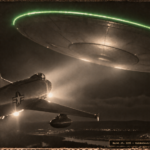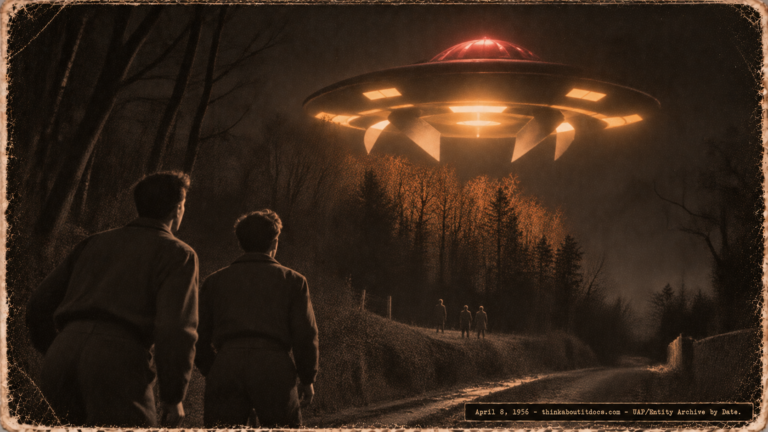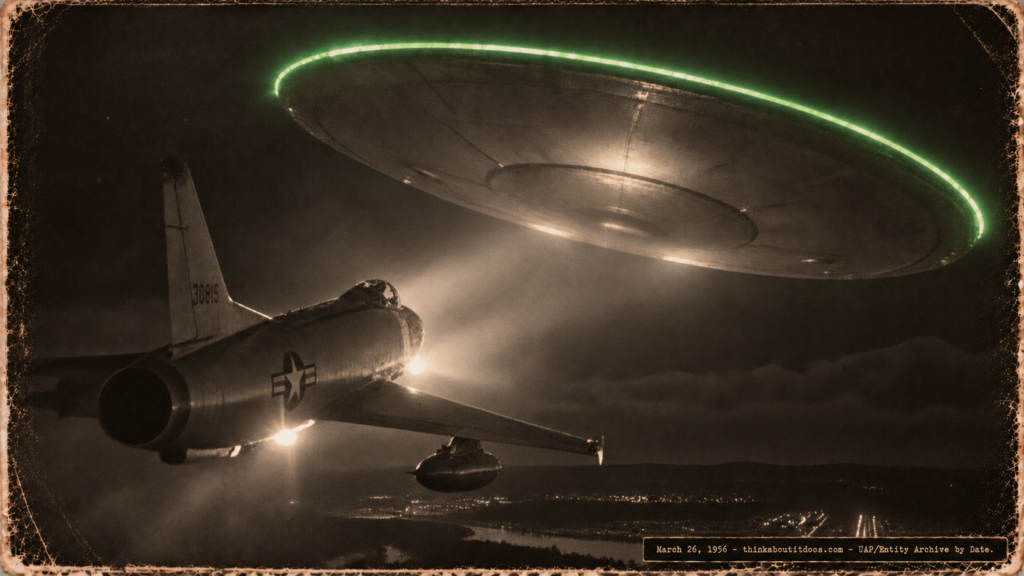
Westover AFB, Massachusetts, March 26, 1956: a USAF pilot illuminated this 100–150-foot disc with green edge glow before it climbed to 30,000 feet and vanished.
THINK ABOUTIT UFO|UAP SIGHTINGS REPORT
1956: Westover AFB, Massachusetts: A Disc at Landing-Light Range
At 9:17 p.m. on March 26, 1956, an unidentified blip appeared on the radar scope at Westover Air Force Base tower, Massachusetts. Jets were scrambled and vectored toward the contact. The lead interceptor pilot, identified in the source only as Captain E______, closed on a large round object and turned on his landing lights — the standard technique for visual identification at close range. The object he illuminated was round, estimated at 100 to 150 feet across, 8 to 12 feet thick at the center, and carried a green fluorescent glow around its outer edge. As the pilot tried to close further, the disc climbed steeply and disappeared at 30,000 feet.
This is the most dramatic of the March 1956 cases: tower radar, a scramble, a vectored intercept, a close-range illumination, a detailed object description and a rapid departure. It would rank among the strongest American military intercept cases of the decade — if it stood on more than one source. Major Donald Keyhoe reported it in Flying Saucers: Top Secret (1960). The pilot’s name is not given; no Blue Book file has been publicly identified. The page carries the full report as Keyhoe described it, with the sourcing gap clearly flagged.
Date: March 26, 1956
Sighting Time: 9:17 p.m.
Day/Night: Night
Location: Westover Air Force Base, Massachusetts, and surrounding airspace
Urban or Rural: Military air base; rural western Massachusetts airspace
No. of Entity(‘s): Not Applicable
Entity Type: Not Applicable
Entity Description: Not Applicable
Hynek Classification: RV (Radar-Visual): tower radar contact and visual observation by an interceptor pilot
Duration: Unknown; the intercept lasted long enough for the pilot to illuminate the object and attempt to close before it climbed away
No. of Object(s): 1
Description of the Object(s): A large round disc, 100 to 150 feet in diameter and 8 to 12 feet thick at its thickest central point. The outer edge glowed with a green fluorescent light. Visible when illuminated by the aircraft’s landing lights.
Shape/Size/Color of Object(s): Round disc; 100 to 150 feet diameter; green fluorescent glow at outer edge
Distance to Object(s): Close enough to illuminate with landing lights (typical landing-light useful range is a few hundred yards)
Height & Speed: Altitude at intercept not given. Climbed steeply to 30,000 feet and disappeared. Climb rate not given numerically.
Number of Witnesses: Westover tower radar personnel (unnamed), unnamed radioman, plus the lead interceptor pilot (Captain E______). Additional pilots in the scramble not specified.
Special Features/Characteristics: Tower radar contact preceded the visual. The pilot used landing lights for visual identification. The disc climbed to 30,000 feet and vanished rather than maintain altitude or speed away horizontally. Green fluorescent outer-edge glow.
Case Status: Unverified (single source; pilot unnamed; no Blue Book file publicly identified)
Source: Donald Keyhoe, Flying Saucers: Top Secret (1960), pages 78–79
Summary/Description: Westover AFB tower radar tracked an unknown blip; jets scrambled. Lead pilot Captain E______ closed to landing-light range and illuminated a round, 100–150-foot disc with a green fluorescent outer edge before it climbed to 30,000 feet and disappeared.
Related Cases: 1956: March UFO|UAP & Entity Sightings Archive
Detailed Report
Westover Air Force Base in Chicopee, Massachusetts, was in 1956 one of the largest Strategic Air Command bases on the East Coast. According to Major Donald Keyhoe’s 1960 account, at 9:17 p.m. on March 26, 1956, a strange blip appeared on the Westover tower radar scope. The tower operator and a radioman noted the contact and jets were quickly scrambled. Ground controllers vectored the flight toward the circling target.
The lead interceptor pilot, identified in Keyhoe’s account only as Captain E______, closed on the contact. When he was close enough, he activated his landing lights. The light revealed a large round object. The pilot estimated it at 100 to 150 feet in diameter and 8 to 12 feet thick at its center. Around the outer edge of the disc ran a green fluorescent glow. As Captain E______ tried to close the remaining distance, the object climbed steeply and disappeared at 30,000 feet. Keyhoe’s account notes that a tower operator, a radioman and the jet pilot are all named in the original report, though Keyhoe publishes only the pilot’s rank and partial name.
RESEARCHER’S NOTES
One of the Best Intercept Stories of the Decade — With a One-Source Problem
- Keyhoe as sole source: Major Donald Keyhoe was one of the most influential American UFO researchers of the 1950s and a retired Marine Corps aviator. He had contacts inside the military and wrote about cases his sources considered genuine. He also sometimes reported details that no other source can verify. Flying Saucers: Top Secret (1960) is a secondary account; the primary document would be the original tower and pilot report that Keyhoe’s source gave him.
- Unnamed pilot: Keyhoe’s use of “Captain E______” is typical of his practice of protecting Air Force sources. If the underlying report exists, the full name would be in it. A pursueindex search for March 26, 1956, Westover AFB, Massachusetts, would either locate the Blue Book file or confirm its absence.
- What makes it credible if true: The sequence — tower radar blip, scramble, vectoring, landing-light visual identification, structured object with specific dimensions, colored edge lighting and a steep rapid departure — is internally consistent and matches the pattern of documented military intercept cases from this period. None of its elements are implausible in isolation.
- What it needs: A Blue Book file or any independent record naming the tower operator, radioman or pilot would move this from “compelling Keyhoe account” to a well-documented case. Until that search is done, the single-source status prevents it from being treated as confirmed.
- No RV classification upgrade yet: Although the case is listed as RV (tower radar plus pilot visual), both halves of that designation rest on the same uncorroborated source. The classification is the correct one if the account is accurate; it is flagged here because the verification step has not been completed.
Westover 1956 stands as one of the most dramatically reported intercept cases of the decade. If the Blue Book file or an independent record exists, this becomes a strong candidate for in-depth treatment. Until then, it stays in the archive as an important but unverified account — reported by a credible investigator, detailed enough to be specific, and still waiting for primary confirmation.
“Flying the lead interceptor, Captain E______ closed in on a large round object, near enough to illuminate it with his landing lights.”
Donald Keyhoe, Flying Saucers: Top Secret (1960), pp. 78–79