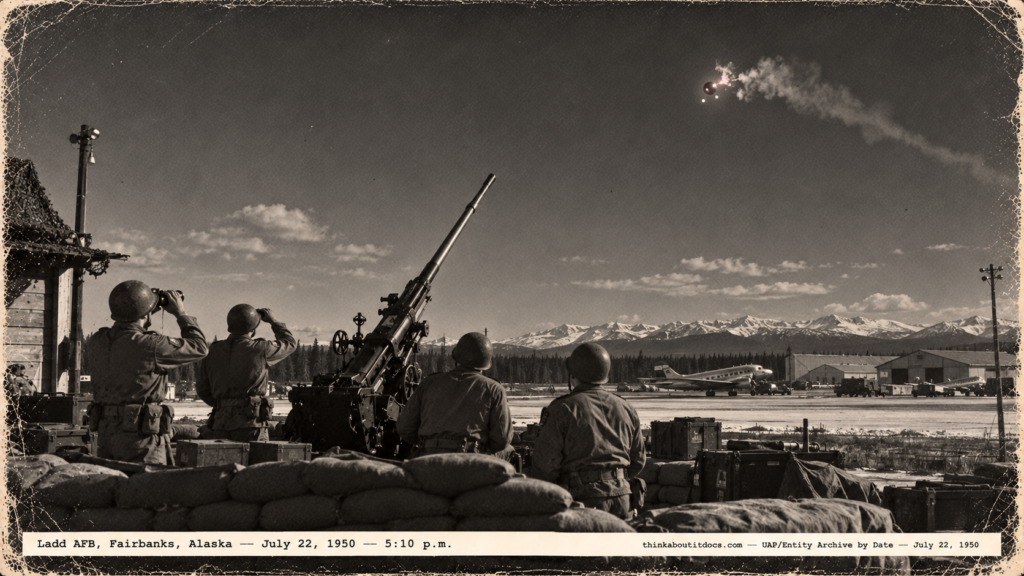
On July 22, 1950, soldiers at Ladd AFB watched a red object with two white dots drift down for 20 minutes before it exploded.
THINK ABOUTIT UFO|UAP SIGHTINGS REPORT
1950: Ladd AFB, Fairbanks, Alaska — The Red Object That Exploded
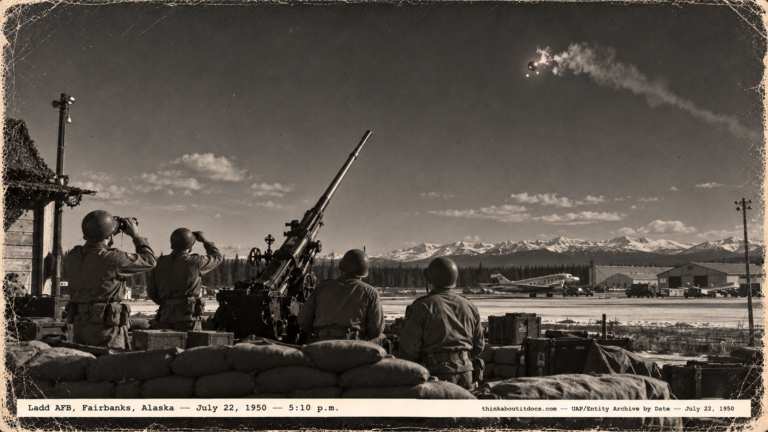
At 5:10 p.m. Alaska time on July 22, 1950, soldiers manning anti-aircraft gun positions beside the airstrip at Ladd Air Force Base, Fairbanks, saw a round red object high in the sky with two white dots beneath it that seemed to revolve around it. It drifted from east to west, slowly descending in a clear sky for about 20 minutes. Then a stream of smoke appeared, and the object exploded and disappeared.
The Alaskan Air Command’s intelligence report called the witnesses very reliable but said the truth of the incident could not be evaluated with dependable objectivity, and floated a meteorological balloon that might have drifted in from another station. The Air Force card closes the Ladd AFB UFO case as Balloon (Exploding). It is the second Ladd AFB report of 1950 in this archive, after the May 10 sighting.
Date: July 22, 1950 (Saturday)
Sighting Time: 5:10 p.m. Alaska time (card: 23/0310Z, July 23)
Day/Night: Day (CAVU weather)
Location: Ladd Air Force Base, Fairbanks, Alaska; seen from AAA gun positions near the base airstrip
Urban or Rural: Military base
No. of Entity’s: 0 — Not Applicable
Entity Type: Not Applicable
Entity Description: Not Applicable
Hynek Classification: DD (daylight disc)
Duration: 20 minutes
No. of Object(s): One
Description of the Object(s): Red, round, with two white dots underneath that seemed to revolve around it; no visible means of support or propulsion, no sound, no air ducts, no antennae or protuberances; a stream of smoke, then an explosion and disappearance
Shape/Size/Color of Object(s): Round; about 3 feet in diameter by estimate; red, with two white dots (the report says they looked like reflectors); construction unknown
Distance to Object(s): Not stated; viewed laterally from the gun positions at an angle of 50 to 70 degrees and appeared very high
Height & Speed: Very high; moved east to west at an unknown speed in a direct line, slowly descending, nearly stationary at the end
Number of Witnesses: Several: soldiers of an anti-aircraft artillery battery at Ladd AFB (names redacted), all with aerial observation training and judged very reliable by the investigating officer
Special Features/Characteristics: Exhaust, if any, evaporated very rapidly; no known aircraft in the vicinity; area weather stations reported no devices sent aloft
Case Status: Balloon (Exploding) per the Project 10073 card; Alaskan Air Command evaluation B-6 (source reliable, truth cannot be judged)
Source: Project 10073 Record Card; Alaskan Air Command Intelligence Report 17-50, as summarized in an Air Intelligence Information Report from Hq USAF, September 1950
Summary/Description: Soldiers at Ladd AFB watched a red object with two white dots drift down for 20 minutes before it smoked and exploded.
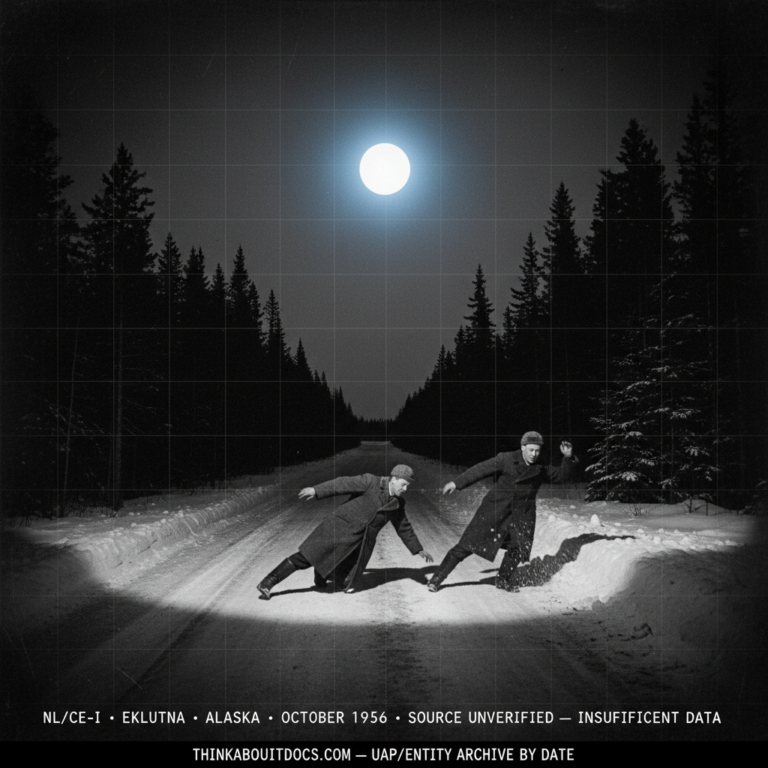
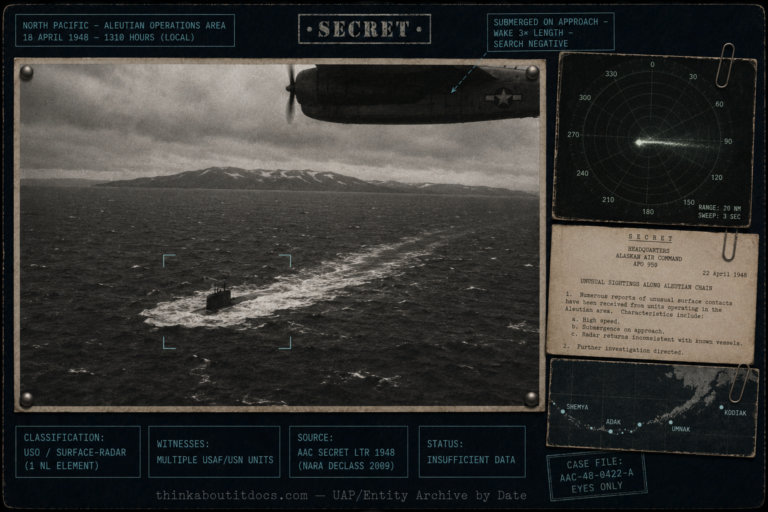
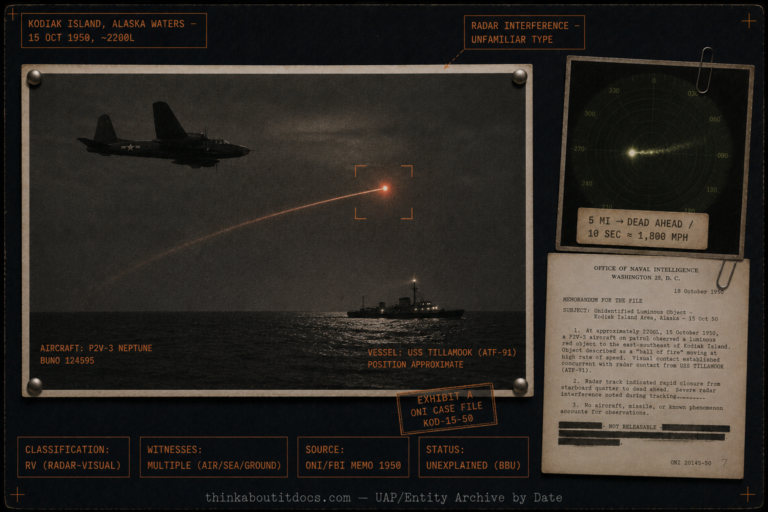
Related Cases: Ladd AFB, Alaska, May 10, 1950; Fairbanks, July 1, 1950 (flash announced as a meteor)
Detailed Report
The sighting. According to the Alaskan Air Command report, at 1710 hours Alaska time on July 22, 1950 an unidentified object was sighted over Ladd Air Force Base by personnel manning anti-aircraft gun positions near the airstrip, and it remained in sight for twenty minutes. It was viewed laterally from the gun positions at an angle of 50 to 70 degrees and appeared very high.
The description. The object was red with two white dots underneath that seemed to revolve around it, round, about three feet in diameter, of unknown construction. It moved from east to west at an unknown rate in a direct line with no evasive action, slowly descending. Any exhaust it emitted evaporated very rapidly. The two white dots appeared to be reflectors. The report lists no visible means of support, no visible means of propulsion, no audible sound, no apparent air ducts and no evidence of radio antennae or irregular protuberances. After the object had been almost stationary for about twenty minutes, a stream of smoke was noted, and immediately afterward the object exploded and disappeared.
The investigation. The observers were soldiers of a battery of an anti-aircraft artillery unit stationed at Ladd, all considered very reliable by the investigating officer and trained in aerial observation. The weather was clear and visibility unlimited. There were no known aircraft in the vicinity, and all weather stations contacted reported no testing devices sent aloft at that time.
The evaluation. The Alaskan Air Command comment said the sources of information were considered reliable, but the truth of the incident could not be evaluated with dependable objectivity, and no material interpretation could be offered as to the origin or nature of the object. It said the objects might have been meteorological balloons that floated into the area from another station in the Territory of Alaska, or possibly some kind of terrestrial body. Alaskan Air Command evaluated the report B-6 and forwarded the original, Intelligence Report 17-50, to the Director of Intelligence, USAF, in Washington on September 13, 1950. The Project 10073 card concludes Balloon (Exploding) and adds that the observation was in daylight and the observer witnessed an exploding balloon.
RESEARCHER’S NOTES
A Reliable Source and an Unverified Explanation
- The balloon theory: Both the Alaskan Air Command and Blue Book rest the balloon explanation on possibility, not on a balloon launch record; the same report notes that area weather stations sent nothing aloft.
- The exploding finish: A balloon can burst at altitude, which is the Air Force reading, but a red object with two revolving white dots and a smoke stream before bursting is a particular description, and the file does not match it to a specific balloon type.
- Reliability grade: The B-6 evaluation means a usually reliable source with information whose truth cannot be judged, which is the Air Force saying it did not know.
- Duration: Twenty minutes of nearly stationary visibility is long for a short-lived burst object, though a slowly descending balloon could drift for that long.
- Other Ladd reports: May 10 at Ladd AFB involved gray spheres seen by many personnel; no connection to this case is established.
The Ladd AFB case is a clear, plain report from trained observers and a cautious intelligence comment. Blue Book fit it to the closest conventional category and recorded no launch. The description and the explanation both stand in the file, side by side.
“the truth of the incident cannot be evaluated with dependable objectivity”
— Alaskan Air Command Intelligence Report 17-50, summarized by Hq USAF, September 1950