A July 1950 Navy memo relayed a fourth-hand story that an Army officer from Hanford collected a small saucer-shaped object.
THINK ABOUTIT UFO|UAP SIGHTINGS REPORT
1950: Horse Heaven Hills, Washington
The Saucer Object and the Army Officer From Hanford
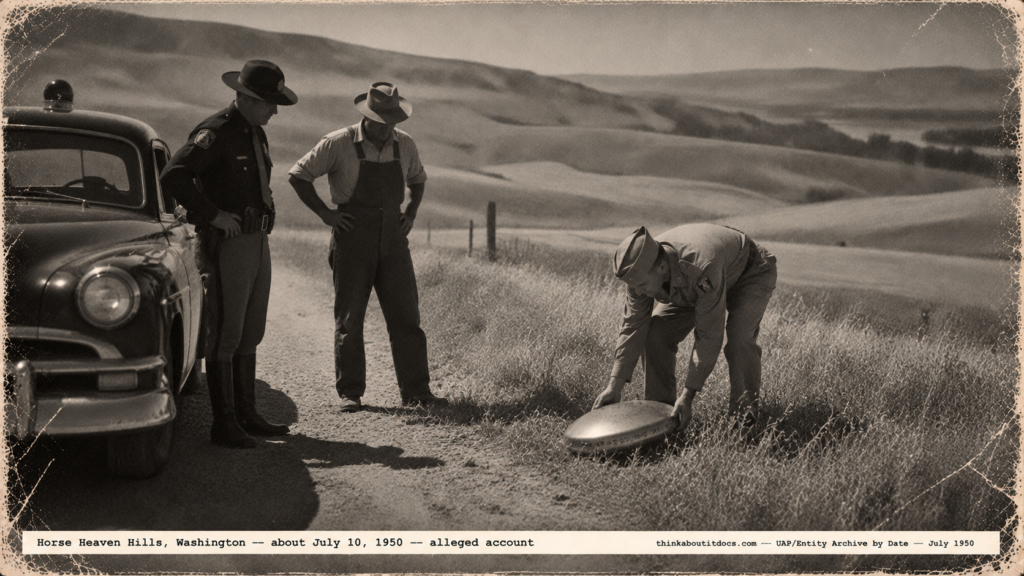
On July 26, 1950, a Navy lieutenant in Pullman, Washington wrote to the 13th Naval District’s intelligence officer about something a college police chief had told him two days earlier. According to the chief, a State Patrol officer in the Horse Heaven Hills had been called about two weeks before by an excited citizen who had found a strange saucer-shaped metal object with writing on it, and an Army officer from the Hanford Atomic Project had arrived and quickly taken it away.
The officer was then said to have told the patrolman that flying saucers come in three sizes, up to 250 feet across, that some are piloted, are atomic-powered, can reach 3,600 miles per hour, and are launched from Hanford. This Pullman, Washington flying saucer report is fourth-hand hearsay with no object produced, and the lieutenant’s real concern was whether the officer had broken security. It is preserved here as documentary evidence of what was being repeated in July 1950.
Date: About July 10, 1950 (estimated from “about two weeks ago” in a conversation on July 24); memo dated July 26, 1950
Sighting Time: Not stated
Day/Night: Not stated
Location: Horse Heaven Hills, Washington State; the memo was written in Pullman and refers to the Hanford Atomic Project at Richland
Urban or Rural: Rural
No. of Entity’s: 0 — Not Applicable
Entity Type: Not Applicable
Entity Description: Not Applicable
Hynek Classification: Not Applicable (hearsay report of a recovered object, no sighting)
Duration: Not Applicable
No. of Object(s): One reported object, recovered, never produced
Description of the Object(s): A strange, saucer-shaped metal object with written material on it that the finder and the patrolman followed
Shape/Size/Color of Object(s): About 6 inches thick and 20 inches across, as relayed; color not stated
Distance to Object(s): Not Applicable
Height & Speed: The officer reportedly claimed saucers could travel as fast as 3,600 mph; not applicable to the object found
Number of Witnesses: Claimed: a citizen who found the object, a State Patrol officer and an Army officer; the memo has only a fourth-hand relay
Special Features/Characteristics: Alleged retrieval by an Army officer from the Hanford Atomic Project; a Reader’s Digest article of July 1950 with a security warning is cited in the memo
Case Status: Insufficient Data (Project 10073 Record Card); hearsay, unverified
Source: Project 10073 Record Card; memorandum, Lt. Rolland L. Soule, USNR-O, to the District Intelligence Officer, 13th Naval District, July 26, 1950
Summary/Description: A fourth-hand report that an Army officer from Hanford collected a small saucer-shaped object found in the Horse Heaven Hills.
Related Cases: None identified in the archive
Detailed Report
The memo. The memorandum is dated July 26, 1950, written by Lt. Rolland L. Soule, USNR-O, in Pullman, Washington, and addressed to the District Intelligence Officer, 13th Naval District. Soule says the information was given to him confidentially by Lt. Charles Kinzel, Chief of the Washington State College Police Force, on the morning of July 24, while they discussed campus traffic. Kinzel is a member of the State Patrol on detached duty at the college and had always been on the watch for someone who had seen a flying saucer. Soule says he did not press Kinzel for more because he did not want to rouse his interest.
The story as relayed. A State Patrol officer stationed in the Horse Heaven Hills district was called about two weeks earlier by an excited citizen who had found a strange metal object that was saucer shaped. When the patrolman saw it, he could see written material on it and followed the directions. Not long after, an Army officer from the Hanford Atomic Project at Richland arrived and quickly picked up the object. A discussion followed between the officer and the patrolman (the memo does not say if the finder was still present) about flying saucers: they come in three sizes, some small like the one found, about 6 inches thick and 20 inches in diameter, others larger, up to 250 feet; some are guided missiles and some are not; some can carry payloads; some are piloted by human beings; they are powered by atomic energy and can travel as fast as 3,600 miles per hour; and they are launched at the Hanford Atomic Project. The officer also said a July 1950 Reader’s Digest article contained more information.
The lieutenant’s concern. Soule had read the article and wondered about its final paragraph, which warns that anyone revealing the description or whereabouts of the missile is subject to prosecution by the United States Government. His memo was sent in the interest of the security of secret data pertaining to the United States, and the question in his mind was whether the military officer who talked to the patrolman had violated the security measures of his office.
The card. The Project 10073 card, dated July 1950, from a civilian source in Pullman, Wash., carries the remark that a civilian found an object and turned it over to a military representative of the Hanford Atomic project, and that this represents statements about types, sizes and other statistics of flying saucers. The evaluation is Insufficient Data.
RESEARCHER’S NOTES
A Rumor Chain, Not a Sighting
- Chain of custody: The memo records a chain of four: the finder, the patrolman, the college police chief and the Navy lieutenant. Only the last two spoke on the record, and neither saw the object.
- Nothing produced: No recovered object, no photograph, no name for the finder and no Army confirmation are in the file.
- Claims in the Army officer’s alleged statement: The reported claims about sizes, atomic power, 3,600 mph and launches from Hanford are not corroborated by anything else in the file.
- Why it matters: The memo shows a Navy intelligence reserve officer treating a rumor as a possible security leak, and shows that the idea of a Reader’s Digest warning was circulating by July 1950.
- Names: The patrolman’s name is redacted in the memo’s main paragraph; this page omits it.
This is a record of belief and worry, not of an object. A fourth-hand story about a small saucer-shaped device and an Army officer from Hanford reached a Navy intelligence officer, who passed it up the chain with a question about security. Blue Book filed it as Insufficient Data, which is the only fair reading.
“Flying saucers are of three sizes”
— As relayed in a Navy lieutenant’s memorandum, July 26, 1950