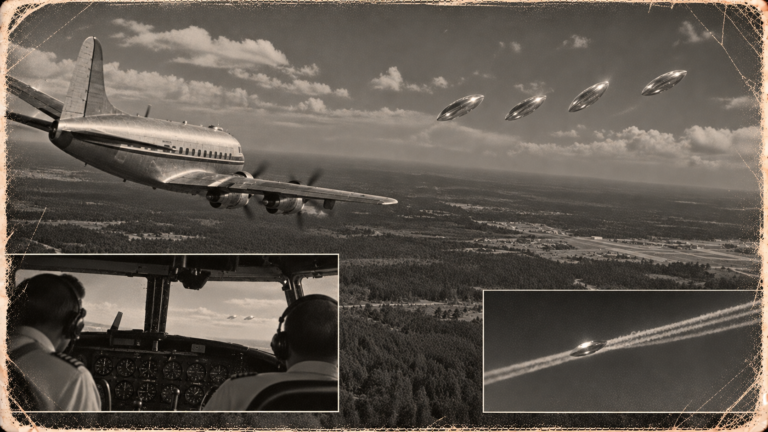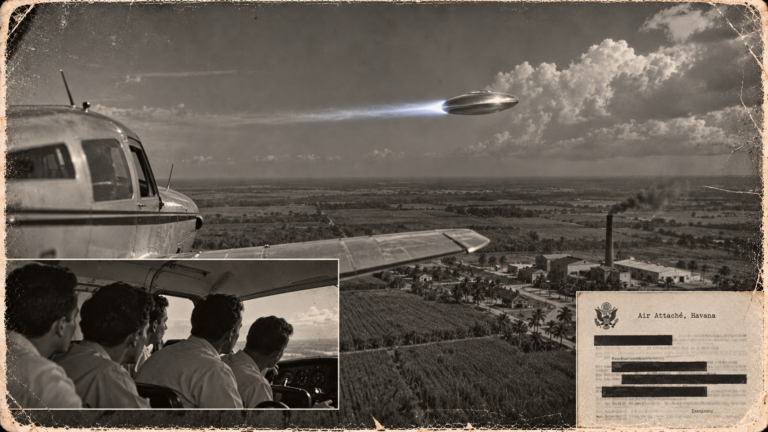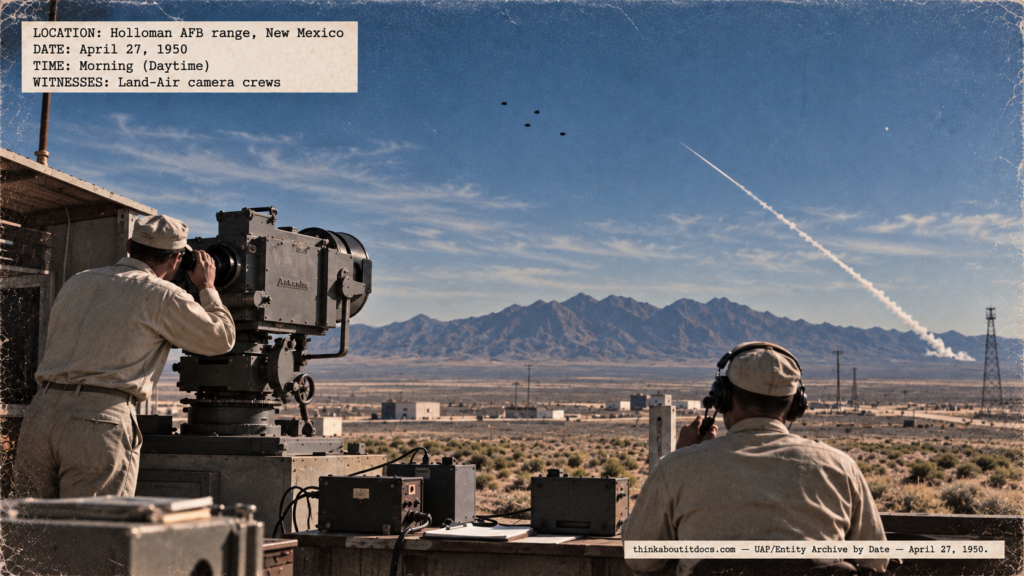
Land-Air crews at Holloman AFB filmed and triangulated four high objects on April 27, 1950.
THINK ABOUTIT UFO|UAP SIGHTINGS REPORT
1950: Holloman AFB Triangulated Objects
On the morning of April 27, 1950, the Land-Air, Inc. crews who run the Askania cinetheodolites on the Holloman range were getting ready to film the launch of an MX-776A missile when, after the test, someone on the intercom spotted something in the sky. The cameras were already being unloaded. Only one station still had film, and it shot the object. An Askania at station P-10 recorded azimuth and elevation angles for four objects, and a second station, M-7, gave a single azimuth. The base’s Data Reduction Unit put the objects at about 150,000 feet, about 30 feet across, over the range between the base and Tularosa Peak, moving at a high but undeterminable speed.
NICAP calls the April 27 tracking a successful triangulation. The film itself, according to a later account in the file, shows only a smudgy dark object, not very well defined. Holloman’s base letter rates the observers’ reliability superior and says objects had been seen in some numbers, as many as eight at once. Project Blue Book’s card for the Holloman AFB April 27 triangulated objects concludes Insufficient Data.
Date: April 27, 1950
Sighting Time: Morning (the exact time is not in the file)
Day/Night: Day
Location: Holloman AFB range, New Mexico, USA, over the area between the base and Tularosa Peak; filmed from Askania station P-10 with a reading from station M-7
Urban or Rural: Rural (military range)
No. of Entity’s: Not Applicable
Entity Type: Not Applicable
Entity Description: Not Applicable
Hynek Classification: DD (Daylight Disc; instrument-tracked)
Duration: Not stated
No. of Object(s): 4 measured (as many as 8 reported visible at one time on the range)
Description of the Object(s): High objects tracked by theodolite crews and photographed by one Askania camera; the film shows a smudgy, dark, poorly defined object moving; the Data Reduction Unit recorded azimuth, elevation and image size
Shape/Size/Color of Object(s): Not described; about 30 feet in diameter from the triangulation
Distance to Object(s): About 150,000 feet altitude from triangulation of station P-10 angles with one M-7 azimuth
Height & Speed: About 150,000 feet; speed high but undeterminable
Number of Witnesses: Land-Air, Inc. camera and theodolite crew members at the Askania stations (named in NICAP’s summary: Charles Riggs); rated superior in reliability by Holloman
Special Features/Characteristics: Triangulated with Askania cinetheodolites and film; a trained observer group working with instruments for the missile test; one camera loaded; film delivered to the Air Force Cambridge Research Laboratory with the Data Reduction report; the program that produced Project Twinkle
Case Status: Insufficient Data. Project Blue Book’s record card concludes Insufficient Data and adds “Objects actually tracked.” NICAP lists the case as a Blue Book unknown (BBU).
Source: Holloman AFB letter EHO 00.92/1 of 31 May 1950 to the Air Force Cambridge Research Laboratory (at the request of Dr. A. O. Mirarchi), with Data Reduction Unit report by mathematician Wilbur L. Mitchell; Project Blue Book (Project 10073) record card; NICAP 1950 UFO Chronology (Sparks)
Summary/Description: On April 27, 1950, Land-Air crews at Holloman AFB photographed and tracked four high objects on Askania cinetheodolites, and the Data Reduction Unit triangulated them at about 150,000 feet and about 30 feet across between the base and Tularosa Peak. Only one camera had film, and it shows a smudgy dark object. Blue Book’s card concludes Insufficient Data.
Related Cases: Holloman AFB, May 24, 1950, cinetheodolite filming; Datil, New Mexico, photographed light (February 24-25, 1950); Vaughn, New Mexico, movie-film sighting (March 5, 1950); Holloman AFB sighting of March 11, 1950
Detailed Report
The Base’s Letter
Holloman’s letter of May 31, 1950 to the Air Force Cambridge Research Laboratory, written at the request of Dr. A. O. Mirarchi during a visit to the base, says sightings were made on April 27 and May 24, 1950 of aerial phenomena during the morning daylight hours. They were made by Land-Air, Inc. personnel while tracking regular projects with Askania phototheodolites. It reports that objects are sighted in some numbers, as many as eight visible at one time, and that the individuals making the sightings are professional observers whose reliability the writer rated superior. In both cases photographs were taken with Askanias.
April 27: Four Objects
The base’s Data Reduction Unit analyzed the April 27 pictures. In its report, mathematician Wilbur L. Mitchell wrote, on the basis of a conversation between Col. Baynes and Capt. Bryant, that the film from station P-10 was read, recording azimuth and elevation angles on four objects and the size of each image on the film. From that information together with a single azimuth angle from station M-7 he concluded that the objects were at an altitude of about 150,000 feet, over the Holloman range between the base and Tularosa Peak, about 30 feet in diameter and traveling at an undeterminable but high speed. A later account filed with the letter says the objects were spotted shortly after a missile had been fired, climbed into the stratosphere and fallen, that the theodolites were connected by intercom and several stations were told to try for pictures, and that unfortunately only one camera had film, which showed a smudgy dark object, not very well defined, that was moving.
May 24
The letter adds that triangulation had been expected from the May 24 pictures because they were taken from two stations, but the films showed that the two stations had filmed two different objects, so triangulation could not be effected. The report and film were sent to the Air Force Cambridge Research Laboratory with the base’s April 27 report and a map of the range.
The Card
The Project 10073 card dates the sighting April 27, 1950 at Holloman AFB, with a handwritten note “Objects actually tracked” and the conclusion INSUFFICIENT DATA.
RESEARCHER’S NOTES
Four Objects, Two Stations, One Smudge of Film
- A Rare Instrumented Case: The measurement is the point. A trained crew, two stations and film produced an altitude and size from geometry, not a witness’s guess.
- A Thin Baseline: The triangulation used P-10 angles for four objects and only a single azimuth from M-7, so its altitude figure comes from one baseline. The Data Reduction report states the conclusion without error bars.
- Only One Camera Had Film: The missile test was over, and most stations had begun unloading. The one loaded camera produced a smudgy dark image, enough to show something was in the air and moving.
- Why Blue Book Said Insufficient Data: The card notes the objects were actually tracked, but with a single clean film, no color or shape and no weather, the Air Force could not say what they were.
- The Origin of Twinkle: Holloman’s Vaughn and Datil observation posts led to Project Twinkle, whose contract period began April 1. The April 27 film came from Land-Air’s regular range work, not from the Twinkle posts.
- A Later Film Debate: Pages added later in the file are 1950s correspondence about UFO film footage held by the Air Force. They do not describe this film.
The Holloman April 27 case is the best of the spring’s instrumented attempts: two stations, a film, a triangulated altitude and size, and trained observers. It is filed here as Insufficient Data, in line with Blue Book’s card, because the film shows only a smudge and the altitude rests on one baseline.
“Objects actually tracked.”
Handwritten note on the Project Blue Book card for the April 27, 1950 Holloman AFB sighting.