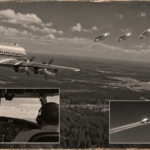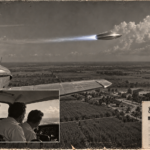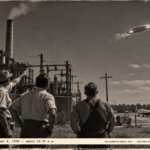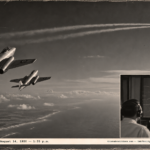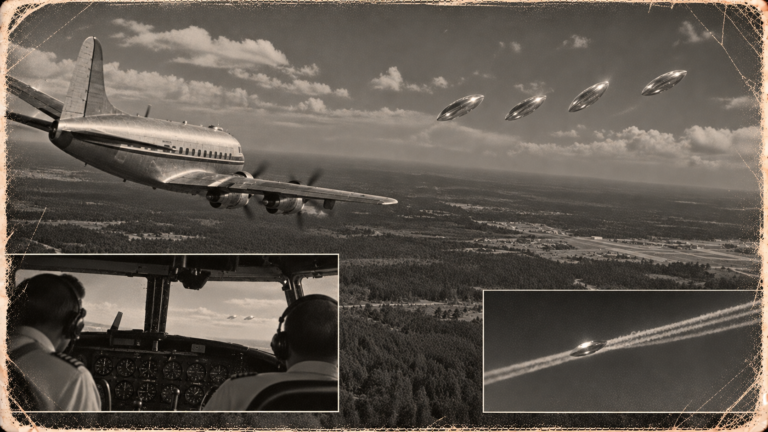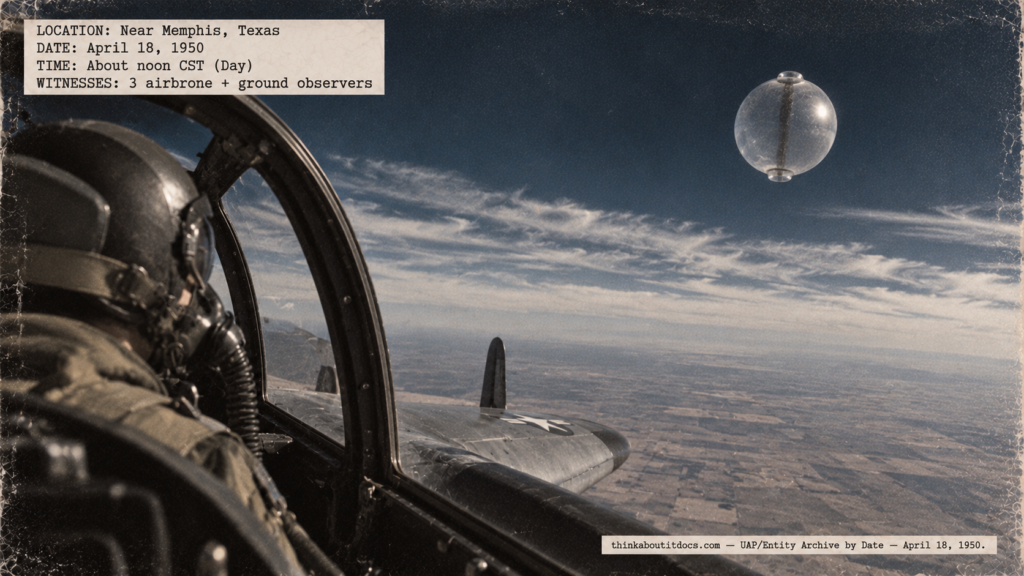
CAA stations triangulated a stationary object near Memphis, Texas, and a Northrop test pilot chased it to 50,000 feet on April 18, 1950.
THINK ABOUTIT UFO|UAP SIGHTINGS REPORT
1950: Memphis, Texas Triangulated UFO, Northrop Pilot Max Stanley
On the morning of April 18, 1950, CAA observers at Clarendon, Texas, spotted a silvery object in the sky with an orange glow around its edge and kept it in view. By noon, observers at Childress, about 50 miles away, had triangulated its position in the vicinity of Memphis, Texas, and it had not moved appreciably for three hours despite winds aloft. As a Northrop test crew prepared to leave Amarillo for California after a missile-guidance flight, the airport asked their pilot, Max Stanley, to fly out and look. At 20,000 feet he saw a distant point of glinting metal to the southeast, and he flew toward it, climbing to 50,000 feet.
At 50,000 feet, close to the base of a cirrus deck, a silvery, translucent sphere with prominent detents top and bottom appeared slightly to his right and above, about half the width of a full moon. A B-36 sent up from Fort Worth could not see it. Stanley and his two observers agreed it was not an airplane, balloon, celestial body or anything commonly seen above the earth, and the Memphis, Texas triangulated object went to Air Materiel Command as a Northrop memorandum. Blue Book’s card has a handwritten answer anyway: Astro (Venus).
Date: April 18, 1950
Sighting Time: About 9:00 a.m. to 12:40 p.m. CST (ground observers); the airborne observation began shortly after noon and lasted about 20 minutes
Day/Night: Day
Location: Near Memphis, Texas, USA: triangulated by CAA observers at Clarendon and Childress, Texas, about 50 miles apart, and approached by an F-61C from Amarillo
Urban or Rural: Rural (airborne)
No. of Entity’s: Not Applicable
Entity Type: Not Applicable
Entity Description: Not Applicable
Hynek Classification: DD (Daylight Disc)
Duration: More than three hours from the ground; about 20 minutes from the aircraft
No. of Object(s): 1
Description of the Object(s): A silvery object with an orange glow around its perimeter as seen from the ground; from the aircraft a silvery, metallic, translucent sphere with prominent detents on top and bottom connected by a dark streak or shadow that tilted occasionally; no visible means of propulsion; no orange ring seen from the aircraft
Shape/Size/Color of Object(s): Sphere-like with top and bottom detents; apparent diameter about half that of a full moon seen directly overhead; silvery metallic with a translucent quality
Distance to Object(s): Not estimated; it seemed much closer when it reappeared; first seen at considerable distance to the southeast
Height & Speed: Triangulated near Memphis, Texas; stationary for over three hours despite winds aloft; seen from the aircraft at about 50,000 feet near the base of a cirrus deck; slow, short-duration sideways movement
Number of Witnesses: Several CAA observers at Clarendon and Childress, plus 3 airborne (Northrop test pilot Max Stanley and observers Lloyd Balsam and Sam F. West, who agreed with his report)
Special Features/Characteristics: Ground triangulation from two stations; engineers aboard an F-61C (AF 8557) on a Project MX-775 test flight; weather station said no free balloon could remain visible for four hours in those winds; B-36 from Fort Worth could not find it; oxygen limits ended the pursuit
Case Status: Disputed. Project Blue Book’s record card carries the handwritten conclusion “Astro (Venus).” The Northrop crew reported it was not a balloon, celestial body or aircraft. NICAP lists it as a Blue Book unknown (BBU).
Source: Northrop Aircraft memorandum by Max Stanley, April 27, 1950, forwarded by the Los Angeles AF Procurement Field Office to Air Materiel Command (confidential); Project Blue Book (Project 10073) record card; NICAP 1950 UFO Chronology (Jan Aldrich)
Summary/Description: CAA observers at Clarendon and Childress, Texas, triangulated a stationary silvery object near Memphis, Texas for more than three hours on April 18, 1950. Northrop test pilot Max Stanley and two observers flew an F-61C to 50,000 feet and saw a silvery, translucent sphere about half a full moon wide. They agreed it was not a balloon, aircraft or celestial body. Blue Book’s card concludes Venus.
Related Cases: Goshen, Indiana, TWA Flight 117 (April 27, 1950); Holloman AFB triangulated objects (April 27, 1950); Kirtland AFB (March 17, 1950); Farmington, New Mexico (March 15-18, 1950)
Detailed Report
The Ground Watch
Max Stanley’s memorandum says that shortly before leaving Amarillo on the return flight to Northrop Field in Hawthorne, California, he was asked by the Amarillo airport office to call the local CAA radio range station. The CAA observers at Clarendon, Texas, he was told, had had an unidentified object under observation since 9:00 a.m., then about noon Amarillo time. They described a silvery object with an orange glow around its perimeter. The Clarendon observers, together with observers at Childress, had triangulated its position in the vicinity of Memphis, Texas, and he was asked to fly to its position for a closer look.
The Flight
The aircraft was F-61C No. AF 8557, on a flight from Hawthorne to Amarillo on April 17 and back in connection with Project MX-775, with Lloyd Balsam and Sam F. West as observers. At about 20,000 feet near Memphis, Stanley saw an object to the southeast at considerable distance, detectable only by the intermittent reflection of sunlight on what looked like a metallic surface; it could have been another airplane. He turned toward it and established radio contact with the Amarillo range station, which said no other aircraft at 50,000 feet or above were known in the area but that a B-36 had taken off from Fort Worth to search for it. After about ten minutes of flying toward it the object began to take form and looked as if it might be a weather balloon. Amarillo contacted the local weather station, which said it could not possibly be a weather balloon, because it had been observed continuously in the same area for about four hours and the winds aloft would preclude a free balloon staying visible that long. The object was lost behind a cirrus deck. After about five more minutes on the same heading it reappeared slightly to his right and above, with the aircraft at about 50,000 feet and very close to the base of the cloud deck. It looked much closer, though he could not estimate its distance since its size was unknown, and he put its apparent diameter at about half that of a full moon seen directly overhead.
What They Saw
The object was silvery metallic with a translucent quality, without any orange ring. It was sphere-like with prominent detents on the top and bottom and a dark streak or shadow connecting them. The shadow was mostly vertical and tilted occasionally, producing a sideways movement of the object. The motion was not rapid and was of short duration. There was no visible or apparent means of propulsion. The crew described it by radio to the B-36, which reported it was above the cloud layer at 46,000 feet and unable to see the object. The object was again lost behind a cloud. After circling for about five minutes near the last contact, they sighted it for about 50 seconds in a break between two clouds, and then had to descend because the oxygen supply was running low. About 20 minutes passed between first sight and the last loss of sight, on a constant easterly heading while climbing from 20,000 to 50,000 feet at an average indicated airspeed of 180 mph. A couple of minutes into the descent the B-36 reported it too was leaving because of low fuel and had not seen the object.
The Observers and the Memo
Stanley wrote that Balsam, who rode in the gunner’s station, is a graduate of the Massachusetts Institute of Technology and West a graduate of the University of California who had worked five years in MIT’s Radiation Laboratory. Both were familiar with the report and agreed with it. All three agreed that the object was not an airplane, balloon, celestial body or any other object commonly seen above the earth. The Los Angeles Air Force Procurement Field Office forwarded the memorandum to Air Materiel Command on April 27, marked Confidential pending evaluation.
The Card
The Project 10073 card gives the date as April 18, 1950, with the location Memphis, Texas (and, in handwriting, Clarendon), the sources as ground-visual observers and a Northrop test pilot, 0900 to 1300 hours, silvery metallic, a sphere, half the diameter of the moon, above 50,000 feet, 20 minutes, aerial, lateral movement. The handwritten conclusion reads Astro (Venus).
RESEARCHER’S NOTES
A Planet by the Card, and Something Else by the Crew
- Venus at 50,000 Feet: Blue Book’s card names Venus, which can be visible in daylight. The Northrop memo describes a sphere that grew closer and showed detail as the aircraft climbed, which is not how a planet behaves. The file does not explain how Venus was reached.
- A Ground Triangulation: The Clarendon and Childress observers, 50 miles apart, fixed the object near Memphis for hours without significant movement. A planet would not need triangulation, and the weather station ruled out a free balloon.
- Qualified Airborne Witnesses: The pilot was a Northrop engineering test pilot, and the two observers were an MIT graduate and a former MIT Radiation Laboratory worker.
- The B-36 Never Saw It: The Fort Worth B-36 reached 46,000 feet above the clouds and did not see the object, which was seen only near the cloud deck’s base.
- A Balloon Considered: Stanley’s own first thought was a weather balloon, which the weather station rejected. Its translucence, detents and shadow are the details a high-altitude balloon might produce, and the file does not discuss Skyhook launches that spring.
- Why a Test Aircraft Was There: The F-61C was on a Project MX-775 flight, which NICAP identifies as the Navaho cruise missile’s celestial guidance test. The crew’s assignment that morning was unrelated to the object.
The Memphis, Texas object is a case with two competing answers inside one file: a Blue Book card that says Venus, and a three-person Northrop crew, backed by a four-hour triangulation, that says it was something else. It is filed here as Disputed, with both positions stated, and with the caution that the file contains no explanation of how a planet would have been triangulated or approached.
“…not an airplane, balloon, celestial body, or any other object commonly seen…”
From Max Stanley’s Northrop memorandum on the April 18, 1950 Memphis, Texas observation.