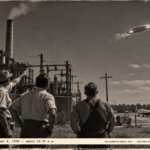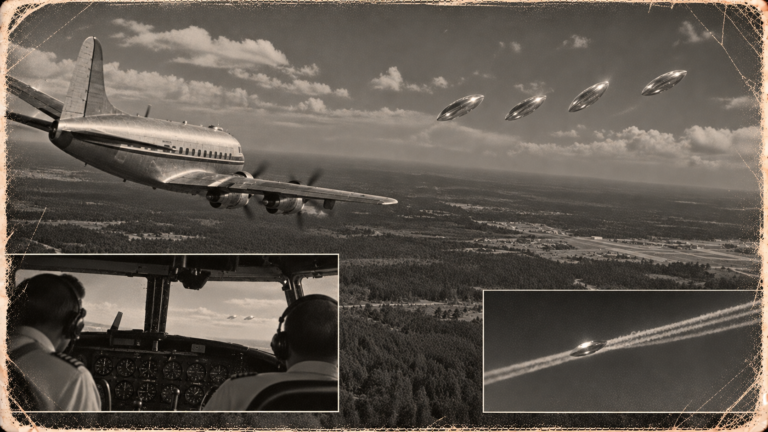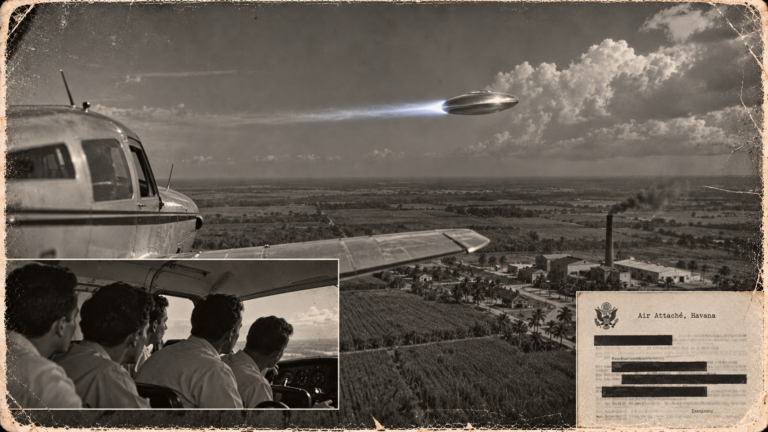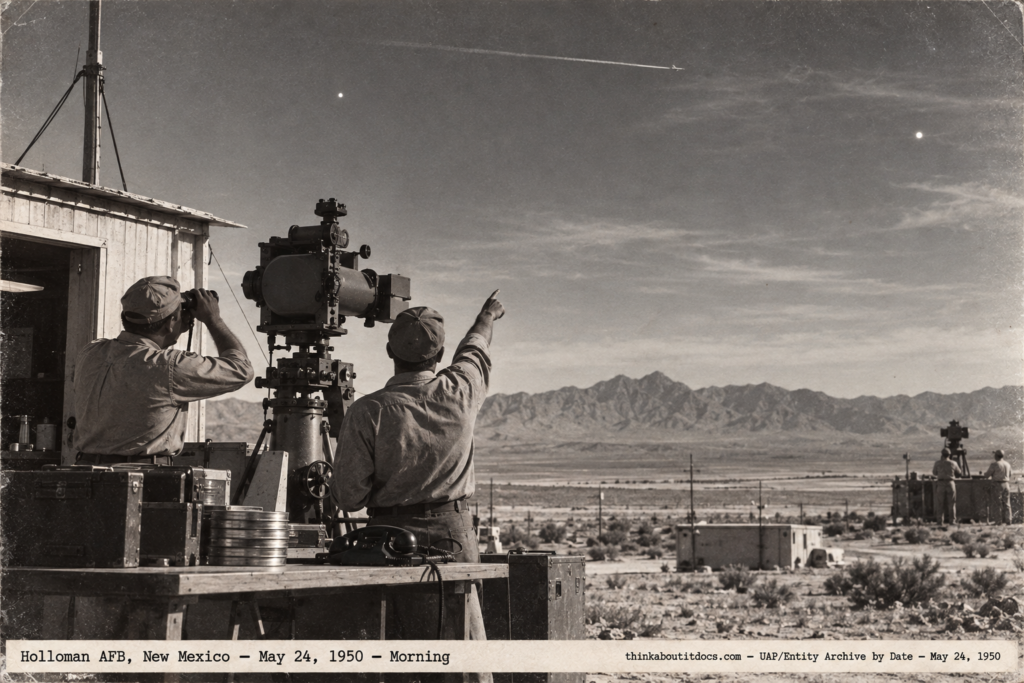
Two Holloman AFB cinetheodolite stations filmed two different unidentified objects on the morning of May 24, 1950.
THINK ABOUTIT UFO|UAP SIGHTINGS REPORT
1950: Holloman AFB, New Mexico, Two Cameras, Two Objects
On the morning of May 24, 1950, two cinetheodolite stations on the Holloman Air Force Base missile range swung their cameras onto unidentified objects during an MX-674 Tarzon bomb test — and each station filmed something different. One camera followed a bright dot for six frames; the other, 5.68 miles up range, held a second object for 74 frames, nearly fifteen seconds of film. As many as eight objects were visible at one time to the professional tracking crews of Land-Air, Inc., and because the two cameras never locked onto the same target, the one result the Air Force wanted — a triangulated distance, size and speed — could not be extracted.
This Holloman AFB UFO tracking case is one of the best-documented instrument sightings of 1950: a Data Reduction Unit memo with station coordinates and angle-by-angle readings, a Project 10073 record card, and a forwarding letter that rates the observers’ reliability “superior.” It is also a frustrating one, because the film itself is not in the Blue Book file.
Date: May 24, 1950
Sighting Time: Morning, daylight hours (exact time not recorded)
Day/Night: Day
Location: Holloman AFB missile range (North American Aviation line of fire), Alamogordo, New Mexico; cinetheodolite stations P-8 and P-10
Urban or Rural: Rural (military test range)
No. of Entity’s: 0 — Not Applicable
Entity Type: Not Applicable
Entity Description: Not Applicable
Hynek Classification: DD (daylight, instrument-tracked; objects recorded only as bright dots, shape unresolved)
Duration: Station P-8: six consecutive frames at five frames per second (about 1.0 second between first and last frame). Station P-10: 74 consecutive frames (about 14.6 seconds).
No. of Object(s): Up to eight visible at one time; two filmed (a different one at each station)
Description of the Object(s): Bright dots of light on film; no shape, structure or size could be determined
Shape/Size/Color of Object(s): Not determined from the record; bright, dot-like
Distance to Object(s): Not determined; triangulation could not be effected
Height & Speed: Not determined. Recorded angular change: P-8 azimuth 58°19’30” to 58°26’30”, elevation 47°32’20” to 47°25’50”; P-10 azimuth 106°01’40” to 105°39’50”, elevation 25°48’00” to 25°07’50” (angles measured from the range reference system)
Number of Witnesses: Multiple Land-Air, Inc. tracking-crew members (described as professional observers); Floyd Fannon named by Sparks
Special Features/Characteristics: Two Askania cinetheodolite stations about 5.68 miles apart on the range; filmed during an MX-674 Tarzon controllable-bomb test; each station tracked a different object
Case Status: Insufficient Data (Project 10073 Record Card). Triangulation not possible; film not in file; file incomplete.
Source: Project 10073 Record Card; Holloman Data Reduction Unit memo, May 31, 1950 (Capt. Perry K. Bryant); Holloman letter to AF Cambridge Research Laboratory, July 1950; Sparks
Summary/Description: Two cinetheodolite stations filmed different unidentified objects during a missile test, so no triangulation was possible.
Related Cases: April 27, 1950 Holloman AFB tracking (successfully triangulated, Land-Air crews, per Sparks); August 30-31, 1950 Holloman sightings; Project Twinkle
Detailed Report
The setting. Holloman AFB ran a busy missile and bomb test program in 1950, and Land-Air, Inc., an Air Force contractor, operated the Askania phototheodolites that tracked each shot. According to NICAP’s chronology, Project Twinkle, a contract signed that spring to have those crews film unusual aerial objects, formally began April 1. The crews therefore were not casual skywatchers; filming anything odd in the sky was part of the job.
The reports. A letter forwarded to the Air Force Cambridge Research Laboratory, at the request of Dr. A. O. Mirarchi during a recent visit to the base, says sightings were made on April 27 and May 24, 1950, during morning daylight hours, by Land-Air personnel tracking regular projects. It says objects were being sighted “in some number,” as many as eight visible at one time, and that the people making the sightings were professional observers whose reliability the writer rated superior. In both cases photographs were taken with Askanias.
Why May 24 was supposed to work. The April 27 pictures had been analyzed by the base Data Reduction Unit. Because May 24 pictures came from two stations, it was believed triangulation could be done. The films were rapidly processed and examined, and the unit determined that the two stations had filmed two different objects.
The data. A May 31, 1950 Data Reduction memo, signed by Capt. Perry K. Bryant, Chief of the Data Reduction Unit, lays out the reference system (the NAA line of fire, 19°52’30.8″ west of north), the station coordinates (station 8: 13549, 20190, 106; station 10: 43309, 23819, 113), and a frame rate of five frames per second. Station 8 followed an object for six consecutive frames while its azimuth changed uniformly from 58°19’30” to 58°26’30” and its elevation from 47°32’20” to 47°25’50”. Station 10 followed an object for 74 consecutive frames while azimuth changed uniformly from 106°01’40” to 105°39’50” and elevation from 25°48’00” to 25°07’50”. The memo’s verdict: because the two stations did not follow the same object, no reduction was possible. Brad Sparks’ catalog adds that the P-8 object moved south and the P-10 object moved north, and names Floyd Fannon among the crew.
The magazine account. An extract from a True magazine article attached to the file describes the same pattern: after word of the first picture had spread, the stations were more alert, another object was spotted just before a missile was to be fired, a second station was called and also saw it, both swung into action and took photos, and on developing the film each turned out to have tracked a different object, bright dots of light, again with no triangulation. The extract dates this May 29, 1950; the Project 10073 card, the Data Reduction memo and the forwarding letter all say May 24.
The aftermath. The letter enclosed the two Data Reduction reports, the P-10 and P-8 film from May 24, the P-10 film from April 27, and a map of the range. The Blue Book card notes the photos went to Dr. Mirarchi at Cambridge and that the file is incomplete; the film is not in the Blue Book file today.
RESEARCHER’S NOTES
Two Cameras, Two Objects, No Answer
- Why triangulation failed: Triangulation needs two lines of sight to one target. The memo is explicit that stations 8 and 10 followed different objects, so the angles cannot be combined into a distance.
- What the angles do and don’t say: Taken alone, the P-8 object moved roughly 0.16 degrees across six frames and the P-10 object roughly 0.76 degrees across 74 frames (simple combined azimuth and elevation change, ignoring geometry). Small angular motion cannot separate a distant fast object from a near slow one without a range, which is exactly what is missing.
- Date conflict: The primary Air Force documents say May 24; a magazine extract and an earlier NICAP listing say May 29. The documents carry more weight.
- Observer quality: The tracking crews were contractor professionals who filmed aerial targets for a living, and the forwarding officer rated them superior. Describing the objects as bright dots is a limit of the film, not of the observers.
- Missing film: The card marks photos “not in file.” The Cambridge laboratory received the film in 1950, so its archives are the logical place to look for the frames.
- The April 27 companion case: The April 27 tracking at the same base is usually cited as a successful triangulation; May 24 is the case where the same method failed, and the two belong side by side.
The Holloman tracking of May 24, 1950 documents professional observers filming unidentified objects, and also the limit of what the film could prove. What exists is a pair of short angle records, two different objects, a missing film and a set of sober Air Force memos. There is no basis in the file for saying what the objects were, and none for dismissing them.
“professional observers therefore I would rate their reliability superior”
— Holloman AFB letter to the Air Force Cambridge Research Laboratory, July 1950