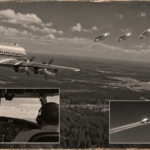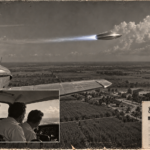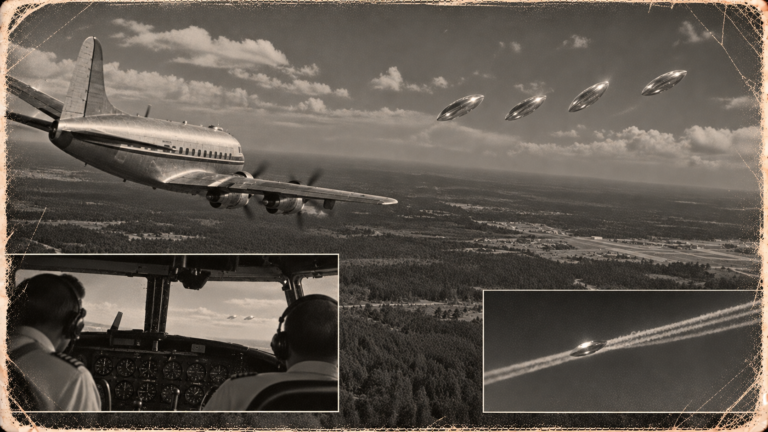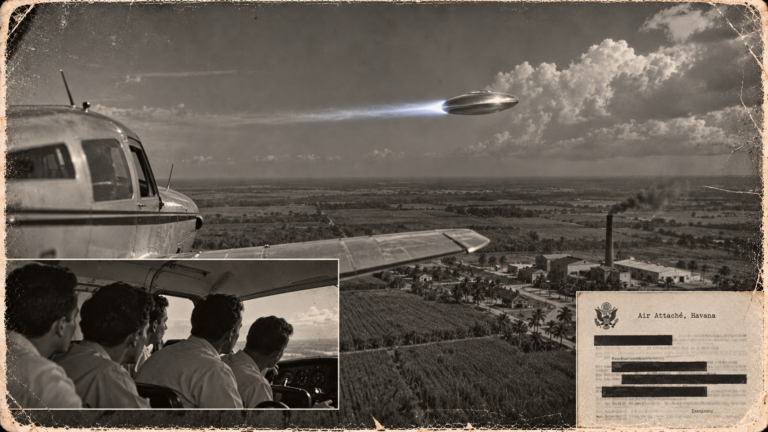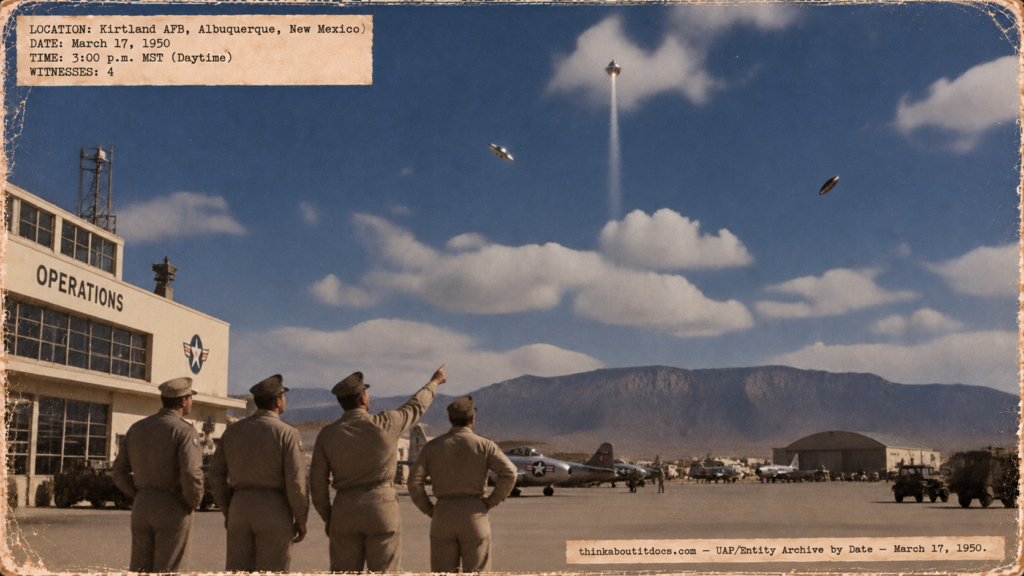
Four Eighth Air Force airmen at Kirtland AFB watched three tumbling objects, one of which rose vertically into cloud, on March 17, 1950.
THINK ABOUTIT UFO|UAP SIGHTINGS REPORT
1950: Kirtland AFB UFO: Four Airmen, Three Objects
At 3:00 on the afternoon of March 17, 1950, an Eighth Air Force captain and three technical sergeants standing on the ramp in front of the Operations building at Kirtland AFB, New Mexico, watched three objects tumbling in the sky at 10,000 to 12,000 feet, flashing silver and dark as they turned. They first took them for parachutes, then for wing tanks dropped from fighters. Then one shot straight up at high speed into the scattered cumulus over the field, while the other two drifted off, one north and one northeast. The northeast object stayed in view for 15 minutes before it vanished into mountains about 20 miles away.
It was the same day as the Farmington, New Mexico “Armada,” and the Air Force’s intelligence staff wrote the report up carefully: the airmen were of considerable experience, their reliability was beyond question, and three unidentified objects had been sighted. The Project Blue Book card that summarizes the Kirtland AFB March 17 sighting carries a different word in handwriting: Balloon. The file also holds a book passage attributing the Farmington sightings to a burst Skyhook balloon.
Date: March 17, 1950
Sighting Time: 3:00 p.m. MST (1500 hours)
Day/Night: Day
Location: Kirtland AFB, Albuquerque, New Mexico, USA, from the ramp in front of the Operations building
Urban or Rural: Rural (airbase)
No. of Entity’s: Not Applicable
Entity Type: Not Applicable
Entity Description: Not Applicable
Hynek Classification: DD (Daylight Disc)
Duration: About 15 minutes for the longest-lived object
No. of Object(s): 3
Description of the Object(s): Three objects, silver and dark, tumbling and rotating so that they showed a silver side and a dark side alternately; no shape could be described by any witness
Shape/Size/Color of Object(s): No shape described; silver and dark; size estimates: a C-54 (the captain), a desk (T/Sgt. Miller), a fighter aircraft (T/Sgt. Key), no estimate (the fourth witness)
Distance to Object(s): Not estimated; the northeast object disappeared into mountains about 20 miles away
Height & Speed: 10,000 to 12,000 feet; two objects drifted at about 60 to 80 mph (wind speed); T/Sgt. Miller estimated 100 mph and T/Sgt. Key about 300 mph laterally; one object rose vertically at high speed into the cloud at 15,000 feet
Number of Witnesses: 4 (an Eighth Air Force captain and three technical sergeants on an administrative trip to Kirtland: Capt. Thencher, T/Sgt. Terrance W. Miller, T/Sgt. Alvin Neumann and T/Sgt. James E. Key; spellings of the captain’s and the fourth sergeant’s names are uncertain in the scan)
Special Features/Characteristics: Four experienced airmen; tumbling motion; one object climbed vertically at high speed; witnesses ruled out parachutes, balloons and radar reflectors used on weather balloons; report filed days later after the witnesses read of other sightings; same day as the Farmington mass sighting
Case Status: Explained. Project Blue Book’s record card carries the handwritten conclusion “Balloon,” although the Eighth Air Force intelligence officer who wrote the report judged the objects unidentified.
Source: Air Intelligence Information Report (AF Form 112), Headquarters Eighth Air Force, 21 March 1950 (prepared by Capt. Carl C. [surname illegible], Chief, Operational Intelligence Branch; evaluation A-1), with the four witness statements; Project Blue Book (Project 10073) record card; Blue Book file excerpt on Farmington, New Mexico (Balloon)
Summary/Description: From the ramp at Kirtland AFB at 3:00 p.m. on March 17, 1950, an Eighth Air Force captain and three sergeants saw three silver-and-dark objects tumbling at 10,000 to 12,000 feet. One rose vertically at high speed into cloud and the other two drifted away, one north and one northeast, the latter visible for 15 minutes. The intelligence report called them unidentifiable; Blue Book’s card says Balloon.
Related Cases: Farmington, New Mexico, “Armada” (March 15-18, 1950); Kirtland AFB and Sandia Base cluster (March 21-22, 1950); Albuquerque theodolite case (February 24, 1950)
Detailed Report
On the Ramp
The four men were with Headquarters Eighth Air Force on an administrative trip. Captain Thencher said he was watching aircraft fly the pattern when his attention was drawn to three objects at about 10,000 to 12,000 feet. At first glance they looked like parachutes, and he called the three sergeants’ attention to them. As they watched, the tumbling and rotating motion, alternately exposing a silver side and a dark side, made him decide they were probably wing tanks jettisoned from fighters. He discarded that idea when one object suddenly rose vertically at high speed and disappeared into the scattered cumulus at 15,000 feet over the field. The other two, which seemed to be carried at wind speed, 60 to 80 miles an hour, separated, one traveling north and the other northeast. He kept his eyes on the northeast one until it seemed to disappear behind the mountains about 20 miles away. He compared the objects’ size to that of a C-54, could not describe their shape, and stated definitely that they were not parachutes, balloons or reflectors used on weather balloons. The weather was clear except for scattered cumulus, with calm surface winds.
The Sergeants
T/Sgt. Terrance W. Miller said his observations were substantially the same, except that the objects seemed to him about the size and shape of a desk, metallic, moving at about 100 mph. T/Sgt. Alvin Neumann, of the 11th Bomb Group, said he had nothing to add except that the rate at which one object ascended was considerably faster than would have been possible if air currents were the motivating force. T/Sgt. James E. Key said the objects looked about the size of fighter aircraft, and that he first thought they were aircraft dogfighting in a tight spinning maneuver, until one rose vertically at high speed and he realized they were not fighters. He estimated their lateral speed at about 300 mph.
The Report
Headquarters Eighth Air Force’s intelligence directorate wrote the report on March 21 and rated it A-1. The preparing captain, Chief of the Operational Intelligence Branch, wrote that no report was turned in at Kirtland at the time because the incident was not considered important until the witnesses read of other reports of unidentified flying objects in the same area. He wrote that the witnesses were all airmen of considerable experience and their reliability was beyond question, that there was no question that three unidentified objects were sighted, and that the observers were familiar with radar reflectors used on some types of weather balloons and sure the objects were not of that type. He added that information about weather-forecasting activities, special projects and similar matters in the area at that time was necessary before the report could be properly analyzed.
The Card and the Farmington Excerpt
The Project 10073 record card lists the source as USAF personnel, silver and dark, sizes varied, altitude 10,000 to 12,000 feet, course north and northeast, observed from the ground, with a tumbling motion ascending and descending. A handwritten word at the lower right reads Balloon. Filed in the same Blue Book folder is a page headed “17 March 1950, Farmington, New Mexico (BALLOON) Observation.” It is a passage from a later book, with bracketed references and a chapter cross-reference, stating that a Skyhook balloon launched that morning from Holloman AFB became brittle at 60,000 feet, burst, and scattered hundreds of light plastic fragments that shone in the sunlight over the town. The Kirtland card and this excerpt share the word Balloon. The excerpt says nothing about Kirtland.
RESEARCHER’S NOTES
Four Airmen, Three Objects, and a Card That Says Balloon
- Two Verdicts in One File: The preparing intelligence officer called the objects definite and unidentifiable to the observers and asked for information on weather and special projects. The card’s conclusion, Balloon, came afterward, and the file does not explain how it was reached.
- What Doesn’t Fit a Balloon: Drifting at wind speed is consistent with a balloon, and so is a tumbling motion that shows two sides. The vertical rise at high speed into cloud, the three witnesses’ comparisons to a C-54, a desk and a fighter, and the witnesses’ statement that they knew balloon radar reflectors are harder to reconcile.
- Timing: The sighting was at 3:00 p.m., nearly five hours after the Farmington objects began to appear at 10:15 a.m. and well over a hundred miles away. The file does not connect them except by placing the Farmington excerpt beside the card.
- A Delayed Report: No one reported the sighting at Kirtland. It surfaced only after the witnesses read of other sightings, and the report is dated four days later.
- Names in the File: The spellings of the captain’s name (Thencher or Chenchar in the scan), the fourth sergeant’s (Neumann or Naumann) and the preparing officer’s are uncertain in the photocopy.
- The Book Passage: The Farmington excerpt is a later explanation, not a 1950 measurement. It fits the Air Force’s Skyhook account, and it is the Air Force’s verdict on the Farmington sightings, not a record of what the witnesses saw.
The Kirtland March 17 sighting is a short, credible report that Air Force intelligence judged unidentified and Blue Book closed as a balloon. It is filed here as Explained, on the card’s word, with the plain caveat that the four witnesses ruled out balloons and that the file never says why the verdict changed.
“…not parachutes, balloons or reflectors used on weather balloons.”
From the captain’s statement in the Eighth Air Force report on the March 17, 1950 Kirtland AFB sighting.