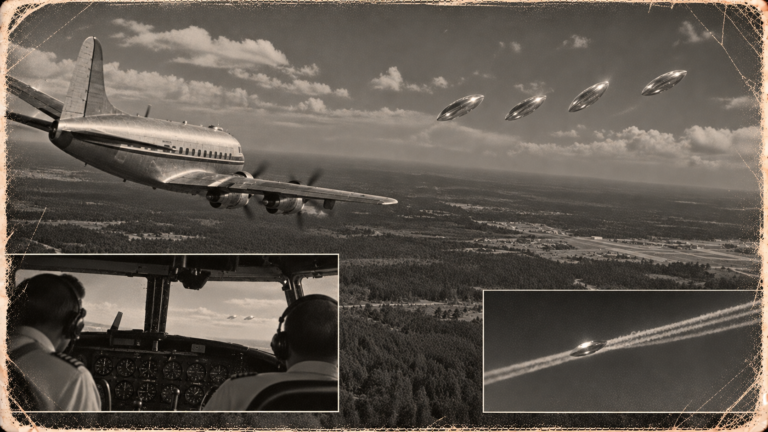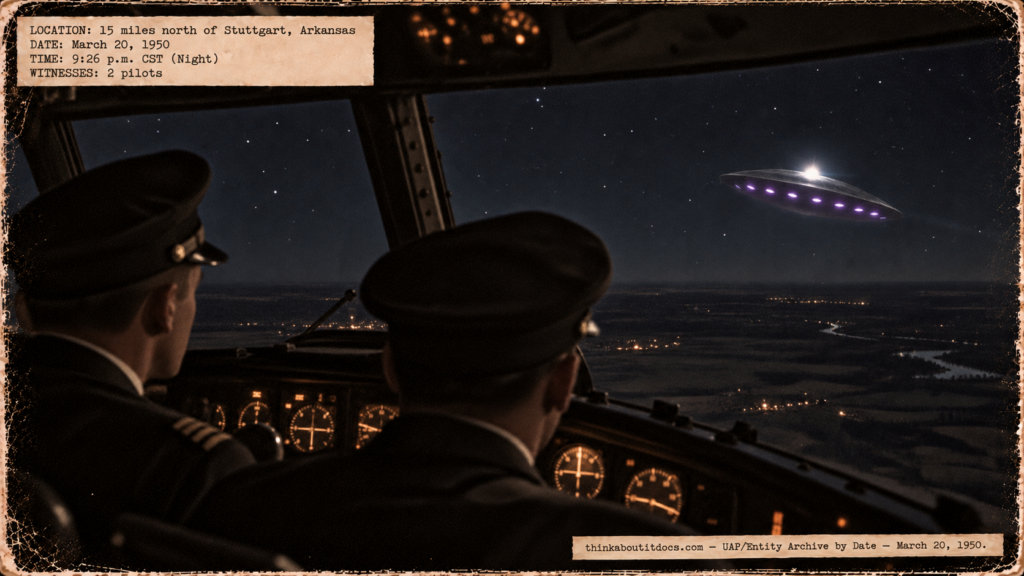
Two Chicago and Southern Airlines pilots watched a 100-foot disc with portholes cross their flight path near Stuttgart, Arkansas, on March 20, 1950.
THINK ABOUTIT UFO|UAP SIGHTINGS REPORT
1950: Stuttgart, Arkansas Airliner UFO
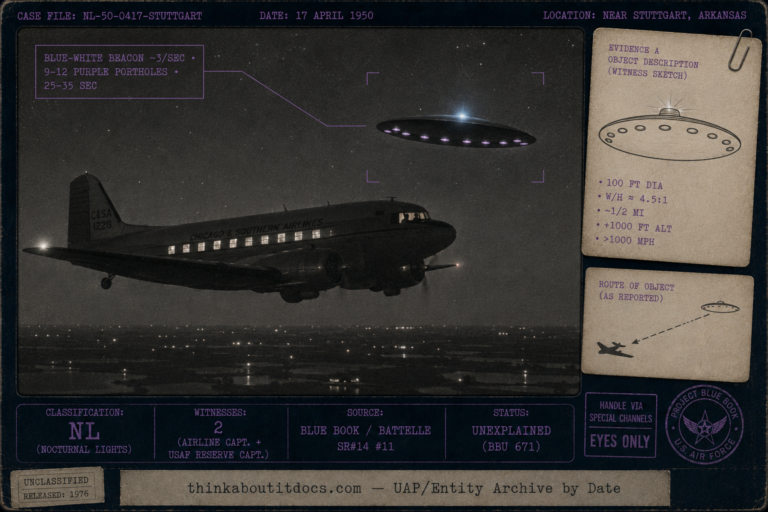
At 9:26 on the night of March 20, 1950, the captain of a Chicago and Southern Airlines flight from Memphis to Little Rock pointed out an unusual object racing toward the airliner from the south at 2,000 feet. His co-pilot, an Air Force Reserve captain, watched it pass in front of them, off to the right and out of sight, in 25 to 35 seconds. It was circular, about 100 feet across, with an extremely bright light blinking three times a second on top, and as it crossed the airliner’s path, not more than half a mile away and about 1,000 feet higher, he saw nine to twelve portholes glowing a soft purple in a ring on its underside.
The co-pilot’s own unit, the 516th Troop Carrier Wing at Memphis Municipal Airport, interrogated him two days later and sent the result to the Director of Intelligence at Air Force headquarters. The Stuttgart, Arkansas airliner sighting ended up as one of the best-documented airline cases of early 1950: a clear night, a veteran observer who had flown the F-86, a conservative speed estimate of at least 1,000 mph, and a Project Blue Book card with one word written across it, circled: UNIDENTIFIED.
Date: March 20, 1950
Sighting Time: 9:26 p.m. CST (2126 hours)
Day/Night: Night
Location: Over U.S. Highway 70, about 15 miles north of Stuttgart, Arkansas, USA; Chicago and Southern Airlines Flight 53, Memphis to Little Rock
Urban or Rural: Rural (airborne)
No. of Entity’s: Not Applicable
Entity Type: Not Applicable
Entity Description: Not Applicable
Hynek Classification: NL (Nocturnal Light; a structured disc seen at night at close range)
Duration: 25 to 35 seconds
No. of Object(s): 1
Description of the Object(s): A disc-like object with a blinking light on top and a ring of 9 to 12 portholes on its underside, flying straight and level; no sign of exhaust flames, jet or otherwise; not revolving or spinning
Shape/Size/Color of Object(s): Circular, about 100 feet across horizontally, with a height considerably less than its diameter; the top light was intensely bright; soft purple light came from the portholes, a shade similar to aircraft fluorescent lights
Distance to Object(s): Not more than half a mile when it passed directly in front of the airliner
Height & Speed: About 1,000 feet above the airliner, which was at 2,000 feet (the card gives 3,000 feet approximately); flying north on a straight horizontal line; estimated at least 1,000 mph, given as a very conservative figure
Number of Witnesses: 2 (the airliner’s captain and its co-pilot, an Air Force Reserve captain of the 516th Troop Carrier Wing; Blue Book summaries name them as Capt. Jack Adams and First Officer G. W. Anderson, while the 516th report blacks out the names)
Special Features/Characteristics: Two airline pilots; a co-pilot with F-86 experience who was interrogated by his own Air Force Reserve unit; clear night (CAVU, visibility 30-plus miles); object showed its underside and portholes at close range; sketch drawn by the co-pilot (not in the file scan); interrogation report sent to the Director of Intelligence USAF
Case Status: Unexplained. Project Blue Book’s record card carries the handwritten conclusion UNIDENTIFIED.
Source: Interrogation report of the 516th Troop Carrier Wing, Memphis Municipal Airport, 22 March 1950, signed by the Wing Ground Training Officer and the Wing Intelligence Officer (both majors, USAF Reserve), to the Director of Intelligence, USAF; Project Blue Book (Project 10073) record card; Project Blue Book summaries
Summary/Description: Two Chicago and Southern Airlines pilots saw a circular object about 100 feet across cross in front of their airliner 15 miles north of Stuttgart, Arkansas, at 9:26 p.m. on March 20, 1950. It had an intensely bright blinking light on top and a ring of 9 to 12 glowing portholes underneath, and it flew straight and level at an estimated 1,000 mph or more. Blue Book’s card concludes UNIDENTIFIED.
Related Cases: Atlanta, Georgia, airline pilots on the tarmac (March 18, 1950); Clovis, New Mexico, T-6 pilot (March 20, 1950); Bradford, Illinois, private pilot (March 18, 1950); Adamant, Vermont (March 26, 1950)
Detailed Report
The Flight
The co-pilot, a captain in the Air Force Reserve’s 516th Troop Carrier Wing, was flying as first officer of Chicago and Southern Airlines Flight 53, which left Memphis at 8:55 p.m. CST on March 20 for Little Rock. Weather was clear and unlimited, the flight was conducted under visual flight rules at 2,000 feet, and visibility was thirty miles or better.
The Object
At 9:26 p.m. the airliner’s captain, of Memphis, directed the co-pilot’s attention to an unusual object approaching from the south on a north heading at tremendous speed. Both men watched it pass in front of them, to the right and out of sight, over U.S. Highway 70 about 15 miles north of Stuttgart. They had it in view for about 25 to 35 seconds. When it passed directly in front of the airliner it was no more than half a mile away and about 1,000 feet higher. It appeared circular, about 100 feet across horizontally, with a vertical height that was unknown but considerably less than the diameter, giving it a disk-like shape. In the center of the top was an extremely bright light blinking at an estimated three flashes per second, so brilliant that it would have been impossible to look at continuously if it had not been flashing. The light could be seen only as the object approached and after it had passed. When it passed in front of the airliner, the co-pilot saw the underside: 9 to 12 symmetrical oval or circular portholes set in a circle about three-quarters of the way from the center to the rim, with a soft purple light coming through them, a shade like aircraft fluorescent lighting. The object was not revolving or spinning and flew in a straight horizontal line. Considering the visibility, the distance, the time in view and his experience observing many types of aircraft, including the F-86, he said it was traveling at least 1,000 miles an hour and gave that as a very conservative figure. He saw no exhaust flame of any kind.
The Interrogation
The 516th Troop Carrier Wing’s Ground Training Officer and its Intelligence Officer, both Reserve majors, interrogated the co-pilot and wrote their report on March 22, addressed to the Director of Intelligence at Air Force headquarters in Washington. It includes a rough sketch he drew, which is referenced in the file but is not in the scan.
The Card
The Project 10073 card lists airline pilots and crew, 2126 hours, circular, 100 feet across, a bright blinking light, a speed of 1,000 mph, an altitude of about 3,000 feet, 25 to 35 seconds observed, one object, and a sketch that exists but is not in the file. Across the lower right, circled, is the handwritten conclusion UNIDENTIFIED.
RESEARCHER’S NOTES
A Ring of Purple Portholes at Half a Mile
- A Unit Report, Not a Newspaper Story: The account comes from an Air Force Reserve interrogation of one of the two pilots, written by his own wing’s staff officers within two days, and it reads as a careful first-person description, not a press summary.
- Altitude: The report puts the object about 1,000 feet above an airliner flying at 2,000 feet, which the card converts to about 3,000 feet. The 1,000-foot difference is the witness’s estimate at half a mile or less.
- Only One Witness Interrogated: The file records the co-pilot’s account. The captain, who saw the object first, is not interviewed in these pages, and both names are redacted in this copy.
- What’s Distinctive: The portholes in a ring, the purple light and the strobing top light are precise details that most early-1950 reports lack, and the witness gave them before the public had a settled picture of a flying saucer.
- No Alternative Offered: The report offers no explanation of its own, and the file contains no weather, radar or aircraft checks. Blue Book’s card adds only UNIDENTIFIED.
- Names: Jack Adams and G. W. Anderson appear in Blue Book summaries of the case. The 516th report blacks out the names, so this page attributes them to those summaries.
The Stuttgart airliner case is a clear-night, close-range sighting by two experienced pilots, documented by an Air Force unit within two days and left unidentified by Blue Book. It is filed here as Unexplained, with the caveat that the file preserves one pilot’s interrogation and that the sketch that accompanied it is missing.
“9 to 12 symmetrical oval or circular portholes”
From the 516th Troop Carrier Wing interrogation report on the March 20, 1950 Stuttgart airliner sighting.