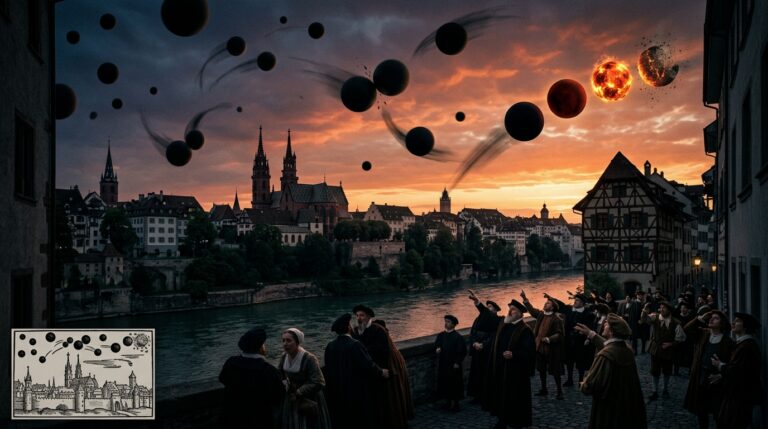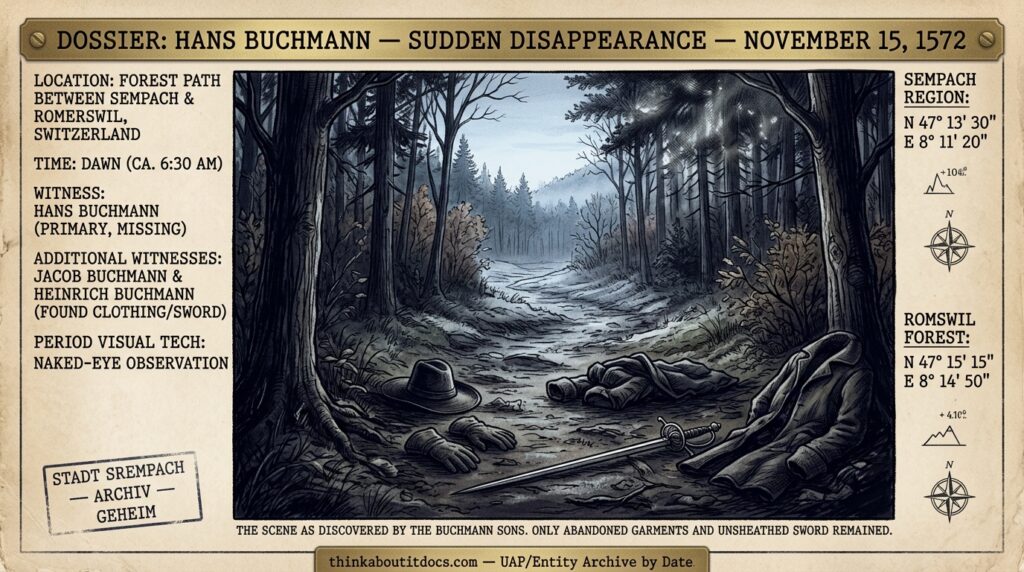
Where Hans Buchmann vanished — Romerswil, November 1572
THINK ABOUTIT ENTITY ENCOUNTER REPORT
1572: The Hans Buchmann Abduction | Romerswil to Milan
A 50-year-old farmer vanishes on a familiar forest path, leaving his hat, coat, gloves, and unsheathed sword scattered on the ground. Two and a half months later he reappears 190 miles away in Milan — hairless, swollen-faced, and with no memory of how he got there. The case survives because a named town chronicler sat in on the interrogation and wrote down what Hans Buchmann said, in his own words, while the details were still fresh.
Date: November 15, 1572 (disappearance); February 2, 1573 (return)
Sighting Time: Dawn, returning from Sempach
Day/Night: Day
Location: Romerswil to Sempach, Switzerland (disappearance); Milan, Italy (reappearance)
Urban or Rural: Rural (forest path); reappearance in the urban center of Milan
No. of Entity(‘s): Not directly seen; presence inferred from the “music” and lifting sensation described by Buchmann
Entity Type: Not Applicable — no entity visually described
Entity Description: Not Applicable
Hynek Classification: Not Applicable — no craft or aerial object described in the source account; classified here as an entity/missing-time encounter outside the standard Hynek scale
Duration: Approximately ten weeks of missing time (November 15, 1572 to February 2, 1573)
No. of Object(s): Not Applicable
Description of the Object(s): Not Applicable
Shape of Object(s): Not Applicable
Size of Object(s): Not Applicable
Color of Object(s): Not Applicable
Distance to Object(s): Not Applicable
Height & Speed: Not Applicable
Number of Witnesses: One direct witness (Hans Buchmann); his sons as secondary witnesses to physical evidence left at the scene
Special Features/Characteristics: Total loss of hair on the head, face, and chin and severe facial swelling on return, sufficient that his own family did not immediately recognize him; recovered clothing and unsheathed sword at the disappearance site
Case Status: Unexplained
Source: Town chronicle of Romerswil; Renward Cysat (1545–1614), town chronicler, present at Buchmann’s interrogation
Summary/Description: Hans Buchmann, a 50-year-old farmer, set out from Romerswil to pay a debt and attend to business in nearby Sempach. He did not return. His sons found his hat, coat, gloves, and his unsheathed saber and sheath scattered along the forest path, prompting suspicion that his cousin Klaus — a longstanding family enemy — had murdered him. Four weeks later, word came that Buchmann was alive in Milan. He returned home on February 2, 1573, over two and a half months after vanishing, with no hair anywhere on his head, face, or chin, and a face so swollen his own family did not immediately recognize him.
Related Cases: 1586: Alison Pearson, Grangemuir, Scotland | 1207/1211: Gravesend, Kent, England
Detailed Report
Because his disappearance triggered a formal murder investigation against his cousin Klaus, Buchmann’s account survives in unusual detail — recorded by town chronicler Renward Cysat, who was present at the interrogation once Buchmann returned. Buchmann explained that he had been carrying money to settle a debt of sixteen florins with innkeeper Hans Schürmann. Finding Schürmann away, he attended to other business in Sempach, stayed until dawn drinking only lightly, then set off home through the forest.
On the path, he described hearing a strange noise — first like a swarm of bees, then resolving into something more like music. Frightened and disoriented, he drew his sword and swung it at the air around him, in the process losing his hat, gloves, and coat — the items his sons later found scattered on the ground. He reported losing consciousness with the sensation of being lifted into the air, and the next clear memory he could offer was finding himself, disoriented and in pain, with swelling around his face and head, in an unfamiliar country. He said he had gone without food or water for days. He did not know Milan and did not speak Italian, and was unable to communicate his situation until a German-speaking guard took pity on him and helped him find his way home.
RESEARCHER’S NOTES
The Buchmann Case — Romerswil 1572 and the Missing Ten Weeks
- Source chain assessment: The account did not originate as folklore — it was recorded by a named town chronicler present at a formal legal interrogation prompted by a murder investigation, giving it a level of contemporary documentation rare for pre-modern anomalous accounts.
- Physical evidence / evidentiary weight: The recovered hat, gloves, coat, and unsheathed sword corroborate the location and manner of disappearance; the reported total hair loss and facial swelling on return are described by witnesses (his own family) but were not medically examined by any independent party as far as the surviving record shows.
- Pattern context / comparative cases: The distance and duration are the case’s most striking elements — Romerswil to Milan is roughly 190 miles across the Alps, a demanding journey even deliberately undertaken in the 16th century — and Buchmann’s account describes no memory of travel, only sudden relocation, a pattern echoed in other entity-abduction accounts in this archive such as the 1586 Alison Pearson case.
- Classification issues / corrections: Neither Buchmann nor Cysat described a craft or non-human entity in the terms this archive elsewhere uses for aerial phenomena; the “music,” disorientation, and sudden transportation were understood at the time within a demonic or fairy-abduction framework typical of the period, which is why no Hynek classification applies here.
Whatever happened to Hans Buchmann on the road from Sempach, the case is preserved with an unusual degree of period-appropriate rigor: a named chronicler, a formal interrogation, physical evidence at the disappearance site, and a witness account given in the subject’s own words shortly after the fact.
“Before losing consciousness he could feel that he was being lifted up into the air. He was taken to another country. He was disoriented and confused, with no idea where he was. He felt pain and swellings in his face and around his head.”