Crosses over Constantinople — three days in February 1572
THINK ABOUTIT UFO|UAP SIGHTINGS REPORT
The Constantinople Crosses of 1572 | Three Days Over the Mosques
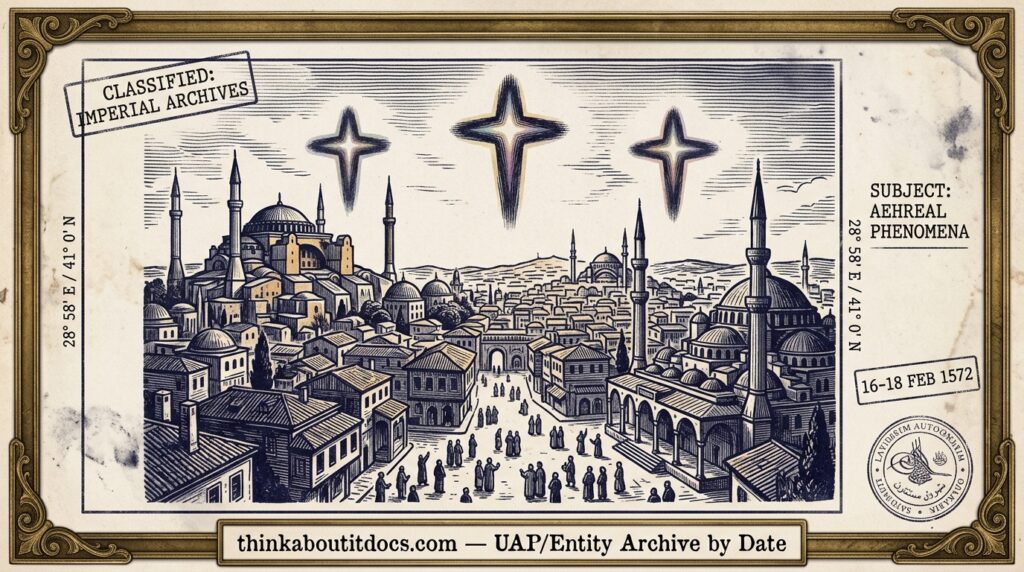
For three consecutive days over besieged Constantinople, cross-shaped objects hovered above three of the city’s mosques, changing color, drawing crowds from every faith in the city, and — according to the printed broadsheet that preserved the account — vanishing each time Ottoman soldiers fired on them, only to reappear moments later.
Date: February 16–18, 1572 (Thursday through Saturday)
Sighting Time: Not recorded (multi-day daylight sightings implied)
Day/Night: Day
Location: Constantinople (present-day Istanbul), Ottoman Empire
Urban or Rural: Urban — major imperial capital
No. of Entity(‘s): Not Applicable
Entity Type: Not Applicable
Entity Description: Not Applicable
Hynek Classification: DD (Daylight Disc)
Duration: Three consecutive days
No. of Object(s): Three
Description of the Object(s): Cross-shaped forms hovering high above the rooftops of three mosques, continuously changing color
Shape of Object(s): Cross
Size of Object(s): Not recorded
Color of Object(s): Continuously changing color (not further specified)
Distance to Object(s): High above mosque rooftops (exact altitude not recorded)
Height & Speed: Stationary/hovering, high above rooftop level
Number of Witnesses: Not recorded — described as visible to the entire population of the city
Special Features/Characteristics: Reportedly vanished momentarily whenever Ottoman soldiers fired projectiles at the objects, then reappeared immediately afterward
Case Status: Insufficient Data
Source: Warhaffte Zeitung vnd Beschreibung der Stadt Constantinopel Dreyer Creutz Gesicht (Augsburg: Hans Rogel, 1572), Staats- und Universitätsbibliothek Göttingen, 4° H TURC. 712
Summary/Description: Three cross-shaped objects reportedly appeared above three mosques in Constantinople — identified in the source as Piyale Pasha, an unnamed second mosque, and Hagia Sophia — floating high above the rooftops and continuously changing color, visible to the entire city over three consecutive days. Christian residents reportedly took the crosses as a sign of divine favor, while Ottoman authorities, after consulting with the city’s Jewish community (who suggested Christian sorcery was responsible), ordered troops to fire on the objects. Each time a projectile approached, the crosses reportedly vanished momentarily before reappearing.
Related Cases: 1528: Utrecht siege cross | 312 CE: Constantine’s luminous cross, Milvian Bridge
Detailed Report
The account survives as a printed German broadsheet — a common 16th-century news format used to report battles, disasters, celestial omens, and other events of public interest, typically produced quickly and sold cheaply for wide circulation. This particular pamphlet, printed in Augsburg by Hans Rogel in 1572, frames the sighting explicitly within the religious and political tension of Ottoman-ruled Constantinople, where a significant Christian population lived under Turkish administration.
According to the pamphlet, the crosses appeared above three mosques rather than churches — a detail the text frames as a deliberate divine message aimed at both comforting the city’s Christian captives and unsettling its Muslim and Jewish residents. The social response described is layered: Christians are said to have rejoiced at the sight, Ottoman authorities responded with confusion and alarm, and — per the pamphlet’s account — sought an explanation from the city’s Jewish community, who suggested the display was Christian sorcery intended to intimidate. This attribution led, in the pamphlet’s telling, to violent retaliation against Christian troops and an attempt to physically destroy the objects with gunfire, an effort the text says repeatedly failed as the crosses vanished and reappeared.
RESEARCHER’S NOTES
The Constantinople Crosses — Constantinople 1572 and a Broadsheet at the Center of Religious Conflict
- Source chain assessment: 16th-century German broadsheets covering the Ottoman Empire were frequently produced for a Christian European audience already primed for anti-Ottoman sentiment during the era of the Turkish wars, and often embedded explicit religious triumphalism in their framing. The pamphlet’s narrative — crosses appearing specifically over mosques to comfort Christians and confound Muslims and Jews — should be read with that context in mind rather than as neutral reportage.
- Classification issues / corrections: The “vanish when fired upon” detail is the pamphlet’s most striking and least independently verifiable claim; no second contemporary source for this specific behavior has been identified. It is retained here as reported, not as independently corroborated, and factored into the Insufficient Data case status.
- Pattern context / comparative cases: A natural halo or sun-cross phenomenon cannot be ruled out — luminous cross shapes in the sky are a documented feature of certain atmospheric optical displays (parhelic circles intersecting with sun pillars can produce a cross-like pattern) — but the pamphlet’s account of repeated appearance over three consecutive days at three specific locations, and the reported vanishing under fire, go beyond what a simple halo display would produce. Compare the 1528 Utrecht siege cross, another period cross-in-the-sky account tied to a military conflict.
- Geographic or historical context: The source attributes the Ottoman decision to attack Christian troops partly to advice from the city’s Jewish community. This detail is preserved as part of the historical document’s own framing and is not presented by this archive as an endorsed account of events — 16th-century polemical pamphlets of this kind routinely assigned blame along religious lines in ways modern readers should treat with appropriate skepticism.
The Constantinople crosses remain one of the more vivid entries in the 16th-century archive precisely because of how thoroughly the surviving source is shaped by the religious conflict surrounding it — a useful reminder that period documentation of unusual sky phenomena rarely arrives free of the political and religious lens through which contemporaries viewed it.
“Whenever a missile was about to hit them, the crosses vanished momentarily, only to reappear immediately afterwards.”