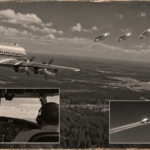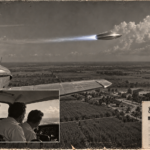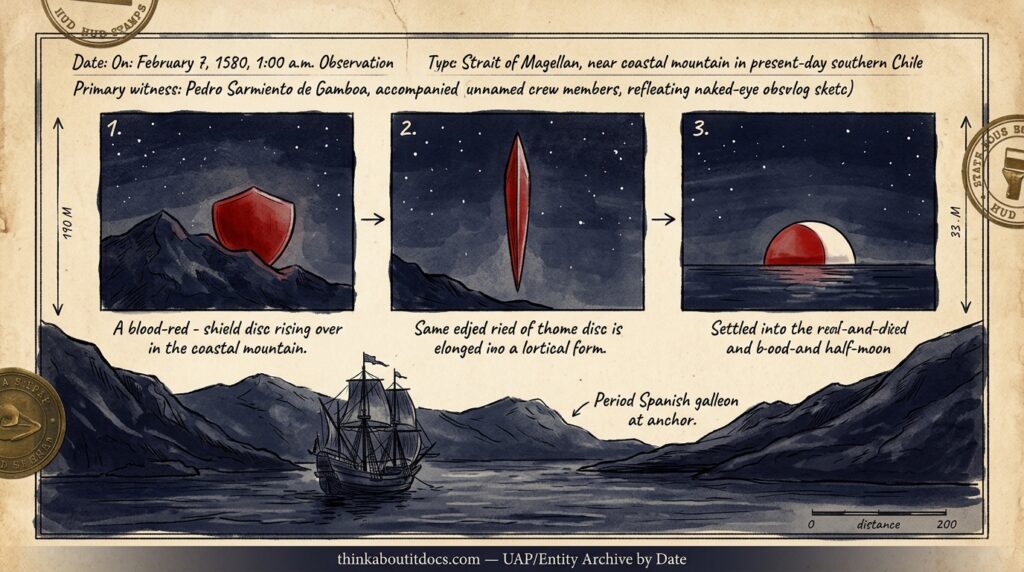
Circle, lance, half-moon — the shape-shifting object over the Strait of Magellan, 1580
THINK ABOUTIT UFO|UAP SIGHTINGS REPORT
1580: The Strait of Magellan Shield-Object | Sarmiento de Gamboa’s Log
In the early hours of a February morning, Spanish navigator Pedro Sarmiento de Gamboa recorded in his official expedition log a red, shield-shaped object that rose over a mountain near the Strait of Magellan and changed shape three times — circle, lance-like elongation, half-moon — before he stopped watching. Sarmiento de Gamboa was not a folklorist or a chronicler working secondhand: he was the expedition’s own navigator, logging what he personally observed as part of the ship’s official record.
Date: February 7, 1580
Sighting Time: 1:00 a.m.
Day/Night: Night
Location: Strait of Magellan (present-day southern Chile)
Urban or Rural: Rural/remote — uncolonized coastal strait
No. of Entity(‘s): Not Applicable
Entity Type: Not Applicable
Entity Description: Not Applicable
Hynek Classification: NL (Nocturnal Light)
Duration: Not recorded (observation ended when the navigator stopped watching)
No. of Object(s): One
Description of the Object(s): A round, shield-like object that rose over a mountain, elongated into a lance-like vertical form, then settled into a half-moon shape
Shape of Object(s): Sequential — circle/shield, then elongated lance, then half-moon
Size of Object(s): Not recorded
Color of Object(s): Red like fire, later described as between red and white
Distance to Object(s): Rising above a nearby mountain, exact distance not recorded
Height & Speed: Rose above mountain height; speed not recorded
Number of Witnesses: One named witness (Pedro Sarmiento de Gamboa); expedition crew likely present but not individually named
Special Features/Characteristics: Three-stage shape transformation, illustrated by the navigator’s own sketches in the log; compared by the observer to an “adarga,” a period military shield shape
Case Status: Unexplained
Source: Logbook of Pedro Sarmiento de Gamboa (c. 1530–1592), Spanish navigator and founder of two ports on the Strait of Magellan, from his account of his 1579–1581 voyages, Viajes al Estrecho de Magallanes
Summary/Description: Looking south-southeast, Sarmiento de Gamboa recorded seeing “a round thing appear, red like fire, like a shield, that rose up on the air.” As it passed over a nearby mountain the object elongated, taking a lance-like form high above the peak, before finally settling into the shape of a half-moon, colored between red and white. The navigator’s log includes simple accompanying sketches of the three shapes — a circle, an oval, and a half-moon — and compares the object’s initial appearance to an “adarga,” a round, oval, or heart-shaped shield of the period.
Related Cases: 1553: Porco, Peru — three suns, two moons
Detailed Report
Pedro Sarmiento de Gamboa is a well-documented historical figure — a Spanish navigator, cosmographer, and colonial administrator who led expeditions to fortify and colonize the Strait of Magellan on behalf of the Spanish crown, founding the short-lived settlements of Nombre de Jesús and Ciudad del Rey Don Felipe. His account of the 1580 sighting appears within his broader travel narrative of the 1579–1581 expedition, a work primarily concerned with navigation, geography, and colonial logistics rather than supernatural or anomalous phenomena — which lends the sighting a degree of incidental, matter-of-fact credibility distinct from broadsheets or chronicles compiled specifically to report wonders.
The object’s described sequence — a red, circular “shield” shape rising over a mountain, then stretching into an elongated lance-like form, then settling into a half-moon shape of mixed red and white coloration — is notable for its explicit three-stage shape change, illustrated by Sarmiento de Gamboa’s own simple sketches in the log. His comparison to an “adarga,” a Moorish-derived shield shape common in period military equipment (and referenced elsewhere in period literature, including Cervantes’s near-contemporary Don Quixote), reflects an attempt to describe an unfamiliar shape using the most precise everyday visual vocabulary available to a 16th-century Spanish military officer.
RESEARCHER’S NOTES
The Magellan Shield-Object — Strait of Magellan 1580 and an Official Log, Not a Folk Tale
- Source chain assessment: Unlike many entries in this archive drawn from secondhand chronicles or later compilations, this account comes directly from the observer’s own official expedition log, written by a named, historically documented naval officer in his professional capacity.
- Classification issues / corrections: A bright meteor, an unusual atmospheric optical effect, or unusual cloud illumination near the horizon could each explain isolated elements of the account, but the specific three-stage shape progression described and sketched by the observer is not typical of any single common natural phenomenon, which is why the case remains classified Unexplained rather than Explained.
- Pattern context / comparative cases: Shape-shifting luminous objects appear throughout the 16th-century record in this archive (compare the 1553 Porco, Peru entry), though this case is distinguished less by its content than by its source — a professional navigator’s own hand, in an official log.
- Physical evidence / evidentiary weight: No secondary corroboration has been located; as with many single-observer 16th-century accounts, no second witness or independent contemporary source for this specific sighting has been identified, limiting the case to a single first-person source however credible.
The Strait of Magellan sighting stands out in the 16th-century record less for its content than for its source: a professional navigator’s own hand, in an official log, describing something he could not readily categorize using the vocabulary of his trade.
“We saw a round thing appear, red like fire, like a shield, that rose up on the air or aloft the wind. It became longer as it went over a mountain and, in the form of a lance high above the mount, its shape became like a half-moon between red and white in color.”