The sign the fleet took for victory — Lepanto, September 1571
THINK ABOUTIT UFO|UAP SIGHTINGS REPORT
1571: The Lepanto Fiery Column | An Omen Before History’s Great Naval Battle
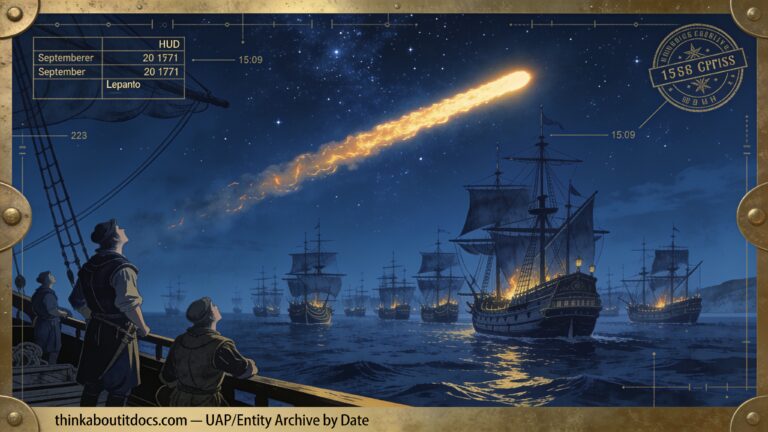
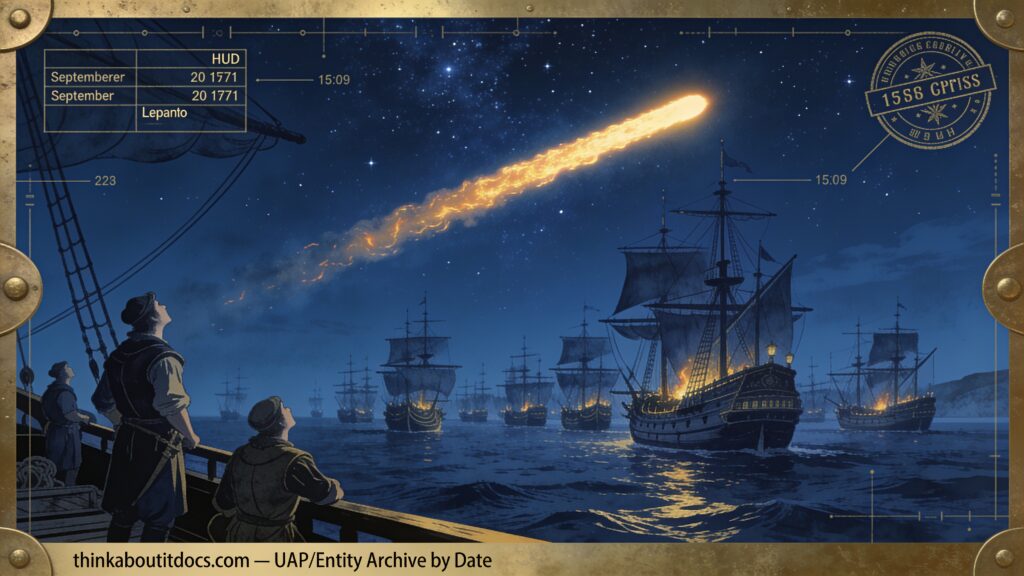
Seventeen days before the largest naval battle in the Mediterranean since antiquity, a colossal column of fire crossed the night sky over the papal fleet massed near Lepanto. The Christian sailors and soldiers who watched it took it as confirmation they would win. On October 7, 1571, they did — decisively defeating the Ottoman fleet in the Battle of Lepanto, one of the most consequential naval engagements in European history.
Date: September 20, 1571
Sighting Time: Evening
Day/Night: Night
Location: Off Lepanto (present-day Nafpaktos, Greece), Gulf of Corinth
Urban or Rural: At sea, off a coastal port town
No. of Entity(‘s): Not Applicable
Entity Type: Not Applicable
Entity Description: Not Applicable
Hynek Classification: NL (Nocturnal Light)
Duration: Described as “over a long period of time” (exact duration not recorded)
No. of Object(s): One
Description of the Object(s): A colossal fire in the form of a shining, flaming column crossing the sky
Shape of Object(s): Column
Size of Object(s): Described as “colossal”; no further measurement recorded
Color of Object(s): Shining, flaming — bright fire coloration
Distance to Object(s): Not recorded
Height & Speed: Crossed the sky; exact height and speed not recorded
Number of Witnesses: Not recorded — described as the assembled Christian fleet, with two named witnesses (Sereno and Caracciolo) cited by the historian
Special Features/Characteristics: Interpreted by witnesses as divine guidance comparable to the biblical pillar of fire leading the Israelites; occurred seventeen days before the decisive Battle of Lepanto
Case Status: Insufficient Data
Source: Padre Alberto Guglielmotti, La Guerra dei Pirati e la Marina Pontificia dal 1500 al 1560 (Florence: Le Monnier, 1876), based on statements from witnesses Sereno and Caracciolo
Summary/Description: On a clear, starry night with a cool northerly wind, a colossal fire in the form of a shining, flaming column was reportedly seen by the assembled Christian fleet crossing the sky over an extended period. Witnesses, per the account of the papal fleet’s official historian, regarded it as a good omen and believed it guided their ships in the same way the biblical Israelites were led across the desert. Seventeen days later, the Holy League’s combined Christian fleet decisively defeated the Ottoman navy under Sultan Selim II at the Battle of Lepanto, ending the immediate Ottoman naval threat to Christian Mediterranean shipping.
Related Cases: 1572: Constantinople cross-shaped objects | 1553: Porco, Peru — three suns, two moons
Detailed Report
The account comes to us through Father Alberto Guglielmotti, the official historian of the papal fleet writing three centuries after the fact, who based his record of the sighting on statements attributed to two named witnesses, Sereno and Caracciolo. Guglielmotti’s broader work is a serious historical treatment of Mediterranean naval warfare in this period, not a compendium of wonders, which lends some institutional weight to his inclusion of the sighting — though the three-century gap between the event and its documented recording means the account passed through at least one, and likely several, intermediate retellings before reaching print.
The Battle of Lepanto itself is one of the best-documented military engagements of the 16th century — a decisive Holy League victory over the Ottoman fleet that halted, for a generation, Ottoman naval expansion in the western Mediterranean. The fiery-column sighting’s proximity to this historically pivotal and thoroughly documented battle is almost certainly why it survived in the record at all: omens interpreted retroactively as predicting major military outcomes were a standard feature of period historiography, and the column’s interpretation as divine guidance for the coming victory fits a well-established narrative pattern common to accounts of major pre-modern battles.
RESEARCHER’S NOTES
The Lepanto Column — Lepanto 1571 and an Omen Before History’s Great Naval Battle
- Source chain assessment: Guglielmotti wrote in 1876, three centuries after the September 1571 sighting; while he names two witnesses, no surviving contemporary 1571-era document for this specific sighting has been identified independent of his account.
- Pattern context / comparative cases: Retroactive-omen framing is common to the genre — pre-battle celestial signs interpreted after a decisive victory as having foretold it are a recurring narrative pattern in period historiography — and this framing should be weighed accordingly rather than treated as contemporaneous, unbiased reporting.
- Classification issues / corrections: A bright meteor or fireball remains the most parsimonious natural explanation for a “shining, flaming column crossing the sky,” though the described extended duration (“over a long period of time”) sits awkwardly with typical meteor durations of a few seconds, which is why the case is classified Insufficient Data rather than Explained.
- Geographic or historical context: Unlike many entries in this archive, the surrounding historical event — the Battle of Lepanto itself — is not in any doubt and is one of the most thoroughly documented military engagements of the period, giving the sighting account a firm chronological anchor even where the sighting’s own sourcing is comparatively thin.
The Lepanto column is best read as a period-typical omen narrative attached to a genuinely pivotal historical event — plausible as a bright meteor or fireball misremembered or embellished with extended duration through three centuries of retelling, but not independently verifiable beyond Guglielmotti’s 1876 account.
“A colossal fire in the shape of a shining, flaming column was seen by everyone to cross the sky over a long period of time, filling all the witnesses with great admiration.”