Two hours over Besançon — the red cloud of January 1603
THINK ABOUTIT UFO|UAP SIGHTINGS REPORT
1603 The Besançon Red Cloud | Two Hours Over the City
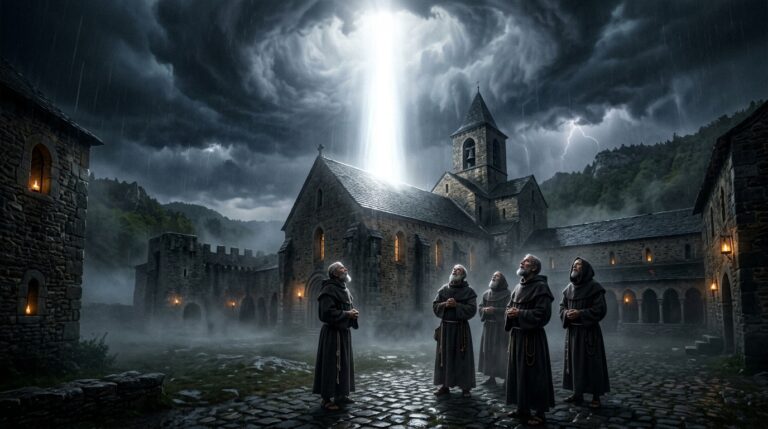
A round, heavy, reddish cloud hangs motionless over a French mountain for the better part of an hour, then drifts down into the city at a pace so slow the Franciscan monastery official watching it could barely detect the motion — pausing over a saint’s relics, crossing a public square, and finally vanishing over the cathedral after a two-hour journey he timed to the half hour.
Date: January 23, 1603
Sighting Time: Between 7:00 and 9:30 p.m.
Day/Night: Night
Location: Besançon, France
Urban or Rural: Urban — city streets, Mount Saint-Étienne, and the cathedral district
No. of Entity(‘s): Not Applicable
Entity Type: Not Applicable
Entity Description: Not Applicable
Hynek Classification: NL (Nocturnal Light)
Duration: At least two hours (7:00/8:00 p.m. to 9:30 p.m.)
No. of Object(s): One
Description of the Object(s): A great light in the air manifesting as a round, heavy cloud, reddish in color, under an otherwise clear, star-filled sky
Shape of Object(s): Round
Size of Object(s): Large enough to cover the whole of Mount Saint-Étienne
Color of Object(s): Reddish
Distance to Object(s): Descended low enough to nearly touch nearby houses and illuminate the streets
Height & Speed: Initially near-motionless over the mountain; later movement described as “so slow it was hardly noticeable”
Number of Witnesses: Not recorded — described as the assembled population of Besançon, with the named witness a Franciscan Visitor to the Sainte-Claire monastery
Special Features/Characteristics: Paused for at least fifteen minutes directly over Saint-Vincent Abbey, where relics of two saints were kept, before continuing its slow traverse of the city and vanishing over the cathedral
Case Status: Unexplained
Source: Reverend Jacques Fodéré, Narration Historique et Topographique des Convens de l’Ordre de St-François (Lyon: Pierre Rigaud, 1619), pp. 10–11
Summary/Description: Reverend Jacques Fodéré, Visitor to the Sainte-Claire monastery in Besançon, records that on Thursday, January 23, 1603, between 7 and 8 p.m., he went into the streets after being told the terrified population was gathering there, and saw a great light in the air over the cathedral — a round, heavy, reddish cloud covering the whole of Mount Saint-Étienne, under a clear sky with stars shining brilliantly. The light remained nearly motionless over the mountain, then descended so low it nearly touched nearby houses, lighting the streets with a motion so slow it was barely perceptible. It paused at least fifteen minutes over Saint-Vincent Abbey, where relics of two saints were kept, then crossed the Grande Place de Chamars to the Doubs river, traveled the Grande Rue to the bridge, and finally vanished over the cathedral — a journey Fodéré timed as lasting until 9:30 p.m., at least two hours in total.
Related Cases: 1608: Genoa USO battle, Italy
Detailed Report
Reverend Jacques Fodéré’s account is preserved in his own institutional history of Franciscan convents, published in 1619 — sixteen years after the sighting, but written by a cleric recording his own direct, named eyewitness experience rather than relaying secondhand testimony. Fodéré’s role as Visitor to the Sainte-Claire monastery placed him in Besançon on official business at the time, and his account is notable for its precision: he names specific streets, buildings, and landmarks the object passed over, and closes with an explicit time estimate for the object’s total transit — a level of geographic and temporal specificity uncommon even among the better-documented cases in this archive.
The object’s behavior resists easy categorization. Its initial appearance — a round, reddish, cloud-like light hanging over a mountain under otherwise perfectly clear, starry conditions — could suggest an unusual atmospheric or optical phenomenon, but the described subsequent behavior (descending to street level, pausing deliberately over a building holding sacred relics, then tracing a specific path through named city streets before vanishing at the cathedral) describes purposeful, low-altitude, controlled movement inconsistent with a passive atmospheric display. Fodéré explicitly notes the sky was otherwise cloudless and fog-free, ruling out a simple weather misidentification for the object’s initial appearance.
RESEARCHER’S NOTES
The Besançon Red Cloud — Besançon 1603 and Two Hours of Precisely Timed Movement
- Source chain assessment: Fodéré is a named, identifiable cleric recording his own firsthand observation in an institutional history, not an anonymous broadsheet or secondhand chronicle — one of the stronger single-source chains of custody in the early 17th-century archive, despite the sixteen-year gap to publication.
- Classification issues / corrections: The initial static appearance over the mountain is broadly consistent with an unusual atmospheric or optical phenomenon, but the reported controlled, low-altitude path through named city streets over a two-hour span does not fit any standard natural explanation, which is why the case remains classified Unexplained.
- Pattern context / comparative cases: The extended, precisely timed slow movement of a luminous object through a populated area recurs elsewhere in the 17th-century record (compare the 1619 Prague fiery globe sequence and the 1608 Genoa entity encounters), suggesting a recognizable period type of “purposeful low-altitude light” account distinct from the more common static or fast-moving fireball reports.
- Geographic or historical context: The object’s pause specifically over Saint-Vincent Abbey’s saintly relics was almost certainly read by contemporaries as religiously significant, consistent with the period’s broader tendency to interpret unusual sky phenomena through a devotional lens.
The Besançon red cloud stands out for the specificity of its documentation — a named, credentialed witness tracking an anomalous light through named streets over a precisely bracketed two-hour window, a level of detail that leaves little room for casual misidentification even as the object’s actual nature remains unresolved.
“I saw a great light in the air over the cathedral, covering the whole of Mount Saint Etienne with a round-shaped, heavy cloud, reddish in color, while all the air was clear and the sky so devoid of fog that the stars were seen shining brilliantly.”