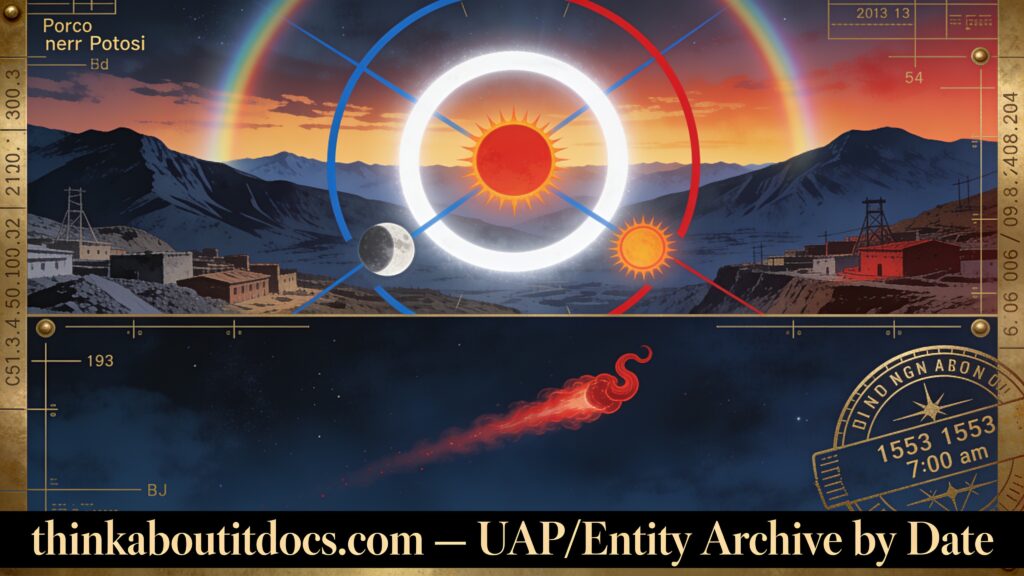
The sky over Porco — a halo display, two moons, and a comet that doesn't quite fit, January 1553
THINK ABOUTIT UFO|UAP SIGHTINGS REPORT
1553: Porco, Peru | Three Suns, Two Moons & a Blood-Red Comet
Fifty-two days before the assassination of General Pedro de Hinojosa amid the unrest surrounding the Hernández Girón rebellion, the sky above the mining town of Porco filled with a spectacle so elaborate that royal cosmologist Enrico Martínez recorded its geometry down to the span — three suns, two moons, colored arcs, and a blood-red comet that returned at dawn for seven consecutive days.
Date: January 13, 1553
Sighting Time: 7:00 a.m.
Day/Night: Day
Location: Porco, near Potosí (present-day Bolivia)
Urban or Rural: Rural mining town
No. of Entity(‘s): Not Applicable
Entity Type: Not Applicable
Entity Description: Not Applicable
Hynek Classification: NL (primary halo display); the associated “comet” element does not fit standard classification and is noted as unresolved
Duration: Primary display not timed; the associated “comet” was seen at dawn for seven consecutive days
No. of Object(s): Multiple (a great ring, two additional sun-images, two moon-images, two colored arcs, and a separately reported comet)
Description of the Object(s): A large white ring passing through the natural sun, flanked by two additional reddened suns and two white-red moons, with blue and red arcs; separately, a fiery blood-red comet with a curling head and matching tail
Shape of Object(s): Ring, disc (suns and moons), arc, and comet form
Size of Object(s): The ring was described as roughly half a league in diameter and a span in thickness
Color of Object(s): White ring; blood-red suns; white-red moons; blue and red arcs; blood-red comet
Distance to Object(s): Not recorded
Height & Speed: Not recorded
Number of Witnesses: Not recorded — described as observed by the town of Porco and surrounding areas
Special Features/Characteristics: Indigenous witnesses reacted with visible alarm, covering their faces and crying out words the Spanish chronicler transliterated as signifying disaster or enemy presence; the phenomenon was retroactively linked by the 1705 chronicler to General Hinojosa’s assassination fifty-two days later
Case Status: Explained (halo display) / Insufficient Data (comet element)
Source: Nicolás de Martínez Arzáns y Vela, Historia de la Villa Imperial de Potosí (1705), Ch. 2, citing royal cosmologist Enrico Martínez
Summary/Description: At seven in the morning, a large white ring appeared stretching toward the west, passing through the natural sun along with two additional suns and two moons. The natural sun appeared reddened, nearly blood-colored; the two flanking suns were intensely red, bright enough that observers had to avert their eyes. Two moons appeared white with a slight red tinge, and two colored arcs — blue and red — accompanied the display. Separately, a fiery, blood-red comet with a curling head and matching tail was seen in the region for seven consecutive dawns, accompanied by two additional arcs, one silver-white and one nearly blood-red.
Related Cases: 1571: Lepanto fiery column | 1580: Strait of Magellan shield-object
Detailed Report
The account survives through Nicolás de Martínez Arzáns y Vela’s 1705 Historia de la Villa Imperial de Potosí, written more than a century and a half after the fact but drawing on the contemporary record of Enrico Martínez, cosmologist to the Spanish crown in colonial Peru. The timing is politically loaded: the sighting is explicitly framed against the backdrop of the rebellion led by Francisco Hernández Girón, with the text noting that Don Sebastián and his allies were mustering forces for revolt in the same period, and that the phenomenon preceded General Hinojosa’s assassination by fifty-two days.
Martínez’s description of the primary display — a great ring passing through the sun, flanked by additional sun-images and moon-images, with colored arcs — is a textbook description of a parhelion (sun dog) or 22-degree halo display, an atmospheric optical phenomenon caused by sunlight refracting through hexagonal ice crystals in high cirrus clouds. Such displays can genuinely produce the appearance of multiple “suns” arranged around a central halo ring, along with colored arcs, and remain a well-documented, entirely natural phenomenon observed worldwide today.
The second element of the account — a blood-red comet with a curling head, visible at dawn for seven consecutive days — sits less comfortably within a single natural explanation. A genuine comet would not typically be described as “curly-headed” in this way, nor would its color usually register as deep blood-red to period observers; the seven-day dawn recurrence is also unusual for a single cometary apparition, which typically shifts position and brightness night to night rather than repeating a fixed appearance. Porco’s low-latitude, high-altitude Andean location also makes an aurora borealis misidentification implausible.
The social reaction recorded in the source is itself a significant part of the account: indigenous witnesses reportedly covered their faces and spat into the air, crying out words the Spanish chronicler transliterated as signifying “some bad event, abominable action, or frightful ruin” — the same term, Aucca, used generically for any visible or invisible enemy. Martínez explicitly links the display’s dual suns and moons to the subsequent political violence, framing the astronomical event as a portent of Hernández Girón’s rise and fall.
RESEARCHER’S NOTES
The Porco Halo Display — Porco 1553 and the Comet That Doesn’t Fit
- Classification issues / corrections: The primary display — ring, dual suns, dual moons, and colored arcs — closely matches a parhelion/22-degree halo display, a well-understood atmospheric optics phenomenon still observed and photographed today, and is classified NL accordingly. The associated “comet,” however, does not fit standard cometary or auroral classification and is left unresolved rather than folded into the halo explanation.
- Source chain assessment: While Martínez Arzáns y Vela published in 1705, he explicitly cites the eyewitness-era cosmologist Enrico Martínez’s account, giving the core description a contemporary chain of custody despite the later publication date. No independent second source for the sighting has been located.
- Pattern context / comparative cases: The pairing of a natural atmospheric display with a separately reported, harder-to-explain “comet” recurs elsewhere in this archive’s Roman and medieval entries (see the 91–90 BC Spoletium globe and the 1571 Lepanto fiery column), where genuine optical phenomena and less explicable secondary elements are frequently reported together in the same account.
- Geographic or historical context: Porco was a significant Andean mining center near Potosí, then the wealthiest silver-mining region in the Spanish Empire, and the sighting is explicitly woven into the source’s account of the Hernández Girón rebellion — a genuine political and military conflict of the period, distinct from the astronomical claim itself.
Taken as a whole, the Porco sighting is best read as two layered phenomena: a genuine, explicable halo display that would be unremarkable to a modern meteorologist, paired with a genuinely puzzling secondary “comet” report that resists easy explanation — all wrapped in the political portent-reading typical of the period’s chroniclers.
“There appeared in the sky, in Porco, the large ring that passes through the middle of the natural sun and through the other Suns and Moons… The natural sun was a little red, almost like blood, and the two at its side very red, just like blood, so much so that the brightness and fire caused those who saw it to avert their eyes.”