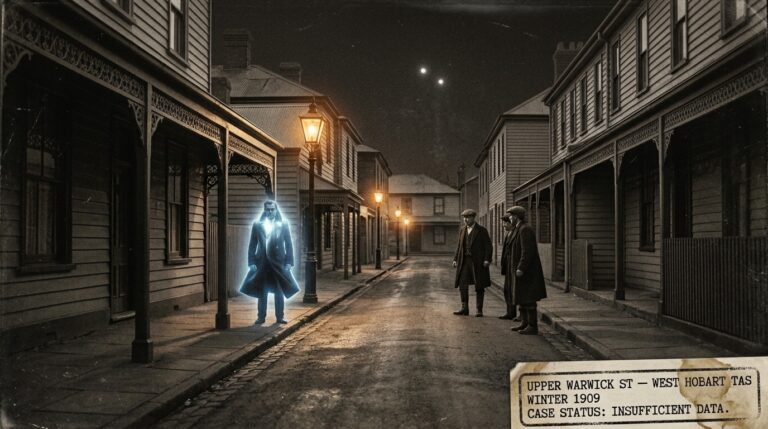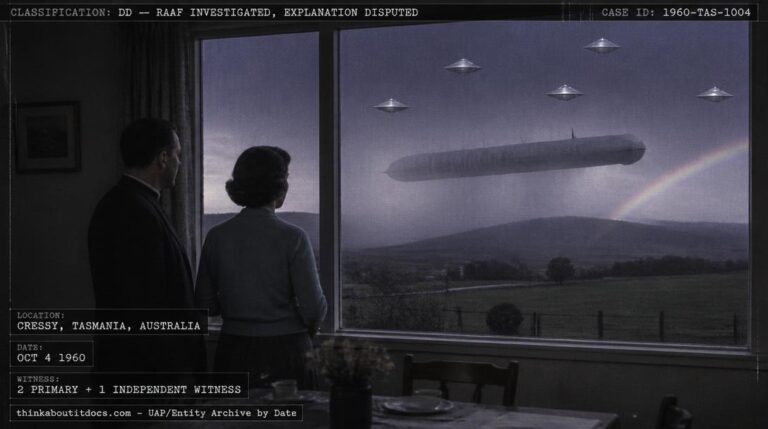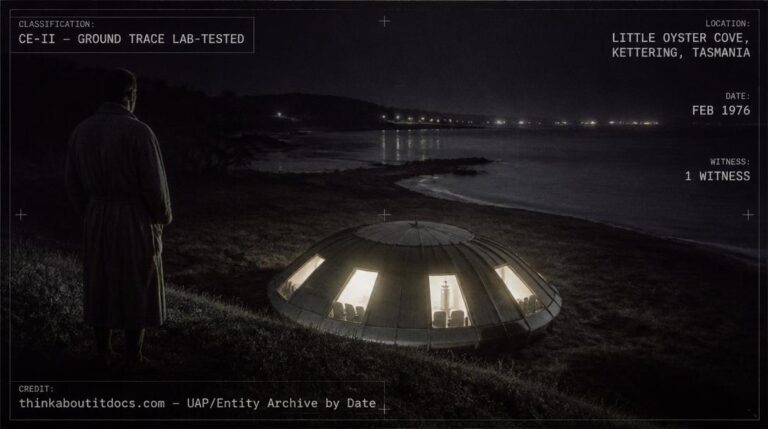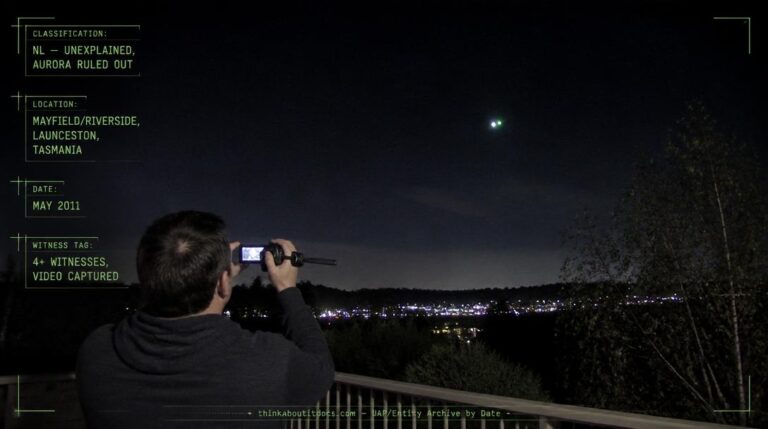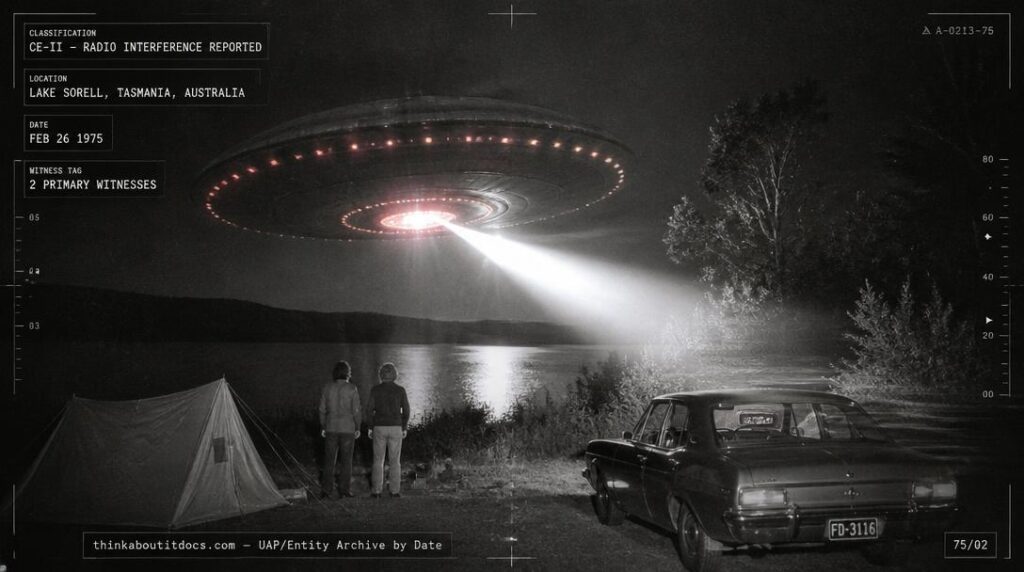
Recreation of the February 1975 Lake Sorell, Tasmania sighting, in which two fishermen watched a 200-foot disc close to 1,000 yards and sweep an intensely bright searchlight across the shoreline while their car radio dissolved into static.
THINK ABOUTIT UFO|UAP SIGHTINGS REPORT
1975: The Lake Sorell Searchlight, Tasmania, Australia
Camped on the shore of Lake Sorell, Tasmania to fish on the evening of February 26, 1975, a former RAAF tail gunner and his commercial-artist friend watched two red-and-orange-lit discs cross the sky before one closed the distance from 2.5 miles to 1,000 yards in an instant, hovered 500 feet above the water, and swept a painfully bright searchlight back and forth across the lakeshore — while their car radio dissolved into static the entire time.
Date: February 26, 1975
Sighting Time: 8:45 PM to approximately 9:30 PM
Day/Night: Night
Location: Lake Sorell, Tasmania, Australia — witnesses camped on the lakeshore
Urban or Rural: Rural
No. of Entity(‘s): Undocumented
Entity Type: Not Applicable — no entity described
Entity Description: Not Applicable
Hynek Classification: CE-II (Close Encounter II) — observation of an object in close proximity to the witness, with an associated electrical effect. This fits well: the object approached to close range and coincided with a specific, described interference effect on the witnesses’ car radio.
Duration: Approximately 5 minutes for the closest, most active phase of the encounter; the fuller sighting, from first notice to departure, spanned from 8:45 to 9:30 PM
No. of Object(s): 2 primary objects tracked closely by the witnesses (of an initial 3 “things” noticed, one smaller object was lost from view early on)
Description of the Object(s): Two large, disc-shaped craft, each showing a red, pulsing light at its center underside and additional red-to-orange lights around its circumference. One of the two closed rapidly from an estimated 2.5 miles to about 1,000 yards, coming to hover roughly 500 feet above the lake. It then projected an intensely bright beam of light downward — described as painful to look at directly and compared to a welding torch’s brilliance — roughly half the object’s own diameter across, which swept back and forth across the lakeshore as if conducting a deliberate search. After several minutes the beam switched off, leaving a blue-white glow hanging briefly above the water, and the object then departed at extremely high speed, rejoining the second craft, which had been holding position near Mt. Penny.
Shape of Object(s): Disc
Size of Object(s): Estimated by the primary witness at no less than 200 feet in diameter
Color of Object(s): Red, pulsing light at the center underside of each craft, with additional red-to-orange lights around the circumference; the search beam itself was intensely bright white, and a blue-white afterglow lingered briefly once it switched off
Distance to Object(s): Approximately 2.5 miles at first notice, closing to roughly 1,000 yards at closest approach
Height & Speed: Approximately 500 feet above the lake surface at closest approach. The witness described the closing speed as effectively instantaneous (“it was about 2.5 miles away when we saw it move — and then it was right there”) and the departure speed as comparable to watching a tracer round fired away from the observer.
Number of Witnesses: 2 primary witnesses at the sighting location (a former RAAF tail gunner, reported under the pseudonym “Smith,” and a friend who worked as a commercial artist), corroborated the following day by a separate group of anglers camped roughly a mile away, who independently reported their tent being lit up like daylight the same night
Special Features/Characteristics: The witnesses’ car radio, in use because a portable radio lacked sufficient range, produced loud, intense static specifically while the object was close to their campsite; sweeping the entire radio band turned up no stations, only static, for the duration. Both witnesses produced sketches of what they observed. No check for physical landing traces at the site is mentioned in the source.
Case Status: Insufficient Data — a detailed, internally consistent account from two witnesses, indirectly corroborated by a separate group who noticed unrelated but simultaneous lighting effects nearby, but relayed under a pseudonym with no independently verifiable identity for either primary witness
Source: APRO Bulletin, Vol. 24, No. 1 (July 1975), credited to William K. Roberts, APRO’s Tasmanian Representative
Summary/Description: Two men sighted two UFOs at Lake Sorell in Tasmania. “It was about 2-1/2 miles away when we saw it move — and then it was right there, only about 1,000 yards away and 500 feet above the lake.” The size of the object was no less than 200 feet in diameter. During the next few minutes the object turned on a “monstrous light” which was directed down toward the lake.
Related Cases: A separate, distinct sighting occurred at the same lake roughly three weeks later, on March 14, 1975, involving a different witness group (the Knapek family and friends) and a differently described object (football-shaped, yellow, no light-beam or radio-interference behavior). That case has been split into its own archive entry rather than merged into this one; it was originally reported alongside this case in the same APRO Bulletin article.
Detailed Report
The primary witness, reported under the pseudonym “Smith” to protect his identity, was a former Royal Australian Air Force tail gunner working as a professional man at the time of the sighting, camped at Lake Sorell with a friend, a commercial artist, for an evening of fishing. Around 8:45 PM, Smith noticed three indistinct shapes in the sky, initially assuming they were aircraft, until a clearer view through broken cloud ruled that out. Two large objects and one smaller one approached from the northeast; the smaller object was lost from view, but Smith tracked the two larger ones as they moved southwest toward the lake, briefly disappearing behind Dogs Head Point and reappearing near Mt. Penny. Each showed a pulsing red light at its center underside, ringed by additional red-to-orange lights. One of the two then closed the distance dramatically — from an estimated 2.5 miles to roughly 1,000 yards — hovering about 500 feet above the water. Smith described the closing speed as essentially instantaneous, saying he wouldn’t have believed a craft capable of it if he hadn’t seen it directly. He judged the object’s diameter at no less than 200 feet, using known local landmarks as reference points.
The object then projected an intensely bright beam of light down toward the lake, roughly half its own diameter in width, painful to look at directly and comparable, in Smith’s description, to the brilliance of a welding torch. The beam swept back and forth across the Robinson’s Swamp area in a pattern Smith interpreted as a deliberate, controlled search. Throughout this phase, the witnesses’ car radio, in use because their portable radio lacked sufficient range, emitted loud, continuous static; sweeping the entire band turned up no stations at all. After several minutes, the light switched off, leaving a faint blue-white glow hanging about 30 feet above the lake’s surface, and the object then departed at extreme speed — Smith likened watching it leave to watching a tracer round fired away from him — rejoining the second craft near Mt. Penny before both vanished from sight around 9:30 PM. The following day, the witnesses learned that a separate group of anglers camped roughly a mile away at Silver Plains had independently reported their tent being lit up “like daylight” from inside during the same window, an account Smith and his companion had not solicited or expected.
RESEARCHER’S NOTES
The Lake Sorell Searchlight — 1975 and a Testable Radio-Interference Claim
- Classification Assessment: CE-II fits well — close-range observation paired with a specific, described electrical interference effect (the car radio static) is precisely what the category covers, and this case has a cleaner match to CE-II than several other entries in this archive that lack any described physical or electrical effect at all.
- Source Chain Assessment: This case was documented by APRO (Aerial Phenomena Research Organization) through its Tasmanian representative, William K. Roberts — the same investigator behind this archive’s Cressy, Tasmania case — and published in the organization’s bulletin the same year. Both primary witnesses are anonymized, which limits independent follow-up, though the primary witness’s stated background (a former RAAF tail gunner, described as a reliable professional) is offered as a credibility marker within the original source, unverifiable independently here.
- Evidentiary Weight: No photograph accompanies the account, though both witnesses produced sketches. Its most notable evidentiary feature is the specific, checkable radio-interference claim — a full band sweep producing only static, coinciding precisely with the object’s closest approach — a detail that goes beyond a vague impression of “something electrical happening” and describes a concrete, testable observation, even though it cannot be independently verified at this remove.
- Pattern and Comparative Context: A bright, searchlight-like beam swept in a deliberate pattern across terrain below a hovering craft is a recurring motif in UFO literature, often interpreted by witnesses (as here) as evidence of an intelligently directed search. Reported radio and electrical interference coinciding with close UFO approach is a well-documented report category generally, valued specifically because it offers, in principle, an independently verifiable physical effect distinct from purely visual testimony.
- Geographic and Historical Context: Lake Sorell is a rural lake in Tasmania’s Central Highlands, popular for fishing, consistent with the witnesses’ reason for being there. This case falls within the same mid-1970s window as several other Tasmanian sightings investigated by APRO’s Roberts and archived elsewhere on this site.
A detailed, internally consistent account of a close approach, a deliberate-seeming searchlight sweep, and a specific, testable radio-interference claim — corroborated at a distance by an unrelated group of anglers who noticed something the same night without knowing why. Both primary witnesses remain anonymous, which limits how far this case can be independently verified. It stands as Insufficient Data.
“It was like watching a tracer bullet going away from you.”