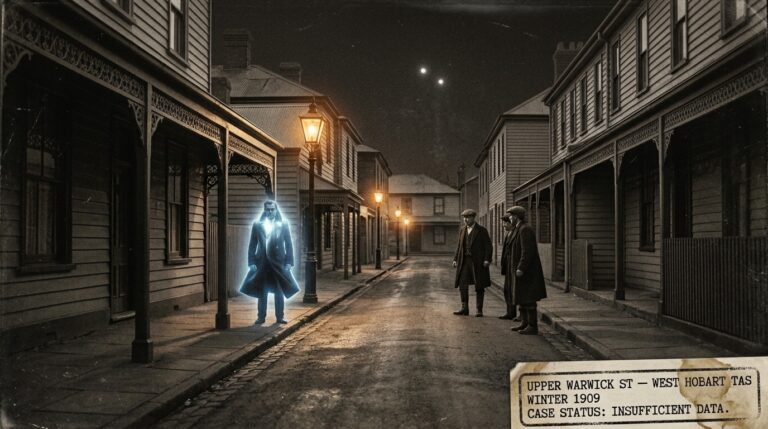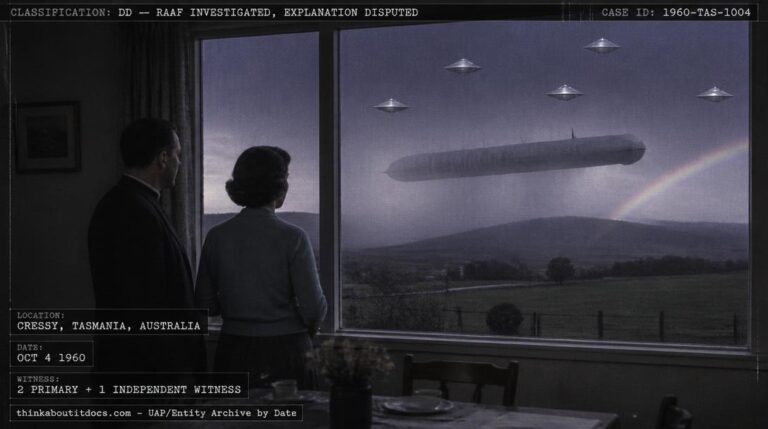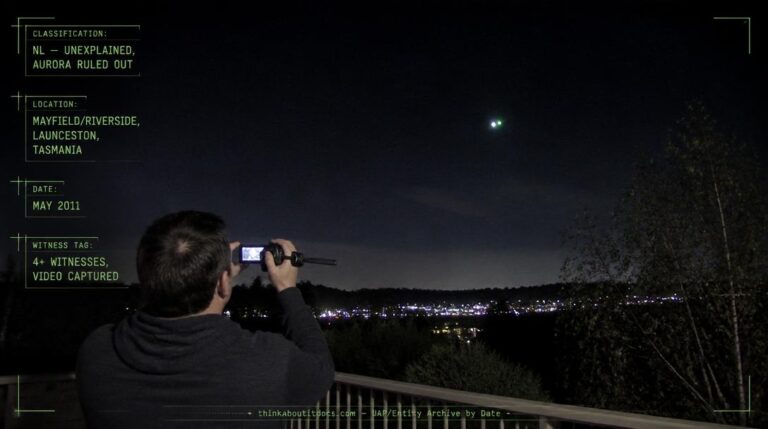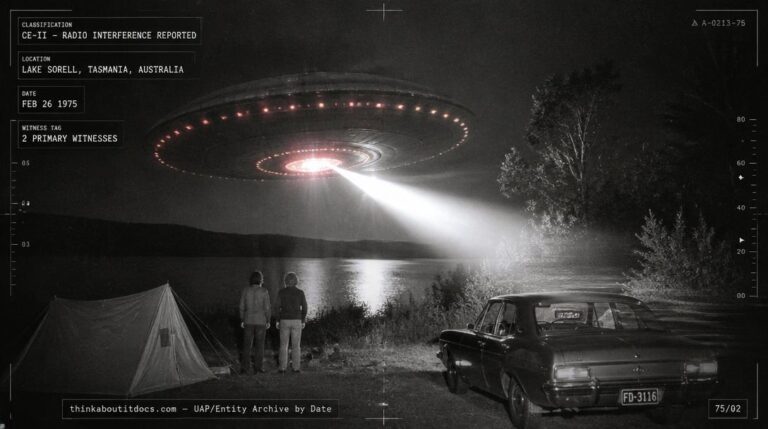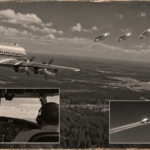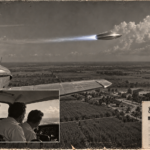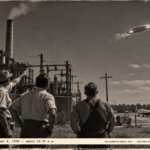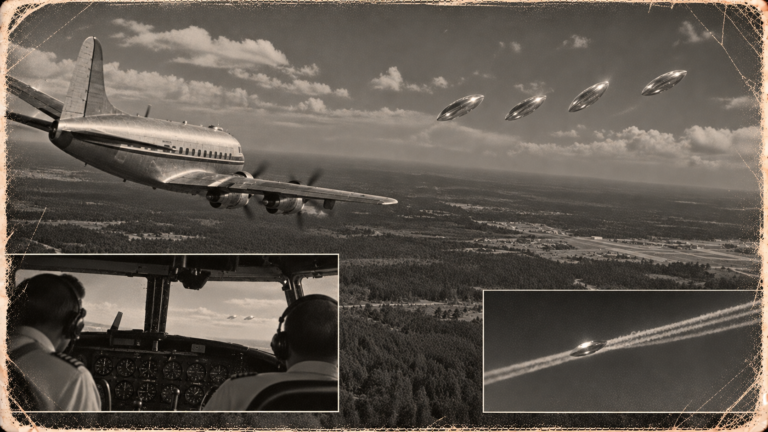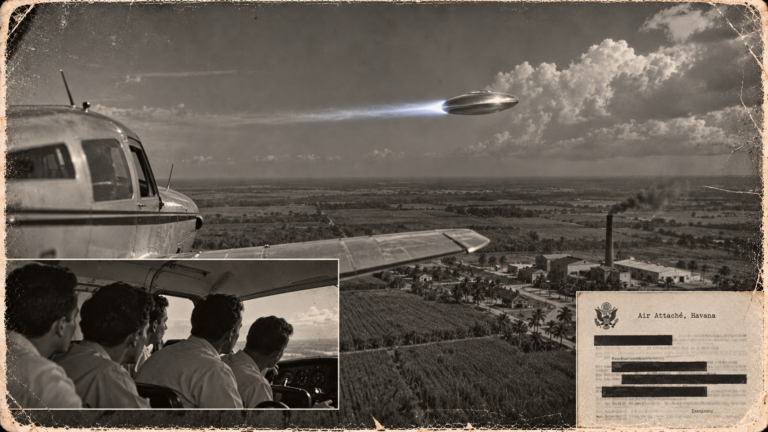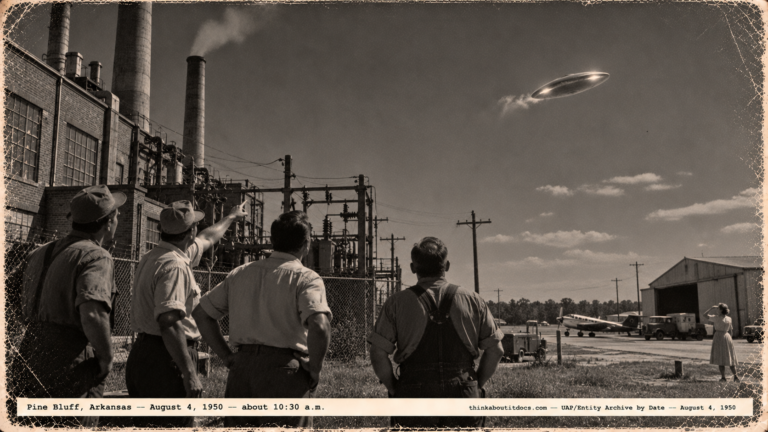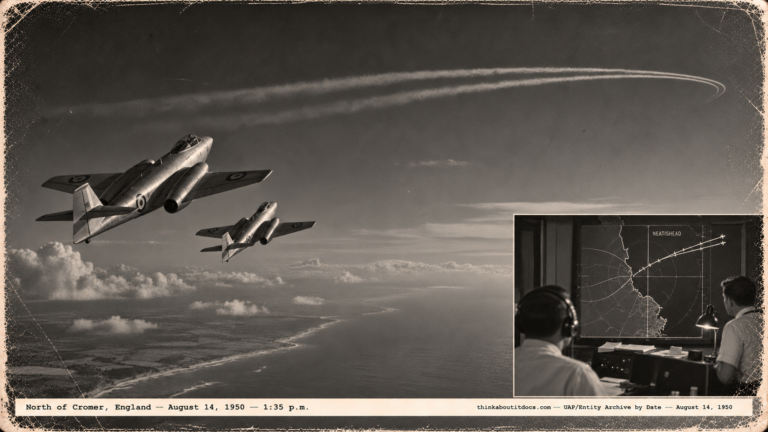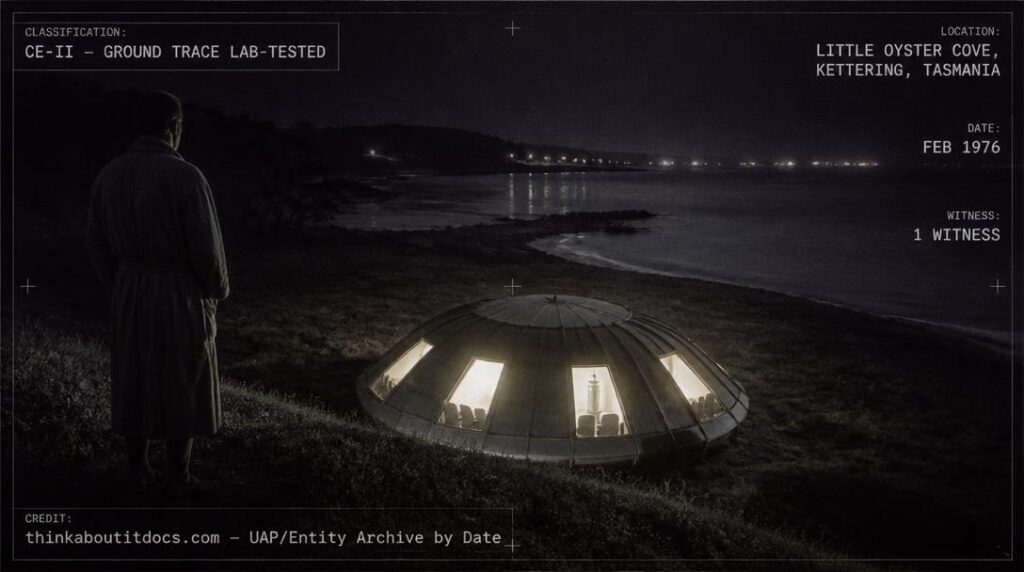
Recreation of the February 1976 Kettering, Tasmania landing, in which a witness watched a dome-shaped craft lift off from Little Oyster Cove, leaving behind a circular grass trace later tested by a scientist.
THINK ABOUTIT UFO|UAP|ENTITY ENCOUNTER REPORT
1976: The Kettering Landing, Little Oyster Cove, Tasmania
Woken by his crying child at 1 AM in February 1976, a 39-year-old Kettering, Tasmania man ran toward what he first feared was a plane crash on the shore of Little Oyster Cove — and instead found, just 25 meters below him, a glowing, dome-shaped, aluminium-ribbed object with windows he could see straight through, revealing a tall cylindrical fixture and rows of motionless grey shapes he could only compare to the backs of car seats, before the object lifted off with a rising hum and vanished into the sky.
Date: February 1976 (specific day undocumented)
Sighting Time: 1:00 AM
Day/Night: Night
Location: Little Oyster Cove, Kettering, Tasmania, Australia
Urban or Rural: Rural/coastal — Kettering is a small coastal town in southern Tasmania. Filled in from the original blank field.
No. of Entity(‘s): Undetermined — the witness observed what he described as “motionless grey shapes,” resembling the backs of car seats with headrests, visible through the object’s windows. Whether these represented occupants or equipment/furnishing was never established; the source itself treats this as uncertain (“perhaps entities”). Filled in from the original blank field.
Entity Type: Undetermined/possible — not confirmed as animate beings. Filled in from the original blank field.
Entity Description: Motionless grey shapes, likened by the witness to the backs of car seats with headrests, seen through the object’s windows alongside a separate tall, cylindrical fixture he compared to a ship’s compass mounting. No movement, faces, or other identifying detail was observed. Filled in from the original blank field.
Hynek Classification: CE-II (Close Encounter II) — observation of an object in close proximity to the witness, with physical traces left behind. This fits well: a landed object was observed at close range, and a genuine, later scientifically tested physical trace (scorched, then regrown grass) remained at the site.
Duration: Approximately 7 minutes total, from the witness’s initial approach to the object’s departure. Filled in from the original blank field.
No. of Object(s): 1
Size of Object(s): Undocumented
Distance to Object(s): Approximately 25 meters, viewed from a small rise above the landing site
Shape of Object(s): Dome-shaped, with a short vertical-sided base beneath a ledge below the windows
Color of Object(s): Aluminium-colored exterior with ribbing or ridging from the top; three or four brightly lit windows around its circumference
Number of Witnesses: 1 (the witness’s young child woke him but is not described as having independently observed or corroborated the object itself)
Special Features/Characteristics: A humming noise resembling an electric motor grew louder as the object lifted off, initially rising slowly before accelerating away and disappearing. The following morning, the witness found a circular patch of scorched-looking grass at the site, which subsequently died off and was replaced by tougher, different grass. A year later, when the Tasmanian UFO Investigation Centre examined the site, the regrown area stood out as noticeably greener than the surrounding, straw-colored grass, and was photographed for the record. Soil and mineral samples from the site were tested using thermoluminescence analysis by Dr. G. Stevens, who found no significant difference between the affected area and surrounding soil, concluding that surface soil had not been heated above approximately 170°C (and subsurface soil, at 5cm depth, not above approximately 155°C), and that the grass death and regrowth pattern was not caused by large doses of ionizing radiation.
Case Status: Unexplained (Investigated) — a single-witness sighting, but one that left a genuine physical trace subjected to real scientific testing, which ruled out substantial heating and ionizing radiation as causes without identifying what actually caused the grass die-off and altered regrowth.
Source: Bill Chalker, “The Oz Files: The Australian UFO Story” (Duffy & Snellgrove, Sydney, 1996), drawing on Chalker’s own research and the Tasmanian UFO Investigation Centre’s site examination and thermoluminescence analysis; illustrated by a witness sketch and a Flying Saucer Review photograph of the regrown grass patch taken one year after the sighting
Summary/Description: A 39-year-old man in Little Oyster Cove, Kettering, Tasmania encountered an extraordinary dome-shaped object that had landed. Through the windows of the metallic object, he saw a tall cylindrical object (which he likened to a ship’s compass mounting) and motionless grey shapes, perhaps entities. The object rose slowly from the ground, then increased speed and was gone. The next morning, a circular patch of scorched grass was found at the site.
Related Cases: Undocumented as a separate archive entry, though investigated by the same Tasmanian UFO Investigation Centre active in this archive’s other Tasmania cases, including the 1960 Cressy and 1975 Lake Sorell sightings
Detailed Report
Woken around 1 AM by his young child’s crying, a 39-year-old Kettering man noticed what looked like a plane descending from the eastern sky toward the shore of Little Oyster Cove, accompanied by a widespread glow. Fearing a crash, he hurried toward the light still in his dressing gown, reaching a small rise that gave him an unobstructed view, roughly 25 meters down the slope, of a dome-shaped object resting on the ground. Its aluminium-colored exterior carried ribbing or ridging from the top, with three or four brightly lit windows set above a ledge leading down to a short, vertical-sided base. Through the windows, he could make out a tall, cylindrical fixture he compared to a ship’s compass mounting, along with rows of motionless grey shapes he could only liken to the backs of car seats with headrests — occupants, equipment, or something else entirely, he could not say for certain.
As he drew closer, he heard a humming sound like an electric motor, which grew louder as the object began to rise from the ground, climbing slowly at first before accelerating away and shrinking to a dot in the sky. The full episode, from his approach to the object’s departure, lasted about seven minutes. Returning to the site the next morning, he found a circular patch of grass that appeared scorched where the object had rested; this grass subsequently died and was replaced by a tougher variety. When the Tasmanian UFO Investigation Centre examined the site roughly a year later, the regrown patch stood out distinctly greener than the surrounding, straw-colored grass, a difference striking enough to be photographed for Flying Saucer Review. Soil and mineral samples from inside and outside the affected circle were tested using thermoluminescence analysis, a technique capable of detecting past heat or radiation exposure in mineral particles, by analyst Dr. G. Stevens. His findings ruled out two of the more obvious conventional explanations: the surface soil had not been heated above roughly 170°C, subsurface soil no more than about 155°C — well short of what would be needed to scorch grass through simple heat exposure — and no elevated levels of ionizing radiation were detected either. What actually killed the original grass and altered its regrowth pattern was left unresolved by the analysis, which excluded rather than confirmed a specific cause.
RESEARCHER’S NOTES
The Kettering Landing — 1976 and a Trace That Passed Its Own Lab Test
- Classification Assessment: CE-II fits well and is unusually well supported here — a close-range landed object paired with a genuine physical trace that was actually subjected to scientific testing, rather than simply asserted, is a rare combination in this archive.
- Source Chain Assessment: This case comes from the same author, Bill Chalker, and the same 1996 book, “The Oz Files,” as this archive’s Father Gill/Boianai case, and shares that case’s credibility markers: a named, respected investigator with direct research access, and institutional follow-up by the Tasmanian UFO Investigation Centre. It remains, at its core, a single-witness sighting with no second observer of the object itself.
- Evidentiary Weight: The thermoluminescence analysis is the standout evidentiary feature of this case: a credentialed analyst (Dr. G. Stevens) tested actual soil and mineral samples and reported specific, quantified findings — upper bounds on soil heating at two depths, and no elevated ionizing radiation — rather than a vague assurance that “nothing unusual” was found. Importantly, this analysis ruled explanations out rather than in: it demonstrates the grass die-off wasn’t caused by extreme heat or radiation, but does not identify what did cause it, leaving a genuine, tested physical anomaly rather than a a fully “solved” one.
- Pattern and Comparative Context: Circular ground traces with altered, “stimulated” regrowth patterns are a recurring and specifically studied physical-trace category in UFO literature, valued because they offer testable material evidence independent of witness testimony. This case’s negative-but-specific lab findings (ruling out heat and radiation) place it among the more rigorously examined trace cases in this archive.
- Geographic and Historical Context: Kettering is a small coastal town south of Hobart, Tasmania. This case falls within the same mid-1970s window and investigative network (via TUFOIC) as this archive’s Lake Sorell case from the previous year, though the two are not otherwise connected.
A single witness, a dome-shaped craft glimpsed through its own lit windows, and a circular patch of ground that genuinely behaved strangely for a year afterward — strangely enough to be lab-tested, and specific enough in its results to rule out the two most obvious mundane causes without explaining what actually happened. That combination of witness account and tested physical trace is rare enough to be worth taking seriously. The case remains Unexplained.
“Motionless grey shapes — like car seats with headrests seen from the rear.”
Media

Kettering UFO, based on sketch by witness. (credit: Bill Chalker)
Photograph, taken one year after the sighting, showing region of stimulated grass growth that replaced grasses that were killed by the presence of the UFO. In the original color transparency the affected area stands out as a rich green region in straw-colored background. (credit: Flying Saucer Review)