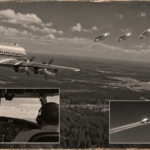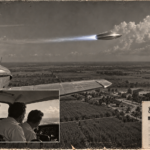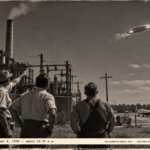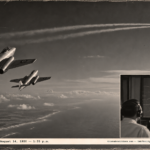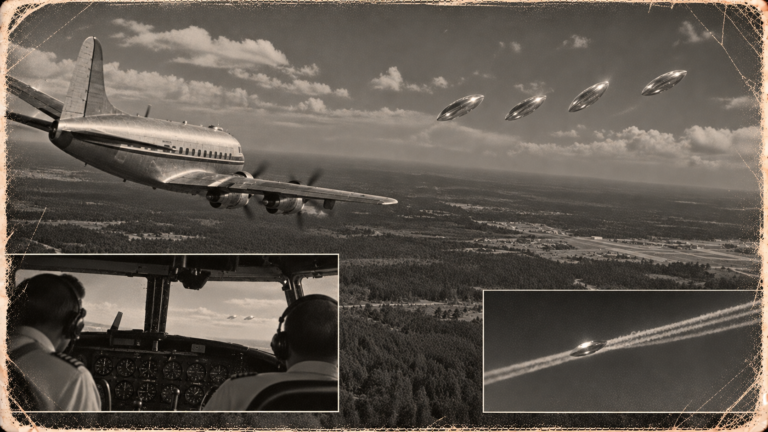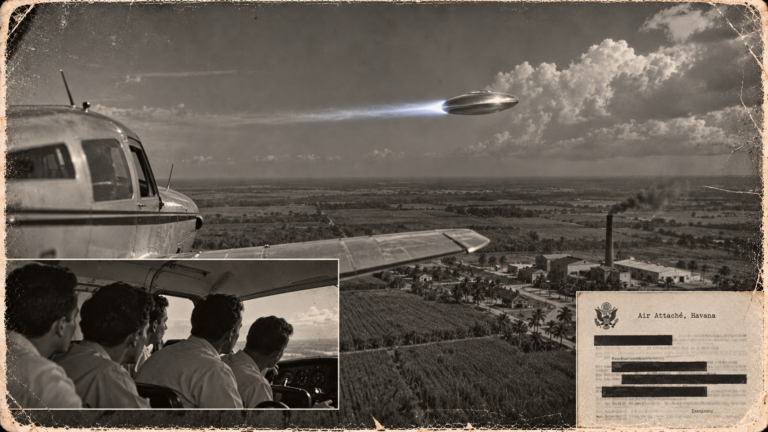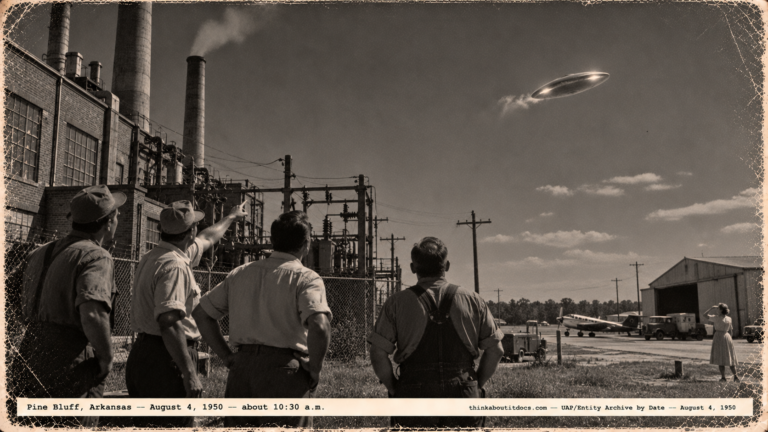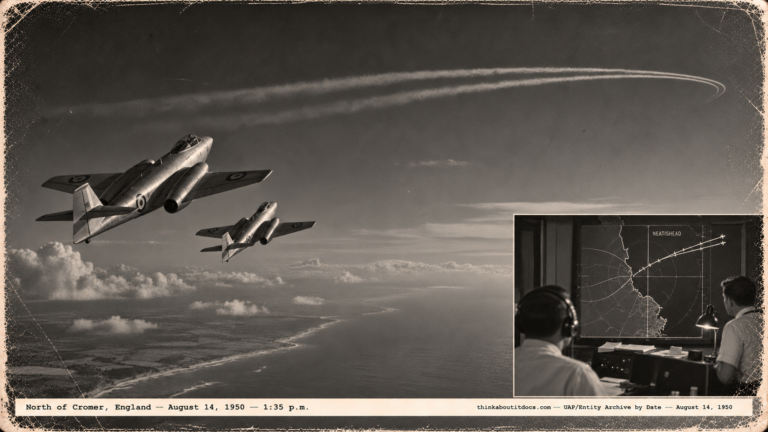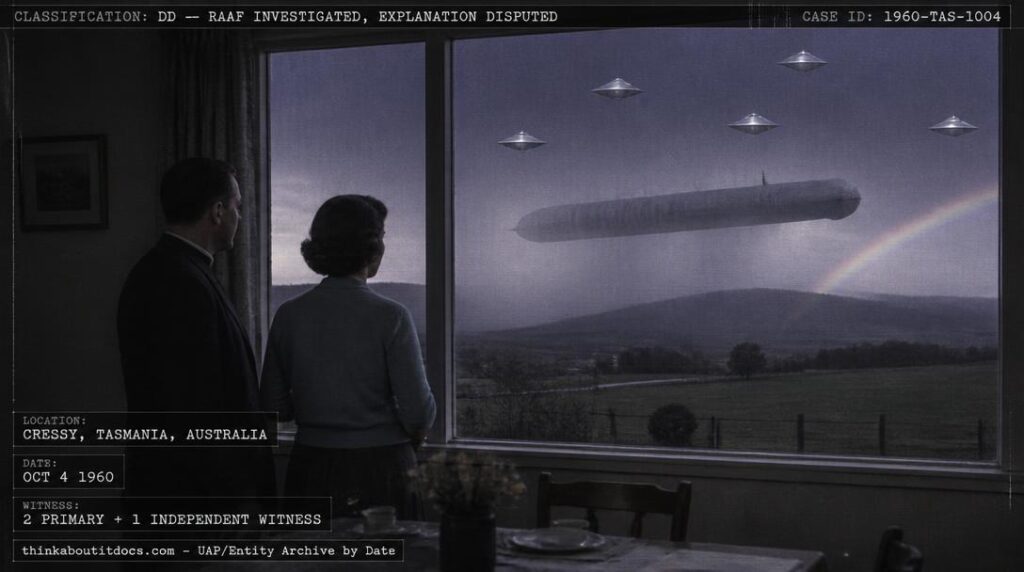
Recreation of the October 1960 Cressy, Tasmania sighting, in which a minister and his wife watched a cigar-shaped "mothership" joined by five or six smaller discs before both reversed together into a rain squall.
THINK ABOUTIT UFO|UAP|ENTITY SIGHTINGS REPORT
1960: The Cressy Cigar — Tasmania’s Mothership and Discs Case
At 6:10 PM on October 4, 1960, an Anglican minister and his wife, watching a rainbow from their dining room window in Cressy, Tasmania, saw a long, grey, cigar-shaped object emerge from a rain squall — and watched it cruise north for two minutes before stopping dead, at which point five or six smaller, metallic-looking discs shot out of the clouds to take up positions around it, held formation briefly, then all reversed together back into the storm from which the cigar had come.
Date: October 4, 1960
Sighting Time: 6:10 PM
Day/Night: Evening, near dusk — overcast but clearing after earlier rain, with the sun close to setting in the west. Filled in from the original blank field.
Location: Cressy, Tasmania, Australia — a rural town in the Northern Midlands, roughly 30 km southwest of Launceston. The object was seen over the nearby Panshanger Estate.
Urban or Rural: Rural — a small country town surrounded by pastoral farmland. Filled in from the original blank field.
No. of Entity(‘s): Undocumented
Entity Type: Not Applicable — no entity described
Entity Description: Not Applicable
Hynek Classification: DD (Daylight Disc) — metallic or whitish object seen in the day. This fits: both the cigar-shaped primary object and the smaller discs were directly resolved in evening daylight with substantial structural detail.
Duration: The cigar-shaped object was visible for approximately two minutes; the smaller discs were visible for approximately one minute of that window
No. of Object(s): 7 total — one large cigar-shaped object, joined partway through the sighting by five or six smaller, saucer-shaped objects
Description of the Object(s): The primary object was a long, dull grey cigar shape with four or five vertical dark bands around its circumference and short, aerial-like projections at regular intervals along its length, angled outward and upward from its forward (northern-facing) end. It cruised north on an even keel, then stopped abruptly, at which point five or six smaller, disc-shaped objects emerged at high speed from the clouds above and behind it, taking up positions around it at a radius of roughly half a mile. After a pause of several seconds, the cigar and the discs together reversed course back into the rain squall they had come from, at roughly the same speed and altitude as the outward journey. No sound was heard from either the large object or the smaller ones at any point.
Shape of Object(s): Cigar (the primary object); disc/saucer (the five or six smaller objects)
Size of Object(s): The primary witness estimated the cigar-shaped object’s length at approximately 100 feet, based on comparison with Viscount aircraft he regularly saw in the area — notably, when the story ran in the local paper, the length was misprinted as 300 feet, an error the witness specifically corrected afterward. No size estimate is given for the smaller discs.
Color of Object(s): The primary object was a dull grey; the smaller discs were separately described by the witness as having a shiny, metallic lustre, a distinct tonal difference he specifically noted when later interviewed.
Distance to Object(s): Estimated at 3 to 4 miles, based on the witness’s identification of landmarks (the Panshanger Estate) beneath the object
Height & Speed: The cigar-shaped object moved at an estimated 60 to 70 mph (100-110 km/h) at a constant altitude of about 400 feet, based on the witness’s comparison to Viscount aircraft speed and to the height of nearby hills. It traveled roughly 1.5 miles north before stopping.
Number of Witnesses: 2 primary witnesses (Rev. Lionel Browning and his wife, observing together from their home), plus a separate, differently located witness, Mrs. D. Bransden, who reportedly saw the cigar-shaped object independently from near the local rectory, along with an unnamed young child.
Special Features/Characteristics: The Reverend Browning reported the sighting to the control tower at Launceston Airport shortly afterward. Roughly two hours later, multiple outlying residents in the wider Cressy-Perth district independently reported hearing a loud, house-shaking explosion, distinct from the routine daytime blasting done by the Hydro Electric Commission at Poatina; the Brownings themselves were not recorded as having heard it, and the RAAF investigation does not appear to have followed up on these reports. Numerous further sightings of unusual airborne objects were reported in the surrounding districts over the following weeks. The case drew RAAF investigation, questions in the Australian federal parliament, national and international press and book coverage, and a personal 1967 interview of Rev. Browning by University of Arizona physicist Dr. James E. McDonald.
Case Status: Unexplained (Investigated) — the RAAF’s official investigation concluded the sighting was astronomical (moonlight reflecting off low cloud), an explanation the primary witness specifically disputed on positional and observational grounds, and which a later independent review found only partially supported by the actual sun and moon positions that evening. See Researcher’s Notes.
Source: Keith Roberts, Tasmanian UFO Investigation Centre (TUFOIC); Tasmanian UFO Investigation Centre Annual Report, 1970; “Cressy Revisited” (TUFOIC); RAAF Unidentified Aerial Sightings file, 1960; Michael Hervey, “UFOs Over the Southern Hemisphere” (1969); Paul Norman, “Motherships over Australia,” Flying Saucer Review, March 1979; The Mercury (Hobart); The Examiner (Launceston); notes and cuttings of Rev. Lionel Browning
Summary/Description: The Cressy sighting remains one of Tasmania’s best-known UFO sightings. A cigar-shaped “mothership” and attendant discs were witnessed by the local Church of England minister, the Reverend Lionel Browning, and his wife. The case was investigated by the Royal Australian Air Force, details were taken by the Victorian UFO Society, and Prof. James E. McDonald interviewed Rev. Browning in 1967.
Related Cases: Undocumented as a separate archive entry, though frequently discussed alongside other “mothership and discs” cases in Australian ufology literature, including in Paul Norman’s 1979 Flying Saucer Review article on the subject
Detailed Report
Rev. Lionel Browning and his wife were standing at their dining room window in Cressy, admiring a rainbow over nearby hills partly obscured by rain, when Mrs. Browning drew her husband’s attention to a long, cigar-shaped object emerging from a rain squall to the east. The object was dull grey, marked with vertical dark bands, and carried short, angled projections along its length that resembled a small aerial array. Browning, familiar with the Viscount airliners that regularly flew through the area, used them as a size and speed reference, estimating the object at roughly 100 feet long and moving north at 60 to 70 mph, holding a steady altitude of about 400 feet. After covering roughly a mile and a half, the object stopped abruptly. Within seconds, five or six smaller, saucer-shaped objects shot out of the clouds above and behind it at high speed, taking up positions in a loose ring around the larger craft. After holding formation for several seconds, the entire group reversed course together, back into the rain squall, at roughly the same speed and altitude as their outward journey. The full episode lasted about two minutes for the cigar-shaped object and roughly a minute for the discs; neither Browning nor his wife heard any sound throughout.
Browning reported the sighting to the control tower at Launceston Airport shortly after and gave a fuller account to the Launceston Examiner five days later, which ran the story on its front page October 10, complete with a sketch superimposed on a photograph taken through the Brownings’ own dining room window — though the paper mistakenly printed the object’s length as 300 feet rather than the 100 feet Browning had actually estimated, an error he corrected afterward. Separately, and from a different vantage point near the local rectory, a second witness, Mrs. D. Bransden, along with an unnamed young child, reportedly saw the same cigar-shaped object independently; Bransden later described it as looking “like a lot of little ships flocking around a bigger one.” No further detail on her account survives. Roughly two hours after the Brownings’ sighting, multiple residents across the wider Cressy-Perth district reported a loud, house-shaking explosion distinct from routine daytime rock-blasting at the nearby Hydro Electric Commission works — the Brownings themselves apparently did not hear it, and it does not appear the RAAF ever formally connected or investigated the two events together. Reports of further unusual aerial objects continued in the surrounding districts for several weeks. The case went on to draw RAAF investigation, coverage in Australian and international UFO literature, questions raised in the Australian federal parliament, and, in 1967, a personal interview of Browning by Dr. James E. McDonald, a University of Arizona atmospheric physicist and prominent UFO researcher, whose RAAF contact separately described the Brownings as mature, stable, and credible witnesses with no apparent motive to misreport what they saw.
RESEARCHER’S NOTES
The Cressy Mothership — 1960 and an Official Explanation That Doesn’t Quite Line Up
- Classification Assessment: DD fits well — both the cigar-shaped object and the smaller discs were directly resolved with substantial structural detail (bands, projections, distinct surface lustre) in daylight conditions, not inferred from an ambiguous light source.
- Source Chain Assessment: This is an exceptionally well-documented case for its era: a named, credentialed primary witness (an Anglican minister), a formal RAAF investigation and sighting-report file, contemporaneous front-page press coverage, a second independent witness observing from a different location, and a personal interview by a professional physicist seven years later. The RAAF’s own interviewing officer assessed the Brownings as credible. This is a considerably stronger evidentiary chain than most single- or dual-witness reports in this archive.
- Evidentiary Weight: The RAAF’s official file explained the sighting as astronomical — moonlight reflecting off low, scud-type cloud near the horizon. This explanation has real problems on its own terms: the moon that evening would have been only about 6 degrees above the eastern horizon and potentially obscured by hills, while the sun was simultaneously setting in the west, arguably the more likely of the two to illuminate anything near the skyline. Browning’s own additional detail — that the smaller discs showed a distinctly different, shinier tone than the dull grey primary object — is a specific, textured observation that a single misidentified light source reflecting off cloud would not easily produce. Neither side of this dispute has been conclusively settled by any source located here, and the RAAF does not appear to have followed up by interviewing the second witness, Mrs. Bransden, from her different vantage point — a step that could have helped test the astronomical explanation directly.
- Pattern and Comparative Context: A large “mothership” object accompanied by smaller attendant discs is a recurring configuration in Australian UFO literature of this era, discussed at length in Paul Norman’s 1979 Flying Saucer Review piece specifically on the subject. The unexplained explosion reported two hours later and several miles from the sighting adds a layer of regional strangeness that was never formally connected to the sighting itself, and may well be unrelated (thunderstorm activity was independently reported near the Western Tiers that same evening).
- Geographic and Historical Context: Cressy sits in Tasmania’s rural Northern Midlands, roughly 30 km southwest of Launceston, with Launceston Airport a comparable distance to the northeast — a detail worth noting given the RAAF’s own confirmation that no aircraft were in the vicinity at the time. The case became prominent enough to prompt questions in the Australian federal parliament and remains a benchmark reference case in Tasmanian ufology.
Few cases from this era combine a credentialed primary witness, a formal air force file, a second independent witness, and a professional physicist’s personal follow-up interview the way this one does — and the official explanation offered for it doesn’t fully survive its own details, by the account’s own analysis of where the moon actually was that evening. The RAAF called it astronomical; the primary witness, and the tonal difference he specifically reported between the two object types, argued otherwise. Neither side of that has ever been resolved. The case remains Unexplained.
“It was a fantastic sight — like a lot of little ships flocking around a bigger one.”