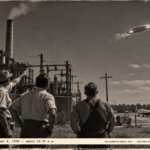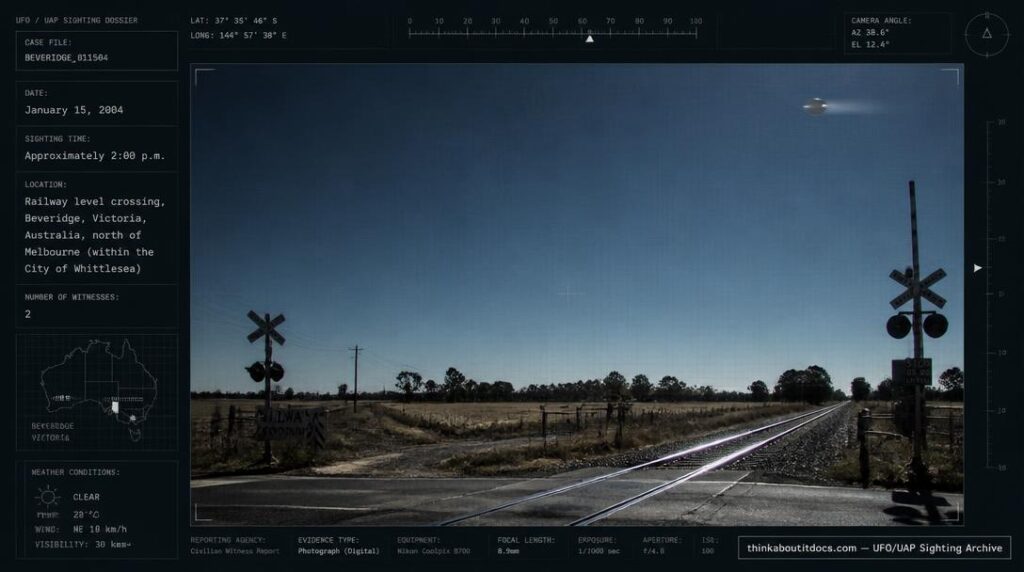
A Whittlesea Council traffic engineer's photograph of a Beveridge, Victoria railway crossing showed an unexplained round object, January 15, 2004.
THINK ABOUTIT UFO SIGHTING REPORT
2004 Beveridge, Victoria UFO Photo:
The Council Worker’s Digital Camera Mystery
On a Thursday afternoon in January 2004, Whittlesea Council traffic engineer Roland Rozario photographed a routine railway level crossing audit at Beveridge, north of Melbourne — a dozen frames, facing east and west, nothing unusual noticed at the time. Back at the office, downloading the images, one frame showed a small, round object streaking through the top right corner of the shot. What followed was a genuinely rare thing for a small municipal photograph: the council referred it to Australia’s Chief Defence Scientist, the Defence Science and Technology Organisation, and the Civil Aviation Authority, while a weather bureau forecaster and a VUFORS scientific advisor each offered their own on-record, unresolved assessments.
Date: January 15, 2004
Sighting Time: Approximately 2:00 p.m.
Day/Night: Day
Location: Railway level crossing, Beveridge, Victoria, Australia, north of Melbourne (within the City of Whittlesea)
Urban or Rural: Rural
No. of Entity(‘s): None documented
Entity Type: None documented
Entity Description: None documented
Hynek Classification: DD (Daylight Disc) — applied loosely; as with other photo-only cases in this archive, the object was not directly observed in real time, only discovered afterward in one of a series of digital photographs
Duration: Not applicable — the object was not observed live; it appears in one of approximately 10 to 12 photographs taken during a routine site audit
No. of Object(s): 1
Description of the Object(s): A small, round object appearing to move quickly through the top right portion of the frame; VUFORS scientific advisor Bernard Wilson noted the object’s sun reflections appeared consistent with those visible on the nearby rails, and identified what might be motion blur suggesting a fast-moving object; office colleagues who viewed the photo felt it did not resemble a bird, aircraft, or insect in front of the lens, while a weather bureau forecaster separately suggested it resembled a plane viewed from the rear
Shape of Object(s): Disc/round
Size of Object(s): Not documented
Color of Object(s): Not documented
Distance to Object(s): Not documented
Number of Witnesses: 2 people present at the scene (photographer Roland Rozario and an unnamed colleague), neither of whom directly observed the object at the time; it was noticed only after the images were downloaded
Special Features/Characteristics: Rozario noted a train passed through the level crossing just seconds after the photograph was taken and speculated a passenger aboard might have independently noticed something in the sky, though this remains unconfirmed speculation rather than an established corroborating account; council staff confirmed the image had not been altered or tampered with; the photograph was formally referred by the City of Whittlesea to Australia’s Chief Defence Scientist, the Defence Science and Technology Organisation, and the Civil Aviation Authority, with the council considering further referral to NASA; a Bureau of Meteorology senior forecaster ruled out a weather balloon and any meteorological phenomenon; VUFORS scientific advisor Bernard Wilson stated the organization required more information before a full assessment could be made
Case Status: Unexplained — a photograph confirmed unaltered by council staff, formally referred to multiple Australian government scientific and aviation authorities, with named professional assessments from a meteorologist and a UFO research organization’s scientific advisor, none of which reached a conclusive identification
Source: City of Whittlesea (Jim Linton, Communications Officer); News.com.au (Kate Uebergang); UFOEvidence.org
Summary/Description: Whittlesea Council traffic engineer Roland Rozario photographed a routine railway crossing audit at Beveridge, Victoria on January 15, 2004, without noticing anything unusual at the time. Downloading the images afterward, he found one frame showed a small, round object moving through the top right of the shot. The council referred the image to multiple Australian government authorities for assessment, and named experts from the weather bureau and VUFORS offered differing, inconclusive perspectives.
Related Cases: None documented
Detailed Report

On Thursday, January 15, 2004, at about 2:00 p.m., Whittlesea Council traffic engineer Roland Rozario and a colleague were conducting a routine audit of a railway level crossing at Beveridge, north of Melbourne. Rozario took approximately 10 to 12 digital photographs, facing both east and west, and neither he nor his colleague noticed or heard anything unusual during the shoot. Returning to the office and downloading the images, Rozario noticed one photograph contained an object in the sky he could not explain.
He shared the image around the office; colleagues who viewed it felt it did not resemble a bird, an aircraft, or an insect in front of the camera lens. Rozario noted that a train passed through the crossing just seconds after the photograph was taken, speculating that a passenger aboard might have independently spotted something in the sky, though no such account was confirmed.
City of Whittlesea communications officer Jim Linton stated the council held no opinion on the object’s nature, describing an obligation to refer the image to relevant government authorities for consideration. The photograph was sent to Australia’s Chief Defence Scientist, the Defence Science and Technology Organisation, and the Civil Aviation Authority, with the council considering further referral to NASA. Linton confirmed staff had assured the council the image was not altered or tampered with, stating plainly that the council was not making any claim about the object and that a definitive answer might never emerge.
Bureau of Meteorology senior forecaster Peter Blake examined the photograph and ruled out any meteorological explanation, including a weather balloon, suggesting instead the object resembled an aircraft viewed from the rear. Separately, Victorian UFO Research Society scientific adviser Bernard Wilson offered a more technical, non-committal assessment, noting the sun reflections visible on the object appeared consistent with those on the nearby railway tracks — suggesting the object was a genuine external element in the scene rather than an internal lens artifact — and identifying what might be motion blur to the left of the object’s position, consistent with a fast-moving subject. Wilson stated the organization would need further information before offering a complete evaluation.
Researcher’s Notes
The Beveridge Photograph — 2004 and a Rare Case of Genuine Institutional Engagement
- This case’s institutional handling is unusually thorough for a photo-only claim. Formal referral by a municipal council to the Chief Defence Scientist, a national defence science organization, and the civil aviation regulator is a substantially more serious institutional response than most photograph-based UFO claims receive, and it reflects the council’s own stated sense of responsibility rather than any UFO research organization’s initiative.
- Two named professionals offered genuinely differing, specific assessments, and both are worth preserving rather than picking one as authoritative. The weather bureau’s forecaster leaned toward a conventional aircraft explanation; VUFORS’s scientific adviser identified a specific, technical detail (consistent sun reflection direction between the object and the rails) that argues against a simple internal camera artifact, while stopping short of endorsing any particular identification. Neither perspective resolves the case, and both are presented here on their own terms.
- The consistent-reflection detail is a genuinely useful technical observation. An internal lens flare or sensor artifact typically wouldn’t show a reflection angle matching real external light sources in the same frame; Wilson’s specific observation on this point is a more substantive piece of analysis than a simple “we don’t know” and deserves to be treated as such.
- The speculative train passenger detail should be read as exactly that — speculation. Rozario raised the possibility a passenger on the train that passed moments later might have seen something, but no such witness or account was ever identified or confirmed.
- The council’s own studied neutrality is worth noting as a model of institutional restraint. Explicitly declining to offer an opinion, confirming the image’s lack of tampering, and openly stating an answer might never come reflects a careful, non-sensationalized institutional response — a notable contrast to how such stories are sometimes handled elsewhere.
The Beveridge photograph stands out for the seriousness with which an ordinary municipal government treated an unexplained image — referring it through proper channels to national scientific and aviation authorities — even as the specific object it shows has never been conclusively identified by any of the named professionals who examined it.
“There are some interesting aspects to this photo. The sun reflections from the object and the rails appear to be fairly consistent.”
— Bernard Wilson, VUFORS scientific adviser, January 2004