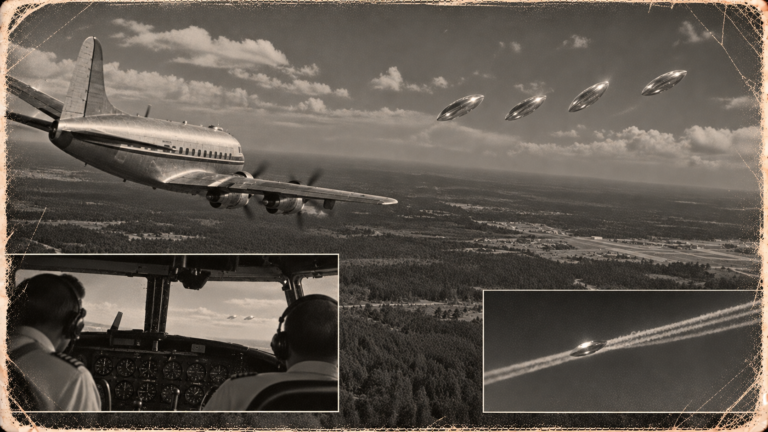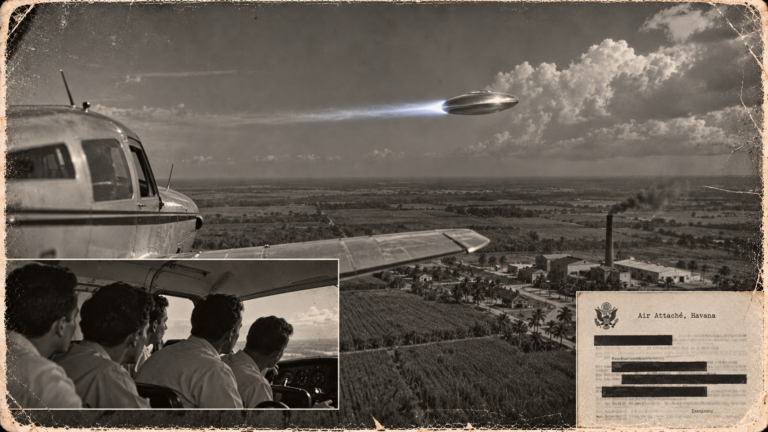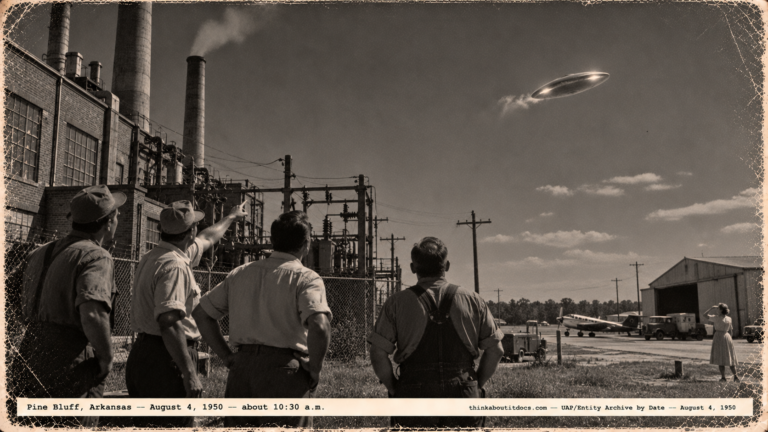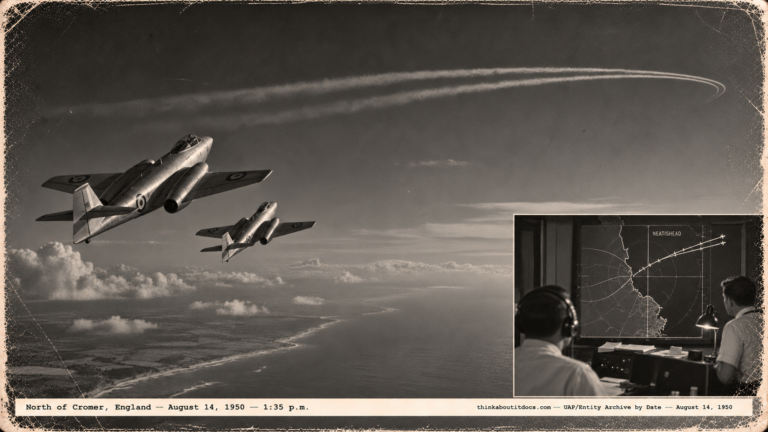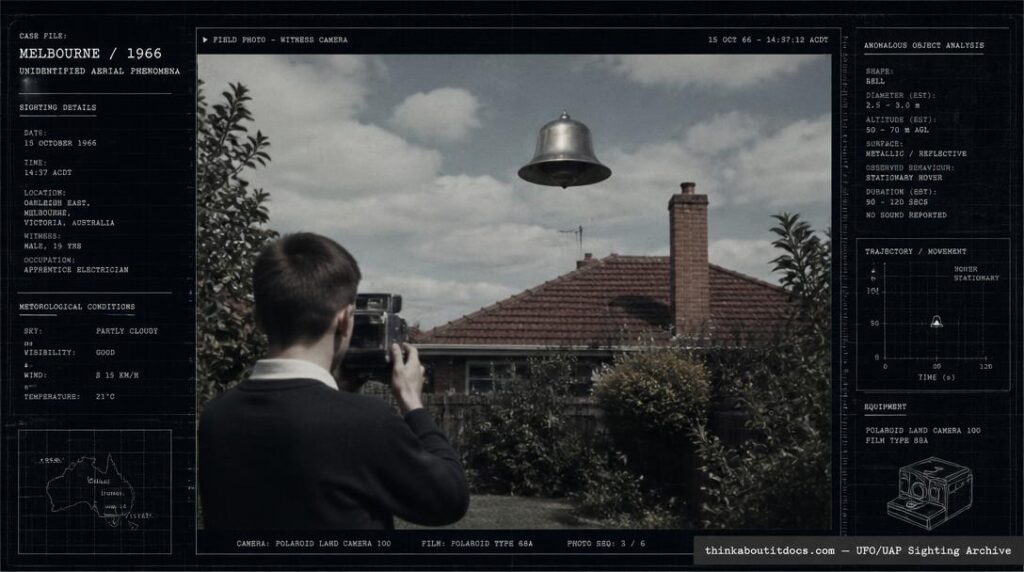
James Kibel photographed a silver, bell-shaped object from his family's garden in Balwyn, a Melbourne suburb, April 2, 1966.
THINK ABOUTIT SIGHTING REPORT
The 1966 Balwyn UFO Photograph: Australia’s Most Contested UFO Image
On the afternoon of April 2, 1966, a young Melbourne businessman named James “Jim” Kibel stepped into his parents’ garden in the suburb of Balwyn to finish off an old roll of Polaroid film — and, he later said, photographed a silver, bell-shaped object hovering briefly near the house. The resulting image became one of the most closely analyzed UFO photographs in the world, examined by four separate research organizations across six decades, with genuinely conflicting conclusions. It’s also a case burdened by a missing original, inconsistent copies, and a first-hand account of the photographer’s own words in the moment that sit uneasily beside his later, more dramatic retelling.
Editor’s Note: This case is presented with the full range of expert opinion on it, because that opinion is genuinely, substantively split — not a case of one fringe skeptic against a broad consensus. Readers should weigh both the investigative case for authenticity and the case against it before drawing a conclusion.
Date: April 2, 1966
Sighting Time: A few minutes after 2:00 p.m.
Day/Night: Day
Location: Balwyn, a suburb of Melbourne, Victoria, Australia
Urban or Rural: Suburb
No. of Entity(‘s): None documented
Entity Type: None documented
Entity Description: None documented
Hynek Classification: DD (Daylight Disc) — retained per the source material and the witness’s own distance estimate (350–400 feet), which falls outside the 500-foot CE-I threshold. Note that this distance estimate is itself central to the authenticity dispute; see Researcher’s Notes
Duration: Not documented in the original site record; described in secondary accounts as brief, on the order of seconds
No. of Object(s): 1
Description of the Object(s): A bell-shaped object, silver-grey in color, photographed against a partly clouded sky. The witness estimated it at roughly 150 feet in altitude, 350–400 feet away, and variously 20–35 feet in diameter
Shape of Object(s): Bell-shaped
Size of Object(s): Estimated by the witness at 20–35 feet in diameter; this figure is disputed (see Researcher’s Notes)
Distance to Object(s): Estimated by the witness at 350–400 feet
Color of Object(s): Silver-grey, metallic-appearing
Number of Witnesses: Two — James Kibel, who took the photograph, and a carpenter working at the house (identified in investigative records by initials only) who watched the Polaroid develop over Kibel’s shoulder and later gave a corroborating statement, written approximately one month after the alleged date
Special Features/Characteristics: Both witnesses reported hearing a loud boom, described as similar to a sonic boom, shortly after the photo was taken; the object was photographed on an old Polaroid camera loaded with expired film; the original photograph was reportedly stolen in a home burglary — the only item taken — at some point before 2016, and did not resurface for independent researchers until years later; no fully independent, published high-resolution analysis of the actual original photograph has been completed to date, despite one being arranged in 2022; copies of the photograph in circulation show inconsistent physical characteristics (differing print edges and aspect ratios), indicating most researchers who have examined “the photograph” over the decades were working from secondary reproductions rather than the original
Case Status: Insufficient Data — genuinely split expert analysis (Ground Saucer Watch’s computer enhancement suggested tampering or a nearby suspended object; the Victorian Flying Saucer Research Society’s independent photogrammetric analysis found no evidence of tampering), combined with unresolved chain-of-custody problems and the absence of any published modern analysis of the verified original, mean this case cannot be confidently placed in either the Unexplained or Explained category
Source: Victorian Flying Saucer Research Society (VFSRS) case files; Ground Saucer Watch (GSW) computer photo analysis; Basterfield & Dean, “Stage One and Stage Two Reports on the 2nd April 1966 Balwyn UFO,” Project 1947; Francois Beaulieu, “A Re-evaluation of the Balwyn UFO Photograph,” Project 1947; investigative analysis by researcher Charlie Wiser, Metabunk, 2022–2024
Summary/Description: James Kibel photographed a silver, bell-shaped object from his family’s garden in the Melbourne suburb of Balwyn on April 2, 1966. The case was meticulously documented at the time by the Victorian Flying Saucer Research Society, which used the house’s chimney as a photogrammetric reference point and concluded the photograph showed no sign of tampering. Later analysis by other organizations reached the opposite conclusion, and the photograph’s provenance has been complicated by a theft, inconsistent surviving copies, and the absence of any published modern examination of the verified original.
Related Cases: None documented — occurred four days before the well-known Westall UFO mass sighting near Melbourne (April 6, 1966); Kibel was himself a member of the Victorian Flying Saucer Research Society, the organization that received the first report of the Westall sighting, a connection some researchers consider suggestive though it does not establish any direct link between the two cases
Detailed Report
At about two in the afternoon on April 2, 1966, James Kibel, a young Melbourne businessman, went into his parents’ garden in the suburb of Balwyn intending to finish off an old roll of film in his Polaroid camera. According to his account, his attention was drawn to something unusual in the sky — a silver, metallic, bell-shaped object that approached rapidly and briefly hovered near the house. He raised the camera and took a single photograph before the object departed. A carpenter who was working inside the house at the time later gave a statement describing Kibel hurrying back inside, saying something to the effect that he had photographed something strange in the air, though possibly just a bird, and that the two men waited together to see what would develop on the film. Both later reported hearing a loud boom, likened to a sonic boom, while waiting for the photograph to develop.
The photograph that resulted showed a bell-shaped object against a partly clouded sky, apparently reflecting elements of the surrounding scene on its surface. Kibel estimated the object’s altitude at roughly 150 feet, its distance at 350 to 400 feet, and its diameter at somewhere between 20 and 35 feet.
The case was taken up by the Victorian Flying Saucer Research Society (VFSRS), which conducted a detailed investigation using the property’s chimney as a fixed reference point to calculate camera angles, distances, and sun azimuths, along with an analysis of light reflections visible on the object’s surface. The society’s investigation concluded the photograph showed no evidence of multiple exposure, montage, or other tampering. The photograph subsequently drew international attention, with separate analyses conducted by the American organizations APRO, Ground Saucer Watch (GSW), and NICAP. GSW’s computer-based edge enhancement analysis reached a different conclusion, identifying fuzzy and in places entirely missing edges on the object, along with density inconsistencies across roughly a third of its surface — findings the analysts considered consistent with a hoax. Physicist Dr. B. Roy Frieden separately raised concerns after reviewing a copy of the photograph, noting that the visible motion blur on the house’s chimney was not matched by similar blur on the object itself — an inconsistency that could indicate the object was closer to the camera than the background elements, tracked separately by the photographer, rather than genuinely distant.
The late physicist Dr. James E. McDonald, known for his rigorous approach to UFO witness testimony, also expressed reservations about the photograph after reviewing it, according to secondary accounts, though the specific nature of his concerns is not fully documented in the available source material. In a 1967 recorded interview, Kibel and his brother Brian separately described a broader family history of unusual sightings at the same property dating back to 1954, when their mother reported seeing a disc-shaped object from the same garden — context presented by researchers as part of the case’s background rather than independent corroboration of the 1966 photograph itself.
Decades later, researchers revisited the case with fresh scrutiny. The original Polaroid photograph was reported stolen during a home burglary at Kibel’s residence — described as the only item taken — with the theft confirmed independently to researchers Basterfield and Dean by Kibel himself in 2016; at that time, the original was not available for re-examination. It later resurfaced in time for an on-camera interview with documentary filmmaker James Fox in 2020, and researcher Bill Chalker reportedly gained access to the original via Kibel’s daughter in 2022, arranging for high-resolution scans to be made for professional analysis. As of the most recent published research on this case, no results from that intended analysis have been made public.
Independent examination of the photograph copies that have circulated among researchers over the decades has identified inconsistencies between different versions — differing decorative print edges and aspect ratios — suggesting that most researchers, including those conducting the original GSW and VFSRS analyses, were working from secondary photographic reproductions of the original Polaroid rather than the original print itself. More recent forum-based analysis has also proposed that the mismatched motion blur between the object and the background is consistent with a small object thrown or suspended near the camera and tracked during the exposure — a known technique for producing convincing “hovering” UFO photographs without visible support wires.
Researcher’s Notes
The Balwyn Photograph — 1966 and a Case Study in Why Provenance Matters
- Four named investigative organizations reached genuinely different conclusions. VFSRS’s meticulous, on-site photogrammetric analysis found no evidence of tampering. Ground Saucer Watch’s computer enhancement analysis found edge and density irregularities consistent with a hoax. This isn’t a case of one credible investigation against fringe skepticism — it’s a case where two methodologically serious efforts reached opposite conclusions, which is itself the most important fact about this case’s evidentiary status.
- The photographer’s own contemporaneous words are hard to reconcile with his later account. The corroborating witness’s statement records Kibel saying, immediately after taking the photo, that it might have been a bird. That’s a strikingly uncertain reaction for someone who, in later retellings, described a large bell-shaped object performing dramatic movements near his house. This discrepancy between the in-the-moment reaction and the fully-formed later narrative is a genuine point worth weighing, not a minor inconsistency.
- Nobody currently examining this case has verified access to the actual original photograph. Between the reported 2016 theft, the photograph’s reappearance for a 2020 documentary interview, and Bill Chalker’s reported 2022 access via Kibel’s daughter, the chain of custody for the one piece of physical evidence in this case is genuinely difficult to follow. Combined with the documented inconsistencies between circulating copies, this means most of the analysis conducted on this case — on both sides of the authenticity question — was performed on reproductions of unknown fidelity to the original.
- The size and distance estimates that drive the DD classification come entirely from the witness. Kibel’s own estimate of 350–400 feet distance is what places this case in the DD category rather than CE-I. If the object was in fact much closer and smaller — as the mismatched motion-blur analysis suggests — the entire classification, along with the “briefly hovered near his house” framing, would need to be reconsidered.
- The proximity to the Westall case is a documented fact, not proof of anything. Kibel’s sighting predates the well-known Westall mass sighting by four days, and Kibel was a member of the same UFO research society that received Westall’s first report. Some researchers have speculated this timing is suggestive of a fabricated sighting inspired by anticipation of similar activity, but the dates as documented actually run the other way — Kibel’s report came first — so this connection remains speculative rather than established.
The Balwyn photograph endures as a genuinely unresolved case, not because the evidence points clearly toward either a real anomaly or a straightforward hoax, but because the case’s own evidentiary trail — a stolen and later recovered original, inconsistent secondary copies, and split expert analysis conducted on those inconsistent copies — makes a confident conclusion in either direction unsupportable with what has actually been published to date.
“It may have been a bird.”
— James Kibel, moments after taking the photograph, April 2, 1966