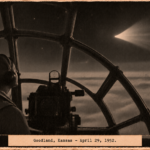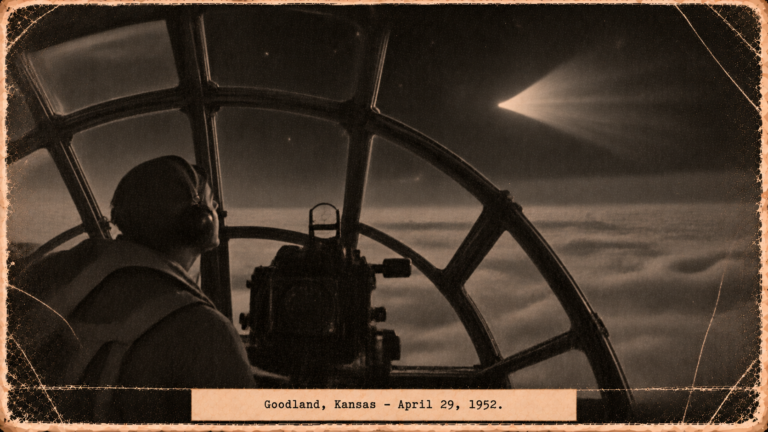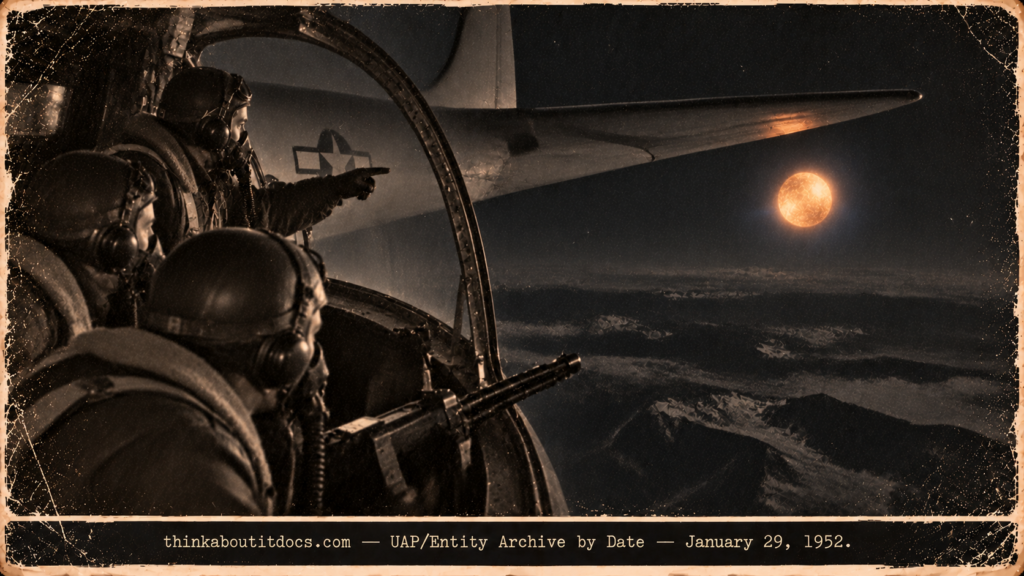
A B-29 crew over Korea watches an orange sphere keep pace with their bomber, January 29, 1952.
THINK ABOUTIT UFO|UAP SIGHTINGS REPORT
1952: Two B-29 Crews Over Korea Watch an Orange Sphere Fly Formation With Their Bombers
At 2300 hours on the night of January 29, 1952, the tail and left gunners of a B-29 flying at 22,500 feet over North Korea saw a light orange sphere, the color of the sun, take up a position at their 8 o’clock and stay there. For about five minutes it kept pace with the Superfortress at 148 knots, fuzzy at the edges and churning inside like flames, before it pulled away and faded. Twenty-four minutes later, near Sunchon, the left and tail gunners of a different B-29, from a different squadron and flying a different mission, saw an identical object approach from between 8 and 9 o’clock, spin beside them for a minute and withdraw, just before their aircraft took flak.
These were World War II combat veterans with several missions over Korea behind them, interrogated separately, and they told intelligence the sphere bore no resemblance to anything they had seen. The Air Technical Intelligence Center’s propulsion specialists ruled out every conventional engine, Edward Ruppelt of Project Blue Book asked for the flame to be analyzed, and months later Air Force Intelligence was still offering tentative theories, from Soviet fighter exhausts to airborne searchlights to enemy balloons. This Korea B-29 UFO sighting remains one of the best-documented encounters between bomber crews and an unidentified glowing sphere in the Korean War.
Date: January 29, 1952 (Sparks dates the Sunchon sighting January 29–30)
Sighting Time: 2300 local Korean time (Wonsan); 2324 local Korean time (Sunchon). The Blue Book card gives 2200 local / 1300Z
Day/Night: Night; weather CAVU
Location: 30 miles west-southwest of Wonsan, Korea (first B-29), and near Sunchon, Korea (second B-29)
Urban or Rural: Rural; airborne over North Korea
No. of Entity’s: Not Applicable
Entity Type: Not Applicable
Entity Description: Not Applicable
Hynek Classification: NL (Nocturnal Light)
Duration: About 5 minutes (Wonsan); about 1 minute (Sunchon)
No. of Object(s): 1 at each location
Description of the Object(s): A globe or disk-shaped object with a slight teardrop effect on its lower side, color of the sun, light orange, occasionally changing to a bluish tint. The outer edge appeared fuzzy and the interior seemed to churn like flames or fiery gases. At the second location it appeared to be spinning.
Shape/Size/Color of Object(s): Globe-shaped or disk; about 3 feet across at its nearest point (size not definitely established because distance was unknown); orange with occasional blue tint
Distance to Object(s): Unknown; it closed to an undetermined distance from the aircraft. The 600-foot figure sometimes quoted does not appear in the Blue Book text
Height & Speed: First B-29 at 22,500 feet, heading 274°, 148 knots ground speed; second B-29 at 22,250 feet, 125 knots ground speed. The object held the bomber’s course, altitude and speed
Number of Witnesses: At least 5 airmen in two crews: three gunners (tail, left and top) are named in the ATIC appendix for the first aircraft, and the left and tail gunners for the second
Special Features/Characteristics: Silent per the wire report; pulling up from the 8 o’clock position and then receding on the same path; the second aircraft received flak shortly after the sighting; both crews were interrogated separately by different squadrons
Case Status: Unexplained at the time. Project Blue Book card: Possibly Balloon and Possibly Aircraft, comment “same type of a/c (enemy or UN)”; ATIC reached no conclusion
Source: Project Blue Book record card; FEAF Bomber Command daily summary cable (January 30, 1952); ATIC appendix; Air Force Intelligence memoranda; Ruppelt/Fournet teletypes; Sparks #352 and #353
Summary/Description: Two B-29 crews from different squadrons reported a glowing orange sphere about 3 feet across flying formation with their bombers within 24 minutes of each other. ATIC’s propulsion group ruled out jet, afterburner, pulsejet and rocket exhausts. Later Air Force theories included a Soviet fighter’s exhaust, an airborne searchlight, an enemy balloon and a ramjet helicopter.
Related Cases: Mitchel AFB Navy TBM chase (January 21, 1952); Nenana radar intercept (January 22, 1952); Cedar Keys B-29 green fireball (January 19, 1952); January 1952 archive
Detailed Report
The incident reached Washington in a message from the Commanding General, Far East Air Force, quoting the FEAF Bomber Command daily summary for the night of January 29–30, 1952. It reports two sightings. At 2300 hours local time the left scanner and tail gunner of aircraft no. 7332 observed a disc-shaped object whose size they estimated at 3 feet across. It was first seen parallel on course at the 8 o’clock level, at an unknown distance from the B-29, and it stayed with the aircraft for about 5 minutes before going away from it at the same clock position. The B-29 was at 22,500 feet on a heading of 274 degrees at 148 knots ground speed. The ATIC appendix adds that the tail, left and top gunners all saw it, that its color was the color of the sun with an occasional bluish tint, that the outer edge appeared fuzzy, and that it seemed to have an internal churning movement like flames or fiery gases. Weather was CAVU.
At 2324 a disc-shaped object was observed by the left and tail gunners of aircraft no. 2224, near Sunchon. This crew saw the object shortly before receiving flak. It approached the B-29 from between 8 and 9 o’clock, then withdrew and disappeared at the same clock position. The observers estimated it at about 3 feet across at its nearest point. It was in view for one minute, appeared to be spinning and had a color resembling the sun. The B-29 was at 22,250 feet and 125 knots ground speed. A second message from FEAF Bomber Command, delayed in transmission, describes a globe-shaped object with a slight teardrop effect on its lower side, and says the observers estimated its size but not its distance. It first appeared at the 8 o’clock level, about the size of a saucer, growing larger as it approached, then remained in the same relative position for about a minute and receded along the same path.
The comments of the 98th Bomb Wing intelligence officers are part of the record. Because of the unusual nature of the sighting, they made a special effort to eliminate known alternatives, including a Plexiglas reflection. Two different crew members saw the object from different positions at the same time. The crews were veterans of World War II combat and several Korean missions, were familiar with flak, flares and rockets, and “stated very emphatically that the sightings noted above bore no resemblance whatsoever to anything they had previously experienced.” The intelligence officers considered fabrication unlikely because the crews were from different squadrons, flew different missions and were interrogated at widely separated times, about an hour apart. The wing commander was present at one interrogation and warned the crew of their responsibilities in reporting such observations. FEAF Bomber Command added that there remained a very real possibility that the phenomena indicated new enemy flare devices, despite the unit intelligence officers’ view that this was ruled out.
ATIC’s own appendix concludes that the length of time the objects followed the B-29s indicates they were propelled by some means, which eliminates unguided ground-to-air missiles or drop missiles. Members of the ATIC Propulsion Group studied the color and shape of the flame to determine whether it could be the exhaust of a conventional jet with or without an afterburner, a pulsejet, a ramjet or a rocket. None was considered applicable. The report notes a similarity to the “foo fighter” or “fireball fighter” reports from Europe in World War II, in which bomber crews described large fiery balls like the sun passing through or near formations, and observes that no documented data on that phenomenon exists beyond verbal accounts. The appendix reaches no conclusion as to the identity or origin of the objects and offers one possibility: a flare towed by an aircraft to mark the B-29 for flak crews, though no aircraft exhaust flame was reported.
On February 18, 1952, Lt. Edward J. Ruppelt of the Aeronautical Sciences Group asked ATIC’s Propulsion Branch to analyze the reported flame as a conventional jet, jet with afterburner, ramjet, pulsejet or rocket. On February 20, Peter A. Stranges of the Reaction Power Plants Group replied that the objects appeared to be propelled but did not fit a conventional jet, afterburning jet, pulsejet or rocket, and gave “slight credence” to a ramjet-powered helicopter or modification with provisions for exhausting along a section of the trailing edge of the rotor blade, creating the fuzzy-edged, internally churning globe observed by the crews.
An Air Force Intelligence evaluation prepared to answer Senator Russell, who had written about the incident after newspaper accounts, records that the press release mixed the preliminary FEAF report with the later detailed report from reinterrogation of both crews, and “played up the ‘flying saucer’ aspects” of the initial “disk-shaped” description. ATIC had asked FEAF to alert bomber crews to the possibility of further sightings so that fire-control equipment could be used to measure distance. There had been no further reports and no final evaluation. The paper offers two tentative explanations: the exhaust stacks of Soviet La-9 or La-11 fighters, arranged in a cluster on each side of the fuselage, which at night might give such an illusion, and an airborne searchlight on a conventional aircraft, as several recent reports had described enemy aircraft intercepting FEAF bombers with searchlights.
Later file notes add more. A Marine pilot’s observation of balloons in the Wonsan area was reported in FEAF Intsum 651 of April 8, 1952, and another report cited globe-shaped orange objects as a type of World War II Japanese balloon being made in Manchuria to frighten UN planes, although the notation observes that balloons of 10–15 feet would be limited in altitude. On May 8, 1952, Ruppelt cabled Capt. Fournet that a photograph of an F-86’s jet exhaust at night was very similar to the two reports and suggested a strong possibility that the crews observed jet aircraft of some type. The Blue Book record card for the case lists Possibly Balloon and Possibly Aircraft, with the comment that the object was believed to be the same type of aircraft, enemy or UN.
RESEARCHER’S NOTES
A Sphere That Did Not Fit Any of the Air Force’s Own Explanations
- Time Conflict. The Blue Book card gives 2200 local and 1300Z; the FEAF cable and ATIC appendix give 2300 local Korean time. The cable’s time is used here. The delayed FEAF message dates the second sighting 1324Z, which would be 2224 local; the cable, appendix and Sparks all give 2324 local, which is used here.
- Gunner Count. The FEAF cable says the left scanner and tail gunner saw the first object; the ATIC appendix says tail, left and top gunners. Both are given; the number of witnesses on the second aircraft is two in all documents.
- Propulsion Analysis. ATIC’s Propulsion Branch rejected jet, afterburner, pulsejet and rocket flames. The ramjet-helicopter idea it floated is described as “slight credence” only, and no evidence is cited that such a machine existed in Korea.
- Competing Theories. The file offers Soviet La-9/La-11 exhausts, airborne searchlights, enemy flares, balloons, F-86-type jet exhaust and a tow flare. Each is stated tentatively, and ATIC never issued a final evaluation. Several theories also conflict: balloons of 10–15 feet would not reach 22,000 feet, and the crews said they knew flak, flares and rockets.
- The Foo Fighter Link. ATIC itself compared the case to World War II “fireball fighters” over Europe. It noted that the evidence for those was verbal only, which is the same position the Korea case is in.
- The 600-Foot Figure. Sparks’ catalog gives a distance of about 600 feet. The Blue Book text on file states the distance was unknown, so this page does not use it.
- Press and Politics. The Senator Russell memorandum shows the incident became public through a press release that emphasized “flying saucer” wording. Ruppelt’s The Report on Unidentified Flying Objects dates the news story to February 19, 1952.
The Korea B-29 encounter combines multiple experienced witnesses, two independent crews, a detailed physical description and an Air Force technical analysis that could not match the flame to any known engine. Its weak points are that nobody measured distance, that the size is an estimate, and that several mundane explanations remain unresolved rather than eliminated.
“Stated very emphatically that the sightings noted above bore no resemblance whatsoever to anything they had previously experienced.”
— FEAF Bomber Command, comments of the 98th Bomb Wing Intelligence Officers, January 30, 1952