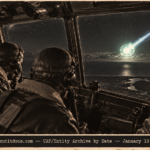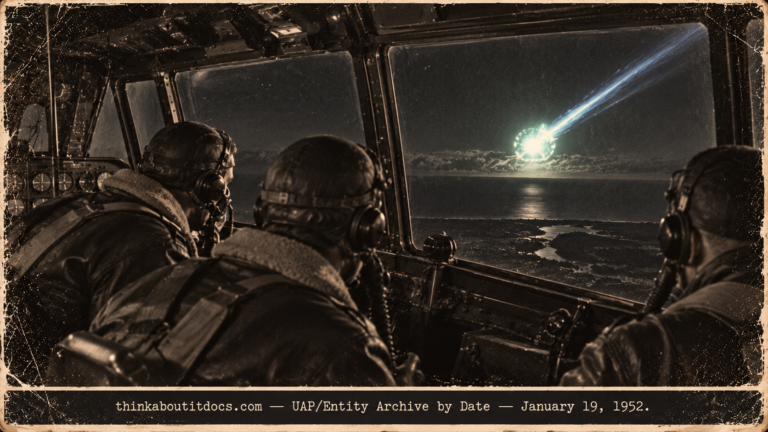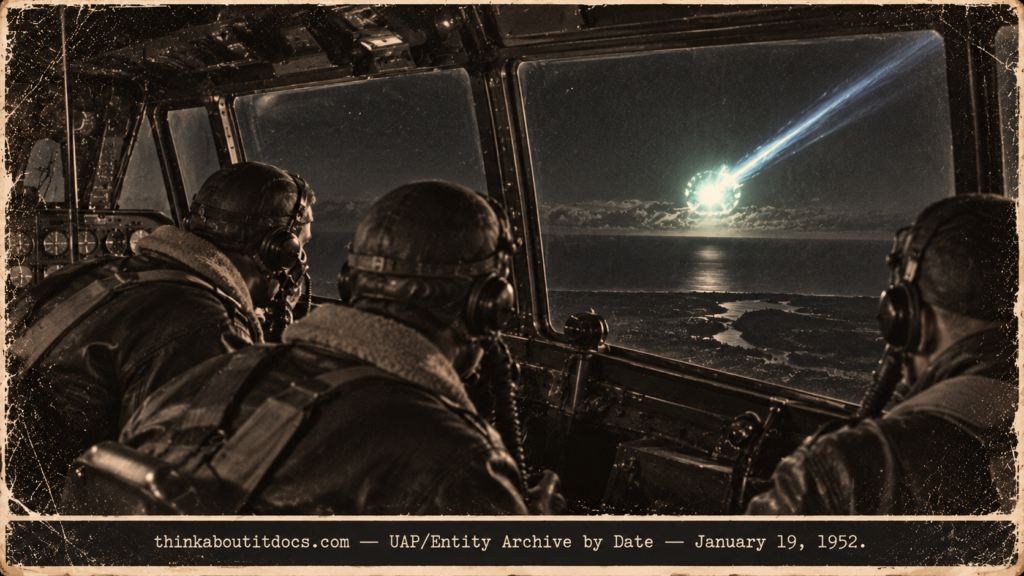
A B-29 crew near Cedar Keys, Florida watches a green fireball fall and burst, January 19, 1952.
THINK ABOUTIT UFO|UAP SIGHTINGS REPORT
1952: A B-29 Crew Over the Gulf Watches a Blue-Green Fireball Fall and Explode
At 8:56 on the evening of January 19, 1952, a B-29 flying a SAC mission at 25,000 feet over the Gulf of Mexico off Cedar Keys, Florida, saw a large, round, bluish-green ball of light fall straight toward the ground. It glowed as if from internal combustion, trailed a glowing tail the crew estimated at 150 feet, and as it neared 5 degrees above the horizon it seemingly exploded, with fallout and force directed downward. Three crewmen saw it, for about three seconds.
They told interrogators it looked much closer and brighter than any falling star or meteor, and one officer said he had seen the same thing twice on a C-47 flight between Denver and Albuquerque in late 1948. When the report reached Project Blue Book, Edward Ruppelt wrote that the observation was “typical of the green fireball class of unidentified objects,” a phenomenon the Air Force Cambridge Research Laboratory had studied for two years without reaching conclusions. This Cedar Keys, Florida green fireball UFO report ties directly to the Los Alamos and Sandia green fireballs of 1948–1950.
Date: January 19, 1952
Sighting Time: 2056 EST (0156Z on January 20); the SAC status extract gives 1954 local
Day/Night: Night
Location: About 15 miles northeast of the Cedar Keys bombing range, Florida, due east of 29°05’N, 83°19’W, over the Gulf coast
Urban or Rural: Rural; airborne over the Gulf coast
No. of Entity’s: Not Applicable
Entity Type: Not Applicable
Entity Description: Not Applicable
Hynek Classification: NL (Nocturnal Light)
Duration: About 3 seconds
No. of Object(s): 1
Description of the Object(s): A large, round, bluish-green ball of light with a blue tail, glowing as if from internal combustion. It fell directly toward the ground, appeared much closer and brighter than a falling star or meteor, exploded near 5 degrees above the horizon with fallout and force of explosion downward, and faded out with its tail.
Shape/Size/Color of Object(s): Round; large; bluish-green with a blue tail; glowing tail estimated at 150 feet
Distance to Object(s): Undetermined distance in front of the B-29
Height & Speed: Observed from 25,000 feet pressure altitude; the object fell from about 30 degrees above the horizon to about 5 degrees above, at a speed greater than expected of a free-falling object
Number of Witnesses: 3 (crew members of B-29 44-962; the aircraft commander and a bombardier first lieutenant are named, the third is not identified in the copy)
Special Features/Characteristics: Aircraft heading 120 degrees at 254 knots; the object first appeared about 30 degrees above and to the left of heading; visual observation only; the crew believed it had no relation to meteorological or astronomical activity
Case Status: Project Blue Book card: Probably Astronomical (meteor). Ruppelt: typical of the green fireball class; the Air Force Cambridge Research Laboratory had no conclusions after two years of investigation
Source: Project Blue Book record card; SAC status report extract no. 3; cable from the 301st Bomb Wing, Barksdale AFB, Louisiana; Ruppelt teletype of January 25, 1952
Summary/Description: A B-29 crew at 25,000 feet watched a large bluish-green fireball fall toward the ground and explode in about three seconds. Blue Book evaluated it Probably Astronomical, while Ruppelt placed it in the green fireball class that the Air Force had been unable to explain for two years.
Related Cases: Korea B-29 orange sphere (January 29, 1952); January 1952 archive (Travis AFB, Watsonville and Falls Church green fireballs)
Detailed Report
The primary record is a cable from the commanding officer of the 301st Bomb Wing at Barksdale AFB, Louisiana, quoted by Strategic Air Command and forwarded to Capt. Fournet at Air Force Intelligence on January 23, 1952. It reports a sighting by a 32nd Bomb Squadron crew during an operation: a large, round, bluish-green ball of light observed at an undetermined distance in front of a B-29 flying in the vicinity of the Cedar Keys bombing range, Florida.
The object first appeared about 30 degrees above and to the left of the aircraft’s heading of 120 degrees. Its fall was directly toward the ground, and it glowed from what appeared to be internal combustion. As it approached 5 degrees above the horizon it seemingly exploded, with fallout and force of explosion directed downward. It traveled at a greater speed than expected of a free-falling object, and appeared much closer and brighter than falling stars and meteors. Before the explosion it left a glowing tail estimated to be 150 feet long. Immediately after disintegration the object and its trail faded from sight.
The object was observed for about three seconds. Only visual observations were made. Three crew members aboard aircraft 44-962 saw the phenomenon due east of 29°05’N, 83°19’W, while at 25,000 feet pressure altitude, about 15 miles northeast of the Cedar Keys bombing range, flying 120 degrees at 254 knots. The cable lists the aircraft commander as Robert E. Gordon, with nine years of flying experience, and a bombardier first lieutenant, with his own experience listed. Each observer was described as very conscientious and cooperative during interrogation, and all remarks as apparently truthful and to the point.
No opinions were offered as to identity. One officer reported that during a C-47 flight between Denver and Albuquerque in late 1948 he had seen the same type of phenomenon on two separate occasions, once about 30 minutes north of Albuquerque and again as he reached the city, with the aircraft at 12,000 feet. Each object had an upward trajectory and seemed to burst several thousand feet above the aircraft. Albuquerque radio was advised, and he was interrogated at Randolph Air Base by OSI a few weeks later. Each of the named officers was convinced that the object had no relation to meteorological or astronomical activity. No physical evidence was available, and no previous report of the incident was available at the wing.
The SAC status report extract (no. 3, January 19) lists the local time as 1954, the length of observation as 3 seconds, the source as a B-29 crew, and the action as “Fireball type phenomena. No investigation. No conclusions,” describing a large blue-green fireball that descended and exploded near the ground. The Blue Book card lists the date as January 19, local time 2056 EST and 0156Z on January 20, and checks Probably Astronomical, with the word “meteor” written beside it.
On January 25, 1952, Lt. Edward J. Ruppelt commented that the observation was typical of the green fireball class of unidentified objects. He added that the Air Force Cambridge Research Laboratory had been investigating the phenomena for the past two years but had reached no conclusions, that ATIC was still collecting data on this type of phenomenon in case it was ever needed, and that ATIC had no previous report on the incident.
RESEARCHER’S NOTES
A Green Fireball the Air Force Could Not Explain Either
- Two Evaluations. The Blue Book card says Probably Astronomical (meteor). Ruppelt’s message says the case is typical of the green fireball class and that the Cambridge Research Laboratory had reached no conclusions in two years. Both are in the same file.
- Time Conflict. The Blue Book card gives 2056 EST on January 19 (0156Z on January 20), the same as 0156Z on January 20. The cable’s time group reads 190156Z in the copy, so its date digits are either misread or give the local date, and the SAC status extract gives 1954 local. The card’s time is used.
- The Witness’s Earlier Sightings. An officer reported two similar 1948 events near Albuquerque, which was the center of the Los Alamos and Sandia green fireball reports of that year. The cable says OSI interviewed him about them.
- Observation Quality. The crew had a clear view from 25,000 feet and watched for only about three seconds. Meteors and fireballs are commonly described as green, and the card’s meteor evaluation rests on that. The crew’s argument against it was the closeness and brightness of the object and the speed of its fall.
- Name Variance. The cable names the aircraft commander as Gordon on one line and uses the name “Goade” on another when describing the 1948 sightings, apparently a typing slip. The page does not assign the 1948 sightings to a named officer.
- Related Fireballs. Travis AFB (January 4) and Falls Church/Philadelphia (January 29) are also green or bluish-green fireballs in the same month.
The Cedar Keys fireball is a short but well-documented three-second observation by an experienced bomber crew, evaluated as a probable meteor by Blue Book and described by Ruppelt as one more example of a phenomenon the Air Force had not solved. The page presents both views.
“Appeared much closer and brighter than falling stars and meteors.”
— Cable from the 301st Bomb Wing, Barksdale AFB, quoted by SAC, January 1952