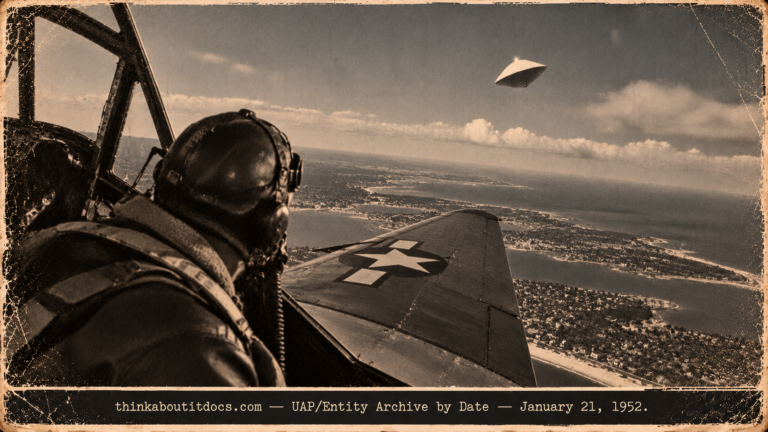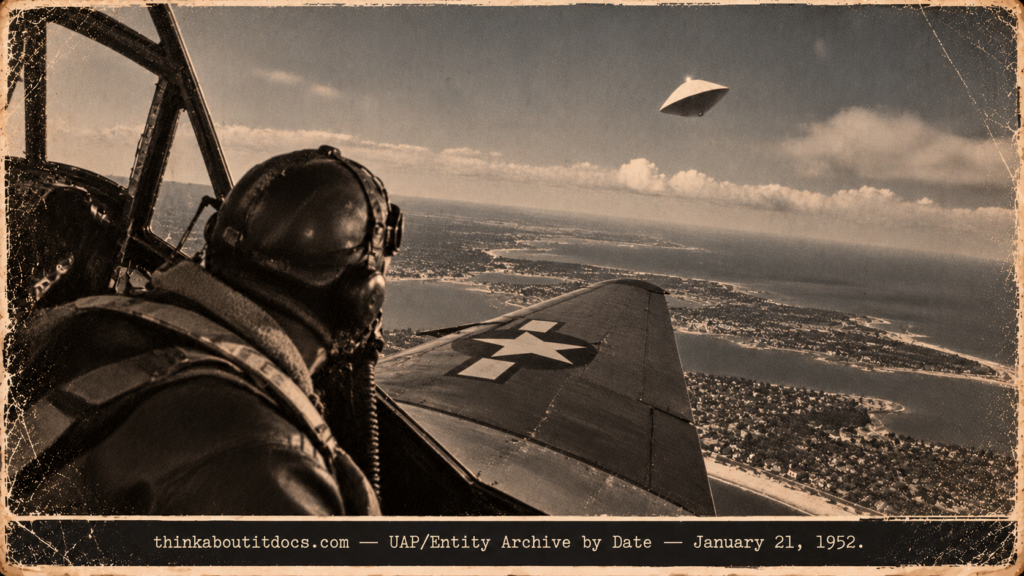
A Navy TBM pilot chases a canopy-shaped disc near Mitchel AFB, January 21, 1952.
THINK ABOUTIT UFO|UAP SIGHTINGS REPORT
1952: A Navy Pilot Chases a Parachute-Shaped Disc Over Long Island and Cuts Inside Its Turns
At about 9:50 on the morning of January 21, 1952, a Navy pilot flying a TBM Avenger southeast of Mitchel Air Force Base on Long Island saw a light-colored object that looked like a parachute canopy. It was moving across the wind, so it could not have been a drifting parachute. He turned left to get a look, banked until he was nearly on his wing, and followed it for about two and a half minutes before it accelerated in a climb and vanished.
Mitchel’s weather station had launched a Rawinsonde balloon at the same minute, and the Air Force’s own investigators spent pages working out whether the pilot had chased it. They could not say. The Air Technical Intelligence Center concluded that it “cannot be definitely concluded” that the object was the balloon, and noted two discrepancies it could not remove. This Mitchel AFB Navy TBM UFO chase, the day before the Nenana radar case, is one of the best-investigated early 1952 sightings, and Ruppelt tied the two events together in his book.
Date: January 21, 1952 (some records say January 22)
Sighting Time: About 0950 EST (1450Z); the tower log puts the first call at 0955
Day/Night: Day
Location: Southeast of Mitchel AFB, Long Island, New York, about three runway lengths from the end of Runway 30
Urban or Rural: Urban; thickly populated suburban area
No. of Entity’s: Not Applicable
Entity Type: Not Applicable
Entity Description: Not Applicable
Hynek Classification: DD (Daylight Disc)
Duration: About 2½ minutes by the pilot’s estimate (the ATIC analysis puts a balloon-based turn at 35–45 seconds)
No. of Object(s): 1
Description of the Object(s): Cone-shaped, like the vertical cross-section of a parachute canopy; the top light-colored, “like nylon”, the underside dark. At first it seemed to show wedge or pie-shaped segments. It appeared to oscillate slowly in level flight.
Shape/Size/Color of Object(s): Disc or canopy-shaped; estimated 20–30 feet in diameter with a 3:1 diameter-to-thickness ratio; light on top, dark below
Distance to Object(s): Low, at about 45 degrees from the aircraft when first seen; the pilot judged its angular size equal to a house
Height & Speed: Pilot estimated 200–300 feet altitude and about 300 knots at first (about 200 knots in later estimate), accelerating in a climb to about 500 knots; the TBM flew at about 160 knots at a nearly constant altitude (about 600 feet in the text layer)
Number of Witnesses: 1 (the pilot; tower operators did not see it)
Special Features/Characteristics: The pilot cut inside its turns to get close; the object stayed below the TBM, then climbed rapidly and disappeared at about 10 degrees above the horizon without shrinking in size
Case Status: Project Blue Book record card: Possibly Balloon. ATIC’s appendix: could not definitely be concluded to be the Rawinsonde balloon
Source: Project Blue Book record card and ATIC appendix; ATIC field-trip report; preliminary wire; Edward J. Ruppelt, The Report on Unidentified Flying Objects, Chapter 10; Sparks #351
Summary/Description: A Navy TBM pilot chased a canopy-shaped object near Mitchel AFB for about 2½ minutes before it climbed away at an estimated 500 knots. A weather balloon was launched from Mitchel at 0950 EST, and ATIC found enough correlation to call a balloon possible but not enough to conclude it.
Related Cases: Nenana radar intercept (January 22, 1952); Korea B-29 orange sphere (January 29, 1952); January 1952 archive
Detailed Report
At approximately 0950 EST on January 21, 1952, a U.S. Navy pilot flying a TBM aircraft sighted an unidentified object southeast of Mitchel AFB. The TBM was on a heading of about 45 degrees and about three runway lengths from the end of, and lined up with, Runway 30 (300 degrees). The object appeared to be halfway between the aircraft and the end of the runway, low, at an angle of about 45 degrees from the aircraft. The pilot’s first impression was a parachute, and he thought he noticed wedge or pie-shaped segments on the top, but he realized the object was going crosswind and could not be a drifting parachute.
He judged its angular size to be the same as the angle subtended by a house on the ground, and by watching it cover the equivalent of a city block he judged its speed to be 300 knots at an altitude of 200–300 feet, on a course of about 225 degrees. He started a left turn in an attempt to identify it, keeping airspeed near 160 knots and a nearly constant altitude (read as about 600 feet), and estimated he was pulling two to three g’s. At one point he had to increase his bank to nearly 90 degrees to keep the object from disappearing under the wing. The object stayed below the TBM during most of the time it was in sight. When the aircraft was near position 4 on the pilot’s overlay, the object appeared to start a rapid climb, accelerating to an estimated 500 knots, and disappeared at about 10 degrees above the pilot’s horizontal line of sight near position 5. It did not diminish in apparent size except possibly near the end. The pilot was very positive that when he was north of Mitchel AFB he could see the object.
The object appeared cone-shaped, similar to the vertical cross-section of a parachute canopy, with a length-to-depth ratio of about 1:3. The top was light colored, “like nylon”, and the undersurface dark. In level flight it appeared to oscillate with a slow period. A preliminary wire summary adds that the pilot was able to get near the object by cutting inside on turns, and that it appeared to circle the base. Total time was estimated at about two and a half minutes.
An ATIC field team made a trip to Mitchel AFB to reinterrogate the pilot and other personnel. His description matched his original report and added details. The tower log showed the first contact with the TBM at 0955 EST, when the pilot reported an object east of the field. At 1008 he called again to describe it in detail, saying it “appeared to be a parachute canopy with a dark colored object underneath.” The tower operators on duty had not seen the TBM or any balloon. A T-11 was the only other aircraft near the time, and it was on an entirely different heading.
At 0950 EST the Mitchel weather section launched a Rawinsonde balloon. Such balloons are about six feet in diameter at launch, light gray, with white streaks of talcum powder, and carry a tin-foil radar reflector about 18 inches square six inches below. The balloon was tracked by radar, but the radar operators could not recall a TBM circling its return because aircraft returns were common in the heavy traffic of the area.
ATIC’s discussion works through the geometry. The initial time was probably nearer 0954. At that time the balloon would have been at about 4,000 feet. An object that the pilot thought was about 30 feet across at 8,500 feet could also have been a six-foot balloon about 1,700 feet away at an altitude near 4,800 feet. The balloon would have moved on a heading reciprocal to the TBM, appearing to travel faster than the pilot assumed. The report finds the turn radius shown on the pilot’s sketch too large for 160 knots and two to three g’s (about 1,500 to 2,500 feet instead of nearly 6,000), and notes the operations officer saw that the pilot’s first sketch was about half the size of his final one. At 1,500 feet radius, a 360-degree turn would take about 35 seconds, or perhaps 45 if elliptical, which sits against the pilot’s estimate of two and a half minutes. Balloons appear oval or dome-shaped, darker at the bottom, and the talcum powder could give an appearance of segments like parachute panels; the oscillation fits a balloon’s period. The report also lists two major discrepancies: the pilot was sure that at one time he was north or northwest of the field and could still see the object, and shortly before it disappeared the line of sight swung toward the aircraft’s nose, when a balloon should have let him come close enough to identify it.
The conclusion states that from the data it cannot be definitely concluded that the object was the balloon, though enough correlates to indicate a possibility. No other reports were received of unusual objects, and since the object appeared 20–30 feet in diameter at only 200–300 feet over a thickly populated area, the report notes that it seemed likely someone else would have reported it. The Blue Book card lists Possibly Balloon, with a comment that a thorough interrogation was made and it is believed that the pilot saw the balloon.
RESEARCHER’S NOTES
The Balloon That Fit Most of the Evidence
- Date Variants. The Blue Book card and ATIC appendix say January 21. A preliminary wire and some later listings say January 22. Ruppelt writes that the Nenana, Alaska radar case occurred 19½ hours after the Mitchel chase, which matches January 21 at 0950 EST (see the Nenana page).
- Speed and Altitude. The pilot’s speed estimate varies between 200 and 300 knots at first sighting. His altitude estimate of 200–300 feet and its angular size are what produce the 20–30 foot size; a smaller, higher object at the balloon’s range fits the same angle.
- The Two Discrepancies. ATIC admits two points it could not remove: the pilot was positive he saw the object from north or northwest of the field, and the object’s line of sight swung toward the nose before it vanished. If it were a balloon, he should have been able to approach it.
- The Rank. Ruppelt calls the pilot a Navy lieutenant commander; the Blue Book documents say only a Navy pilot flying a TBM. The documents are followed here.
- Turn Geometry. The investigators doubted the 6,000-foot turn radius on the pilot’s sketch and noted the pilot admitted the sketch could be in error. They did not suggest he misreported the object; they suggested he misjudged the track.
- Spelling. The file spells the base both Mitchel (correct) and Mitchell.
The Mitchel case is an unusually well-investigated daylight sighting: a pilot who chased an object at close range, a field team that rechecked his story, and an analysis that came close to explaining it without quite doing so. A balloon is the best candidate, but ATIC’s own report leaves two discrepancies open and stops short of calling the case solved.
“From the data obtained on this sighting, it cannot be definitely concluded that the object sighted by the TBM pilot was the Rawinsonde balloon released by the Mitchel AFB Weather Station.”
— ATIC appendix, Mitchel AFB, New York, January 21, 1952