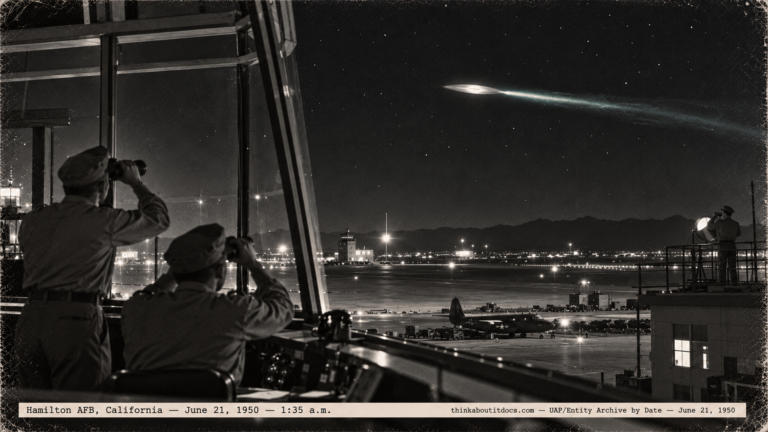
On June 21, 1950, three airmen at Hamilton Field watched a disc-shaped object with a blue flame make five passes.
THINK ABOUTIT UFO|UAP SIGHTINGS REPORT
1950: Hamilton Field, California — Five Passes Over the Beacon
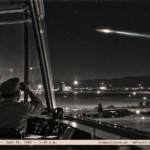
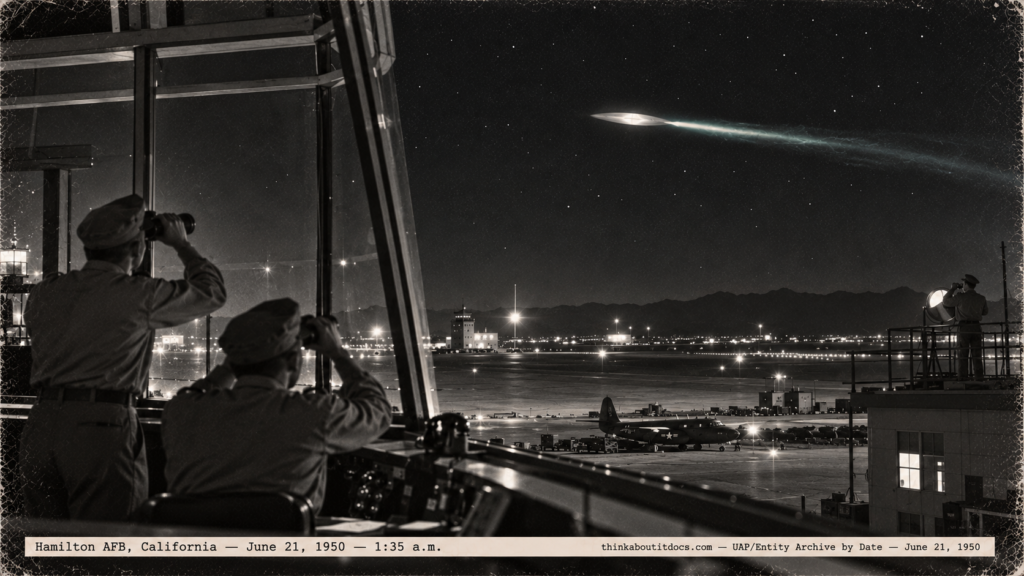
At 1:35 a.m. on June 21, 1950, a control-tower corporal at Hamilton Field, about 25 miles north of San Francisco, saw a blue flame shoot out of an object that flashed past from the southwest and headed northeast. He thought it was a falling star; it did not fall. Over the next stretch of the night he and two other Air Force airmen, one beside him in the tower and one at a second observation post across the field, watched it return again and again, following it with binoculars: a circular object, thick in the middle and tapering to the edges, trailing a flame one of them likened to an acetylene torch.
The story was on the wire services by morning, with speed estimates of 1,000 to 1,500 miles an hour and a “roar like thunder.” By that afternoon the airmen were telling a news conference they had heard no sound and that speed is very hard to judge at night. The Hamilton Field UFO case then dropped out of the official record: the Air Force card says the report is not in the file, the card is not in the file, and the case is missing.
Date: June 21, 1950 (Wednesday)
Sighting Time: 1:35 a.m. PST (09:35Z)
Day/Night: Night
Location: Hamilton Field (Hamilton AFB), about 25 miles north of San Francisco, California; seen from the control tower and a second observation post, the object passing near a beacon just north of the field
Urban or Rural: Rural (air base)
No. of Entity’s: 0 — Not Applicable
Entity Type: Not Applicable
Entity Description: Not Applicable
Hynek Classification: NL (nocturnal light; outline described as circular, thick in the center and tapering to the sides)
Duration: Not given on the card or in the 1950 clippings; later catalogs say about 25 minutes
No. of Object(s): One, making five passes
Description of the Object(s): A circular, disc-like object spraying a blue or blue-green flame; a roar like thunder in the first reports, disputed that afternoon
Shape/Size/Color of Object(s): Circular, thick in the center and tapering to the sides; size not stated; blue to blue-green flame; shape hard to discern because of speed and darkness
Distance to Object(s): Approach altitude estimated at 2,000 to 5,000 feet; distance not stated
Height & Speed: 2,000 to 5,000 feet on approach; first-report speed estimate 1,000 to 1,500 mph, which S/Sgt. Lorimer would not stand behind
Number of Witnesses: 3: Cpl. Pryor (control tower), S/Sgt. Ellis R. Lorimer (control tower) and S/Sgt. Virgil Cappuro (airways communications, second observation post)
Special Features/Characteristics: Binoculars used; clear sky over the field while high fog covered much of the Bay Area; Air Force public information officer said no aircraft were over the field at the time and none landed during the predawn hours; intelligence men questioned the three airmen all morning
Case Status: Insufficient Data (Project 10073 Record Card); report and card missing from the file
Source: Project 10073 Record Card; AP, UP and Oakland Tribune accounts in the Dayton Daily News and Dayton Journal-Herald (June 21-22, 1950), the New York Daily News and a June 22 Herald Tribune clipping; a period magazine dramatization of the case; Dan Wilson, UFO Evidence, Section III
Summary/Description: Three tower airmen watched a thick-centered disc with a blue flame make five passes over Hamilton Field; the Air Force file is missing.
Related Cases: San Leandro, California, June 28, 1950 (circular object with flames and a thunder-like noise, same Bay Area region)
Detailed Report
The first reports. The AP story, datelined Hamilton Field, June 21, said three airmen had told of sighting a mysterious flying object over their base, traveling at a great rate of speed and spraying a blue-green flame. It was first sighted at 1:35 a.m. Because of the speed and the darkness they could not discern its shape, but all agreed it was not a jet plane, or at least not a conventional one. They noted that there are many jets at the big Air Force base and that they had seen them countless times at night.
The tower and the second post. According to the Oakland Tribune, as carried by the UP and AP, the object made five passes near the base. Cpl. Pryor, a control tower operator, said he saw a blue flame shooting out as the object flashed by from the southwest and headed northeast. He said he thought it was a falling star, but that it did not fall and just kept going. The first pass was at 1:35 a.m., and the object traveled so fast he could not see the later approaches. The AP account says Pryor called it to the attention of S/Sgt. Lorimer, 25, of Burbank, California, who had three years’ experience in control tower observation and who did most of the talking to reporters. Across the field, in another observation post, S/Sgt. Cappuro, 36, also watched the craft make three separate passes. The Tribune said the men watched it return from the northwest and make another pass north of the field, then make three more approaches. They described its approach altitude as 2,000 to 5,000 feet, and said the sky was clear over Hamilton Field although high fog prevailed elsewhere in the Bay Area.
The official reaction. Air Force intelligence men questioned the three observers all morning. Headquarters of the Fourth Air Force had no comment, a report was being made to Washington, and Air Force headquarters in Washington said it had received no information about the incident. Major James E. Johnston, the base public information officer, said no planes were over Hamilton Field at the time the object was reported and none landed during the predawn hours.
The afternoon statements. At a Wednesday afternoon news conference, Lorimer said the exhaust or tail resembled the flame of a blow torch, and that he knew it was not a jet plane because of its great speed and because a jet, which he was used to watching, shows no flame. Asked about the 1,000 to 1,500 mph estimate, he said it is very difficult to estimate speed, height and distance at night; asked whether it was two or three times the speed of a jet, he answered, “Maybe.” The first morning report had quoted the observers as saying the object roared across the sky, but at the afternoon conference they said they heard no sound.
The record card. The Project 10073 card lists the date-time group as 21 June 1950, 21/0935Z, at Hamilton AFB, with a military source and one object (five passes). Length of observation is not reported, the observation was ground visual, the course varied, with straight flight, and there were no photos and no physical evidence. The conclusion is Insufficient Data: the report is not in the file, the card is not in the file, and the case is missing. Four newsclippings and one extract from a “Flying Saucer” magazine are the only information available, and the case will be evaluated if the file is located.
RESEARCHER’S NOTES
What the Missing File Leaves Us
- Two Pryors: The UP and Tribune accounts name the tower corporal Roger G. Pryor; the AP and the magazine strip name him Cpl. Garland Pryor, 20, of White Hall, Montana. The archive records both because nothing in the clippings settles it.
- Sound: The roar was a first-morning report; the afternoon statements said no sound. Press accounts do not say whether the airmen or the reporters changed the wording.
- Speed: 1,000 to 1,500 mph came from the first report. Lorimer, the most experienced of the three, would not put a figure on it.
- Passes: Five passes is the Oakland Tribune count; the AP story has the airmen describing three separate passes. Both versions are in the clippings.
- The magazine strip: The dramatization in the file ends by asking whether Air Force intelligence told the men to change their stories so that their afternoon statements would not match the morning reports. No document in the file shows that, and the strip says its quotations are word-changed for dramatization.
- The missing file: The card says the case is missing, so the intelligence interviews that lasted all morning are not available. A fresh search of Fourth Air Force and Air Materiel Command records is the logical next step.
Hamilton Field is a case where three trained tower observers agreed on a circular object with a blue flame and where the official file did not survive. What remains is a set of press accounts that differ on the corporal’s name, the sound and the number of passes, and an Air Force card that states plainly it has nothing to evaluate. It stays unexplained because it was never explained.
“It is very difficult to estimate speed, height, and distance at night.”
— S/Sgt. Ellis Lorimer, Hamilton Field news conference, June 21, 1950, as reproduced in a period magazine account