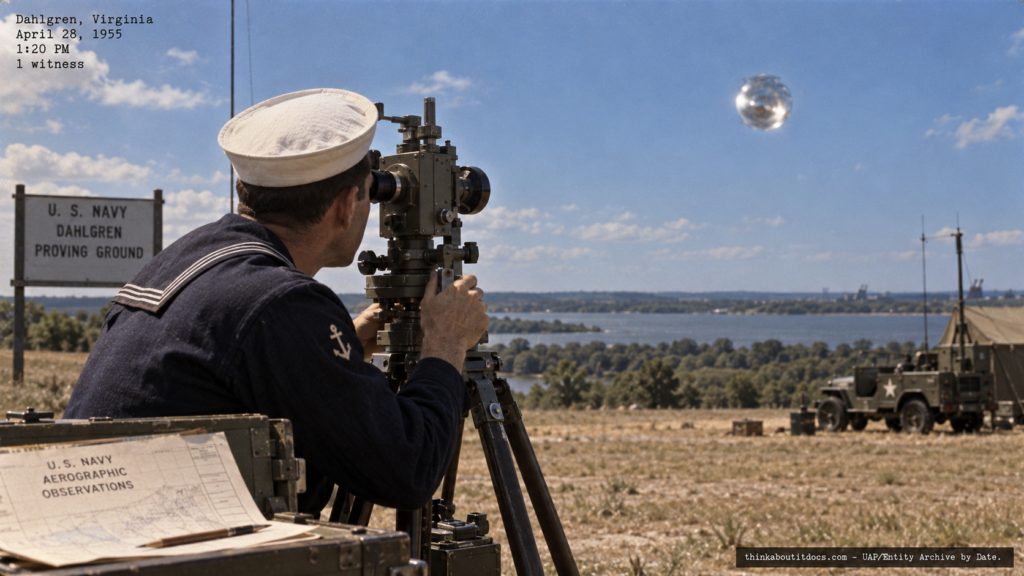
The April 28, 1955 Dahlgren, Virginia theodolite and radar case.
THINK ABOUTIT UFO|UAP SIGHTINGS REPORT
1955: Dahlgren, Virginia: A Theodolite-Tracked, Radar-Confirmed UFO
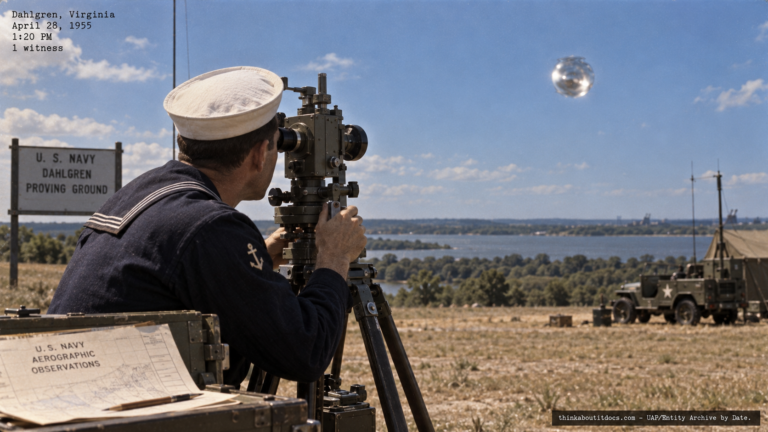
A Navy officer at a Virginia Naval Proving Ground was tracking a routine weather balloon with a ground theodolite on the afternoon of April 28, 1955 when he found himself instead tracking something else entirely — a wavering, silver-metallic round object that held station in the sky for over an hour, its position independently confirmed at two separate moments by air surveillance radar. Anchored by precise instrument data and genuine radar corroboration, Dahlgren stands among the most credibly documented cases anywhere in this archive.
Date: April 28, 1955
Sighting Time: 1:20 PM to at least 2:40 PM EST
Day/Night: Day
Location: U.S. Naval Proving Ground, Dahlgren, Virginia
Urban or Rural: Rural (military installation)
No. of Entity(‘s): Not Applicable
Entity Type: Not Applicable
Entity Description: Not Applicable
Hynek Classification: RV (Radar/Visual)
Duration: At least 80 minutes, spanning the two recorded fixes
No. of Object(s): 1
Description of the Object(s): A round object, silver-metallic in color, that appeared elongated at times and had a wavering quality to its outline
Shape/Size/Color of Object(s): Round (elongating at times), approximately 20-30 ft in diameter, silver metallic
Distance to Object(s): Calculable from the two recorded angular fixes relative to Dahlgren Operations
Height & Speed: First fix: 31.8° elevation, 40° relative bearing from Dahlgren Operations at 1:20 PM. Second fix: 19.8° elevation, 59° true bearing at 2:40 PM. The change in elevation and bearing over 80 minutes indicates the object’s position shifted, rather than the object simply holding a fixed static point.
Number of Witnesses: 1 named directly (AG1 David F. Robinson), with independent radar-operator corroboration implied by the air surveillance radar confirmation
Special Features/Characteristics: Discovered incidentally while tracking a routine weather balloon (pibal) with a ground theodolite — genuine instrument data rather than an unaided visual account; two separately time-stamped angular position fixes; independently confirmed by air surveillance radar, a second and different sensor system than the theodolite
Case Status: Project Blue Book-era (BBU) case with genuine multi-instrument corroboration — among the more credibly documented cases in the archive given the combination of optical theodolite tracking and independent radar confirmation
Source: Dan Wilson; the McDonald list; the Brad Sparks BBU listing
Summary/Description: AG1 David F. Robinson, at the U.S. Naval Proving Ground in Dahlgren, Virginia, was tracking a weather balloon with a ground theodolite on the afternoon of April 28, 1955 when he instead picked up an unidentified flying object. He described it as round, 20-30 ft in diameter, silver-metallic, appearing elongated at times with a wavering quality. He recorded two separate angular position fixes: 31.8° elevation and 40° relative bearing at 1:20 PM, and 19.8° elevation and 59° true bearing at 2:40 PM, both relative to Dahlgren Operations. The object’s presence and movement were independently confirmed by air surveillance radar.
Related Cases: None identified
Detailed Report
On the afternoon of April 28, 1955, AG1 David F. Robinson was carrying out a routine assignment at the U.S. Naval Proving Ground in Dahlgren, Virginia — tracking a weather balloon (a “pibal,” or pilot balloon, used for upper-atmosphere wind measurement) using a ground theodolite, a precision optical surveying instrument capable of recording exact angular measurements. In the course of this ordinary task, at 1:20 PM, Robinson instead found himself tracking a genuine unidentified object.
He described the object as round, roughly 20 to 30 feet in diameter, silver-metallic in color, and noted that it appeared to elongate at times and had a wavering quality to its outline — details consistent with an object at some distance being observed through precision optics rather than a vague unaided-eye impression. Because Robinson was using a theodolite rather than simply looking up, his observation produced actual instrument data: a first recorded fix of 31.8 degrees elevation and 40 degrees relative bearing from Dahlgren Operations, taken at 1:20 PM.
Robinson continued observing, and at 2:40 PM — 80 minutes after the first fix — recorded a second position: 19.8 degrees elevation and 59 degrees true bearing, again from the same reference point. The shift between the two fixes indicates the object’s apparent position changed meaningfully over that interval, rather than the sighting being a single static point mistaken for something anomalous.
Critically, this was not a single-instrument, single-observer case. The case record notes that the object was also tracked by air surveillance radar — an entirely separate detection system from Robinson’s optical theodolite — providing independent confirmation that something real and trackable was present in the airspace over Dahlgren for the better part of an hour and a half.
RESEARCHER’S NOTES
The Dahlgren Case — 1955 Virginia and the Value of Incidental Instrument Data
- Discovered by Accident, Not by Looking for It. Robinson wasn’t scanning the sky for anomalies — he was doing a routine weather-balloon tracking task when the object appeared in his theodolite. This kind of incidental discovery, using an instrument already pointed at the sky for an unrelated purpose, tends to carry more evidentiary weight than a report that begins with someone noticing something strange and then trying to describe it from memory.
- Two Independent Sensor Systems. The combination of optical theodolite tracking and separate air surveillance radar confirmation is a genuinely strong corroboration pattern — two different technologies, operated (presumably) by different personnel, agreeing that something was there. This is one of relatively few cases in the 1955 archive with this level of multi-instrument confirmation.
- Real Numbers, Not Estimates. Unlike the great majority of visual-only sightings in this archive, Dahlgren provides two precise, time-stamped angular position readings rather than a witness’s impressionistic estimate of speed or altitude — allowing, in principle, an actual trajectory to be reconstructed from the data as recorded.
- A Named, Specific Observer. Robinson is identified by full name and rating (AG1 — Aerographer’s Mate First Class, a Navy weather-observation specialty), a role for which precise sky observation was literally his job — adding further weight to the reliability of what he recorded.
Dahlgren belongs among the strongest-documented cases anywhere in this archive: a trained weather observer, using precision instruments for an unrelated task, who recorded two time-stamped position fixes on a genuine unidentified object independently confirmed by radar. It asks for no leap of faith in witness memory — only an acceptance of what the instruments themselves recorded.
“Other manner of observation was air surveillance radar.”
— Case file, Dahlgren, Virginia, April 28, 1955