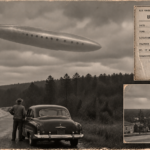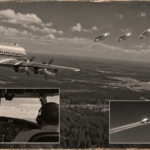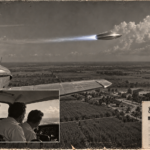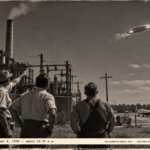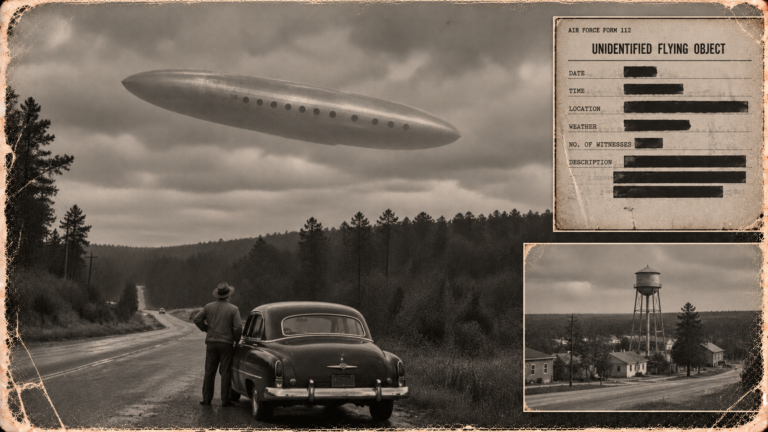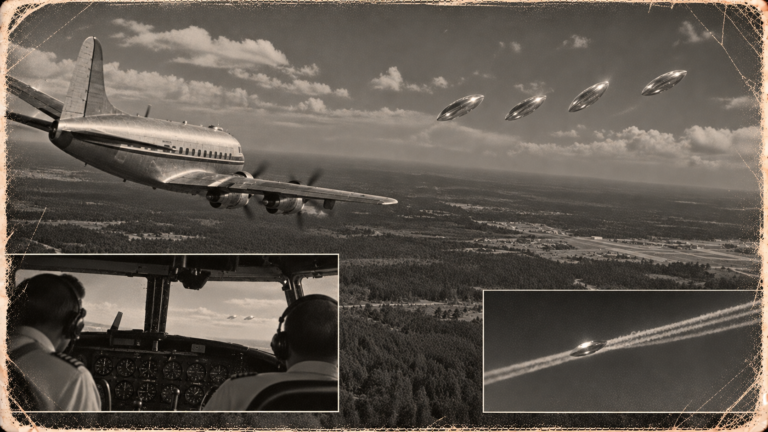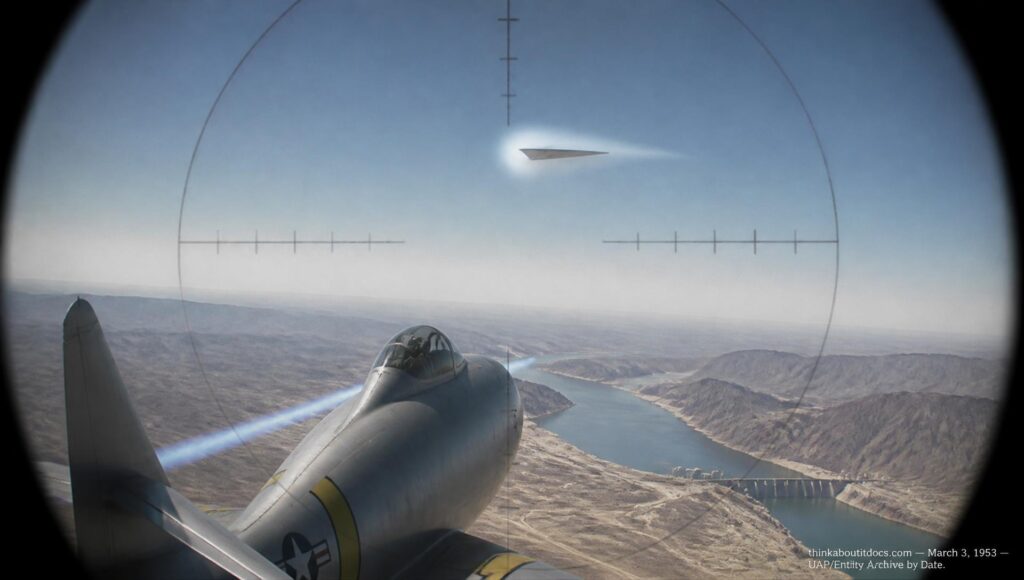
Capt. Roderick Thompson's F-84 pursuit and gun camera footage of an unidentified object near Parker Dam, March 3, 1953.
THINK ABOUTIT UFO|UAP SIGHTINGS REPORT
1953: The Thompson Gun Camera Pursuit — Near Blythe, California
An F-84 instructor pilot at 25,000 feet watched something cross his path that left no doubt in his mind it wasn’t an aircraft — thin, manta-ray shaped, visible only by the vapor condensing off its surface. When Capt. Roderick Thompson broke off training and gave chase, he closed to within five to ten miles of the object over the Colorado River north of Parker Dam and did something almost no other 1953 witness managed: he got it on film.
Date: March 3, 1953
Sighting Time: 1:25-1:32 p.m. (MST)
Day/Night: Day
Location: Approximately 130 miles west of Luke AFB, Phoenix, Arizona, near Blythe, California; pursuit ended over the Colorado River north of Parker Dam, about 70 miles north of Blythe
Urban or Rural: Rural (desert/river airspace)
No. of Entity(‘s): 0
Entity Type: Not Applicable
Entity Description: Not Applicable
Hynek Classification: DD (Daylight Disc — used broadly here for a daylight, non-conventional aerial object; the object itself was not disc-shaped)
Duration: Approximately 7 minutes (1:25-1:32 p.m.)
No. of Object(s): 1
Description of the Object(s): A thin, manta-ray-shaped, flat-surfaced object, visible primarily by the condensation vapor emitted from its surface, leaving contrails that behaved unlike a conventional aircraft’s
Shape/Size/Color of Object(s): Manta-ray/flat-surfaced shape; estimated 300-500 ft wide; color not distinctly given beyond the white condensation trail
Distance to Object(s): Closed to within roughly 5-10 miles during pursuit
Height & Speed: First seen at 35,000-45,000 ft at roughly 400 mph TAS; climbed at approximately 20° angle after Thompson’s pursuit began, with Thompson himself climbing at full power at about 560 mph and reaching 30,000 ft
Number of Witnesses: 3 — Capt. Roderick D. Thompson (pursuing pilot) and student pilots Lt. Jack E. Brasher and Lt. Thomas W. Hale, who saw the object but did not join the pursuit
Special Features/Characteristics: The object’s condensation trail formed abruptly, split in two for roughly 1,000 ft, then ended abruptly without trailing behind the object as a conventional contrail would; Thompson captured 151 frames (roughly 30 feet) of 16mm gun camera film during the pursuit
Case Status: Officially recorded by Project Blue Book (BB Report 11); one of the relatively few 1953 cases with surviving gun camera footage, discussed by Capt. Edward Ruppelt in his own account of Blue Book’s operations
Source: Blue Book Report 11; NICAP; McDonald list; Ruppelt, “The Report on Unidentified Flying Objects,” pp. 229-230; FUFOR Index
Summary/Description: USAF Capt. Roderick D. Thompson of the 3600th Fighter Training Group, Luke AFB, was flying an F-84 instructor mission at 25,000 ft when he spotted a thin, manta-ray-shaped object crossing his flight path at higher altitude, visible mainly by its condensation trail. Two student pilots in accompanying F-84s also saw the object but did not pursue. Thompson turned to chase it at full power, climbing to 30,000 ft and closing to within 5-10 miles over the Colorado River north of Parker Dam, where he shot 151 frames of 16mm gun camera film before the pursuit ended.
Related Cases: None known
Detailed Report
The afternoon of March 3, 1953 began as a routine training flight. Capt. Roderick D. Thompson, an instructor pilot with the 3600th Fighter Training Group out of Luke Air Force Base, was flying an F-84 at 25,000 feet, heading 305° magnetic at roughly 500 mph true airspeed, with two student pilots — Lt. Jack E. Brasher and Lt. Thomas W. Hale — flying their own F-84s nearby.
At around 1:25 p.m., an object crossed Thompson’s path at his 10 o’clock high position, moving left to right at an estimated 35,000 to 45,000 feet and about 400 mph true airspeed. It was thin and flat-surfaced, shaped something like a manta ray, and visible mainly through the condensation vapor streaming off it rather than any solid outline. Both student pilots saw it too, but neither broke formation to follow.
Thompson did. He turned to pursue, climbing at full power to roughly 560 mph. As he closed, the object made a slight dipping turn to the northwest and began climbing at an estimated 20° angle. What happened to its contrail next is the detail that makes this case stand apart from a routine light-in-the-sky report: a heavy condensation trail suddenly formed behind the object, extending roughly 1,000 feet, then split into two for another 1,000 feet — before ending abruptly and simply staying with the object rather than trailing behind it the way a conventional aircraft’s contrail would.
Thompson reached 30,000 feet and closed to within an estimated 5 to 10 miles of the object over the Colorado River, north of Parker Dam, roughly 70 miles north of Blythe. There, using a 16mm N-9 gun camera at an estimated 16 frames per second and a 1/40-second exposure, he shot approximately 151 frames — about 30 feet of film — before the pursuit ended.
The case entered the official record as Project Blue Book Report 11 and was later discussed by Capt. Edward Ruppelt, Blue Book’s first director, in his own book on the project’s history — a level of institutional attention few 1953 sightings received.
RESEARCHER’S NOTES
The Thompson Pursuit — 1953 and the Rare Case With Film
- Actual gun camera footage: Very few cases from this era have any surviving photographic or film evidence at all. Whatever the footage ultimately showed or failed to show, its mere existence sets this case apart from the vast majority of testimony-only reports in this archive.
- A contrail that didn’t behave like a contrail: The detail of the vapor trail splitting and then staying with the object rather than trailing behind it is unusual and specific — not the kind of thing an observer typically invents, and hard to explain as an ordinary aircraft’s exhaust.
- Multiple witnesses, one pursuit: Three trained military pilots saw the object; only one gave chase. That the other two corroborated the sighting without needing to follow it adds a layer of independent confirmation the case wouldn’t have on Thompson’s word alone.
- Institutional attention: Formal designation as Blue Book Report 11, and later discussion in Ruppelt’s own book, means this case was taken seriously by the people running the official investigation at the time — not dismissed as noise.
- What isn’t preserved: The surviving record does not describe what analysis, if any, was done on the film itself, or what conclusion Blue Book reached. That gap is worth being honest about rather than filling in.
This is one of the better-anchored military cases from early 1953 — named witnesses, a formal Blue Book designation, corroborating pilots, and actual film. What’s missing from the record as preserved here is any account of what the film ultimately showed under analysis, and that gap is left open rather than guessed at.
“Immediately began to form a heavy condensation trail behind it for roughly 1,000 ft and split in two for about 1,000 ft but which ended abruptly and moved with the object, the trail not being left behind.”
— Case summary, Blue Book Report 11