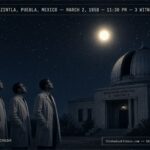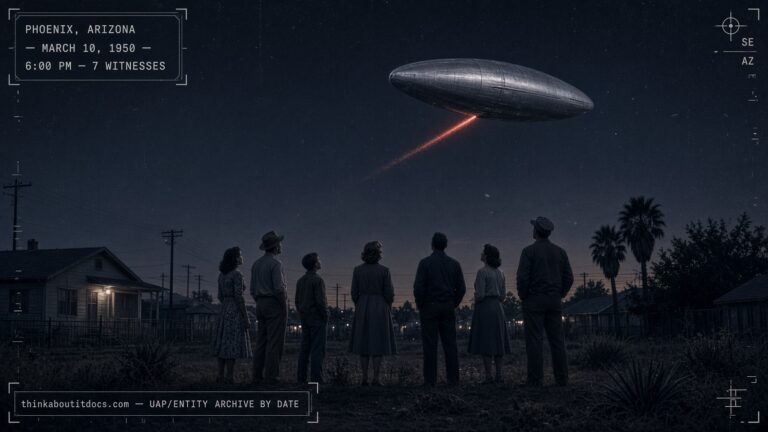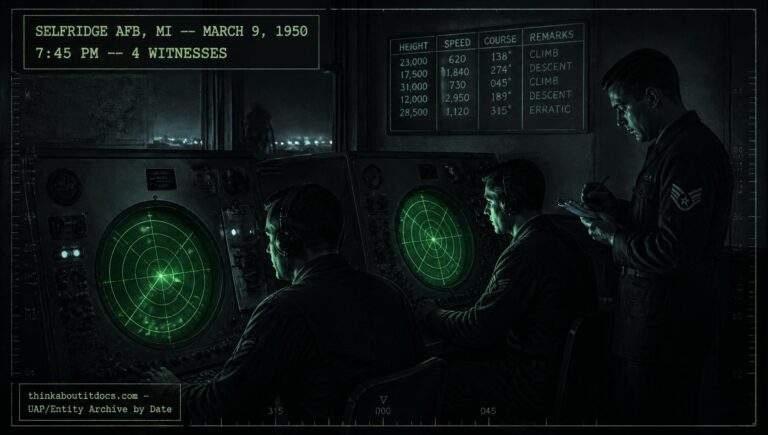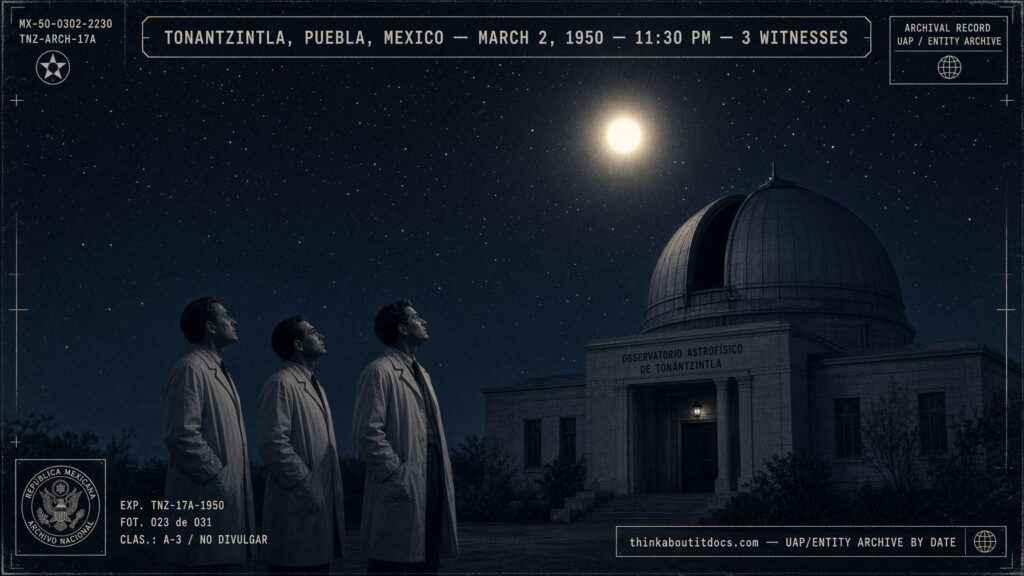
March 2, 1950 — Tonantzintla Observatory director Luis Erro and two colleagues observe and photograph an unexplained object.
THINK ABOUTIT UFO|UAP SIGHTINGS REPORT
1950: The Tonantzintla Observatory Sighting
Late at night at Mexico’s leading astronomical observatory, three men working at the Schmidt telescope — including the observatory’s own director — watched a brilliant object cross the sky in view of the instrument itself, and photographed it as it went.
Date: March 2, 1950
Sighting Time: 11:30 p.m.
Day/Night: Night
Location: Tonantzintla Observatory (Instituto Nacional de Astrofísica, Óptica y Electrónica site), Puebla, Mexico
Urban or Rural: Rural (observatory grounds)
No. of Entity(‘s): Not Applicable
Entity Type: Not Applicable
Entity Description: Not Applicable
Hynek Classification: NL (Nocturnal Lights)
Duration: Approximately 5 minutes
No. of Object(s): 1
Description of the Object(s): A brilliant, round object visible to the naked eye and captured on photographic plate as it crossed the field of the Schmidt telescope
Shape of Object(s): Round
Size of Object(s): Not specified
Color of Object(s): Brilliant/bright
Distance to Object(s): Not determined
Height & Speed: Not specified beyond crossing the sky within the telescope’s field of view
Number of Witnesses: 3 (including observatory director Luis Enrique Erro)
Special Features/Characteristics: Professional Astronomer Witness (Observatory Director), Photographed on Astronomical Equipment, Occurred During Active Telescope Observation
Case Status: Unexplained
Source: H. Edward Hill, Catalog Through 1950
Summary/Description: On the night of March 2, 1950, at 11:30 p.m., three men working at the Schmidt telescope of the Tonantzintla Observatory in Puebla, Mexico — including Luis Enrique Erro, the observatory’s founding director — saw a brilliant, round object cross the sky within view of the telescope. The object was both visually observed and photographed during the roughly five-minute sighting, making this one of the relatively small number of 1950 cases in this archive with an associated photographic record from a professional scientific instrument rather than an ordinary camera.
Related Cases: Not Applicable — though this archive notes the broader pattern of professional astronomer witnesses across its 1949-1950 record, including Clyde Tombaugh (August 1949, Las Cruces) and the Mount Palomar Observatory sightings (October 1949)
Detailed Report
Luis Enrique Erro was not an incidental witness: as the founding director of the Tonantzintla Observatory, one of the leading astronomical institutions in Mexico at the time, he and his colleagues were professionally engaged in careful sky observation at the exact moment the object appeared, using a Schmidt telescope — an instrument specifically designed for wide-field photographic astronomy. That combination of professional expertise, active observation, and functioning photographic equipment already pointed at the sky gives this case an unusually strong evidentiary basis for its era.
This case joins a recurring pattern in this archive of professional astronomers becoming UFO witnesses in the late 1940s and early 1950s — Clyde Tombaugh’s August 1949 Las Cruces sighting and the Mount Palomar Observatory’s October 1949 cases being the clearest prior examples. In each instance, the witnesses’ training in careful, skeptical observation of the sky makes simple misidentification a less comfortable explanation than it would be for an untrained witness, without by itself resolving what was actually seen.
No further detail on the photographic plate’s fate, or any subsequent analysis of it, is documented in the source consulted for this report.
RESEARCHER’S NOTES
The Tonantzintla Sighting — Mexico 1950 and the Astronomer’s Advantage
- Classification issues/corrections: Filed as NL given the nighttime timing; the object’s exact nature remains undetermined, and no entity or close approach is claimed.
- Source chain assessment: Documented in H. Edward Hill’s Catalog Through 1950, with enough specificity (named observatory, named director, specific instrument) to suggest derivation from a contemporary or near-contemporary record rather than a later embellished retelling.
- Pattern context/comparative cases: This is the third documented professional-astronomer UFO sighting in this archive’s 1949-1950 record, following Tombaugh and the Palomar Observatory cases — a pattern this archive notes without asserting any causal connection between the sightings and the observers’ profession.
- Physical evidence/evidentiary weight: A photographic plate was reportedly taken during the sighting, which — if it survived — would be significant physical evidence; however, no further information on the plate’s fate or content is available in the source consulted for this report.
- Geographic/historical context: Tonantzintla Observatory was, in 1950, one of Latin America’s most significant astronomical research sites, making this case notable for the caliber of its scientific setting.
A working observatory director, mid-observation with a telescope built for exactly this kind of precise sky photography, caught something unexplained crossing his own field of view — and got a picture of it. That combination of professional context and instrumented evidence is rare enough in this archive to be worth remembering on its own terms.
“Photo and visual sighting of a brilliant object that crossed the sky at the Schmidt telescope.”
H. Edward Hill, Catalog Through 1950, describing the March 2, 1950 Tonantzintla Observatory sighting.