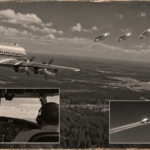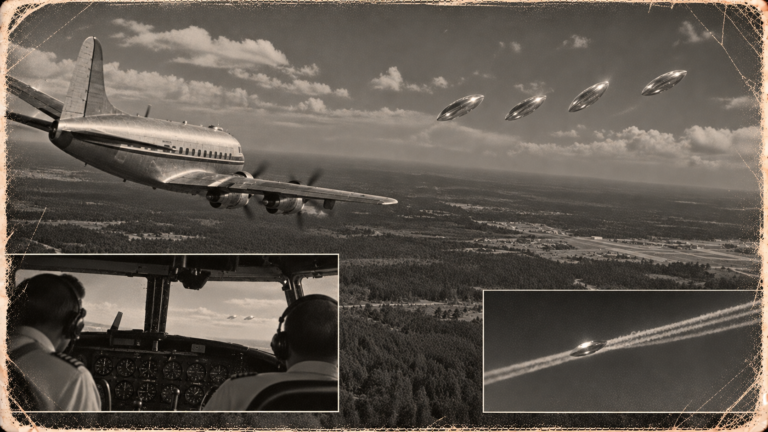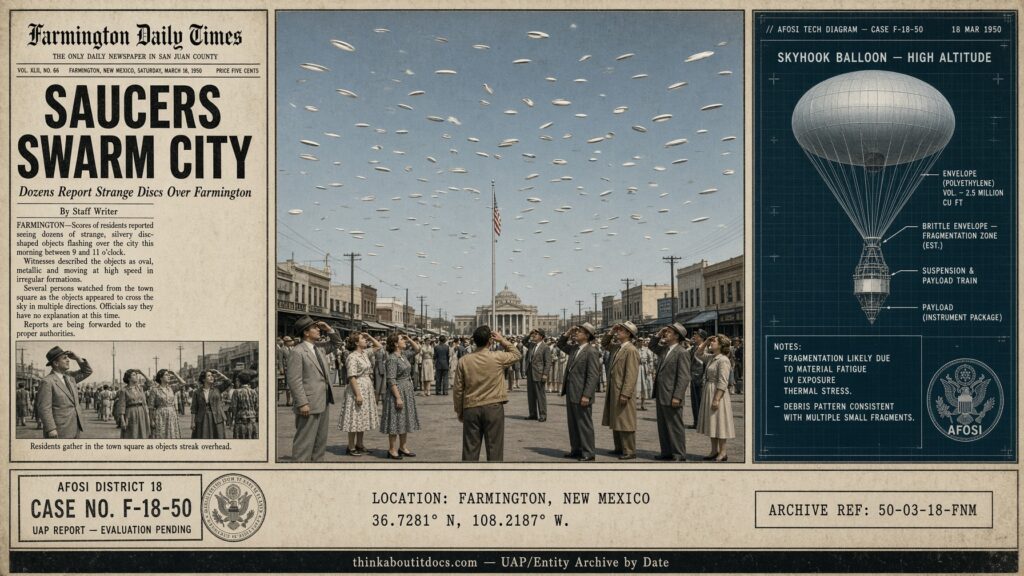
March 17, 1950, Farmington — half the town watches the "armada" through a dust storm. The lone red object was called the leader. The balloon explanation later collapsed: no Skyhook was ever launched that week.
THINK ABOUTIT UFO|UAP SIGHTINGS REPORT
1950: The Farmington Armada — New Mexico
On the morning of March 17, 1950 — St. Patrick’s Day — the sky over Farmington, New Mexico filled with what most of the town’s 3,600 residents took to be flying saucers: estimates ran from a conservative 500 to “thousands,” darting, looping, and reversing direction at speeds no aircraft of the era could match, for the better part of an hour. It was the climax of a four-day build-up that began with a single disc report on March 15 and closed with a final mass sighting on March 18, and it remains one of the largest mass-witness UFO events on record, seen by the mayor, the local newspaper staff, ex-military pilots, the highway patrol, and ordinary citizens of a small Four Corners town who by all accounts had no reason to coordinate a story.
Overview
Farmington sits in the northwest corner of New Mexico, roughly 170 miles from Albuquerque and a short distance from the Four Corners region — and, notably, not far from the nuclear-weapons infrastructure of Kirtland AFB and the Sandia proving grounds. Reports of unusual aerial objects had been trickling in from the area for two days before the main event, but it was the mid-morning display of March 17 that made every major newspaper in the country. Witnesses described saucer-shaped objects of varying number, traveling at extreme speed, with no consistent flight path, occasionally flying in formation behind a larger, faster “leader.” The Air Force’s own preferred explanation — a brittle, high-altitude Skyhook balloon shattering into thousands of drifting plastic fragments — has never been corroborated by a single recovered fragment, and later researchers, including physicist James E. McDonald in the 1960s, concluded the balloon-breakup theory did not adequately account for what multiple independent witnesses described. The case has since become known as the “Farmington Armada.”
The Incidents
March 15, 1950
Location: Farmington, New Mexico
Time: Unknown
Summary: The opening report of the wave — a single flying disc was observed over the town, with no further detail recorded. It drew little attention on its own and is significant chiefly in hindsight, as the first of what would become a four-day pattern.
Source: Flying Saucers, Flying Saucers Magazine (Palmer)
March 16, 1950
Location: Farmington, New Mexico
Time: 10:00 and 11:00
Summary: Two distinct waves the day before the main event. At 10:00, ten observers watched objects to the northeast climb skyward at a 60–80 degree angle from above 20,000 feet altitude, bright aluminum in color, oval-to-oblong in shape, appearing roughly 1/16 to 1/2 inch held at arm’s length, moving faster than conventional aircraft, over a 30-minute span before gradually fading from sight. At 11:00, the same ten observers watched a separate group of objects from north to northeast, turning on their own axis and maneuvering up and down, luminous “like tin foil,” flat and spheroid in shape, over a 3–5 minute span before observation was discontinued.
Source: AFOSI
March 17, 1950 — St. Patrick’s Day
Location: Farmington, New Mexico
Time: 10:15 a.m., continuing roughly one hour
Summary: The mass event. First reports came in at 10:15 a.m.; for the following hour, saucer-shaped objects reportedly filled the sky in numbers estimated anywhere from a conservative 500 up to “thousands.” Observers — including the mayor, local newspaper staff, former military pilots, and highway patrol officers — described objects darting in and out of formation at extreme speed with no fixed flight path, apparently avoiding collision by mere inches. The Air Force’s later explanation centered on a Skyhook balloon launched from nearby Holloman AFB that was thought to have shattered at extreme altitude, its brittle plastic envelope breaking into thousands of drifting fragments that could resemble a fleet of small discs from the ground — though no fragments were ever recovered at Farmington to confirm it.
Source: Condon Committee (Ruppelt account)
March 18, 1950
Location: Farmington, New Mexico
Time: 10:30 a.m., objects appearing around noon
Summary: A final, smaller-scale reprise. A large number of saucers performing aerobatic maneuvers appeared over the town around midday, then departed at an estimated 1,000 mph — closing out four consecutive days of activity over the same small town.
Source: Trench, Brinsley LePoer, Flying Saucer Story, Tandem, 1973
Detailed Report
What separates Farmington from most Cold War-era saucer reports is scale of witness base rather than physical evidence. A town of roughly 3,600 to 5,000 people produced an event witnessed, by contemporary press accounts, by a large fraction of the population — not a handful of isolated observers on a back road, but the mayor, working newspaper staff, the highway patrol, and multiple former military pilots among the crowd. That breadth of witness type is unusual and is part of why the case resurfaces in UFO literature decades later.
The Air Force’s mundane explanation is specific and falsifiable: a Skyhook balloon, launched from Holloman AFB adjacent to the White Sands Proving Ground, is proposed to have reached extreme altitude where temperatures of −50°F to −60°F would make its plastic envelope brittle; a gust of wind or other disturbance could then have shattered the balloon into hundreds or thousands of small, light fragments that, drifting down and catching sunlight, might resemble a formation of small discs from the ground. It is a coherent physical mechanism, and it is the explanation the Condon Committee and Air Force ultimately preferred. It has one persistent problem: despite an extensive search at the time, no fragment of a shattered balloon was ever recovered at or near Farmington, even though the light plastic pieces described in the theory would, in principle, have been easy to find blown across open ground.
That absence of confirming debris is why the case has not been treated as closed by all researchers. Physicist James E. McDonald, documenting witness accounts roughly seventeen years after the event, concluded that the balloon-breakup theory — along with proposed explanations involving windblown cotton or atmospheric plasma effects — did not adequately account for the described behavior: sustained, directional, maneuvering flight over multiple days rather than a single dispersal event. Modern researchers reviewing NICAP’s archival files have separately turned up a previously mis-filed October 1950 report containing a contemporaneous witness sketch of the objects — the type of primary documentation that is rare for a case this old, and one that keeps Farmington under active re-examination rather than settled.
Skeptical treatments of the case point to a different kind of absence: for a town its size, with a functioning daily newspaper (the Farmington Daily Times) and presumably at least some residents owning cameras, no photograph of the March 17 mass sighting has ever surfaced. In an event allegedly witnessed by hundreds to thousands of people over the better part of an hour, the total lack of photographic corroboration is treated by these accounts as a serious evidentiary gap, whichever explanation — hoax, balloon debris, misidentification, or genuine anomaly — ultimately accounts for what was seen.
RESEARCHER’S NOTES
The Farmington Armada — New Mexico 1950 and the Limits of a Mundane Explanation
- Classification issues: This is a wave case rather than a single discrete sighting, and no single Hynek category can honestly describe all four days. The March 16 and 17 daytime object reports are best treated as Daylight Discs (DD); the case as a whole should be read as a cluster of related DD events rather than assigned one blanket classification, consistent with how this archive treats other multi-day flap patterns.
- Source chain assessment: The strongest single-incident documentation is the AFOSI-recorded March 16 report, with specific numeric detail on direction, altitude, and duration consistent with formal Air Force intelligence intake. The March 17 mass event is best known through the Condon Committee’s reproduction of Edward Ruppelt’s account rather than a raw contemporaneous document, meaning the most famous day in the sequence is also the most narratively mediated. The March 15 and March 18 entries rest on thinner sourcing (a UFO magazine account and a 1970s popular history, respectively) and should be weighted accordingly.
- Pattern and comparative context: Farmington belongs to a broader class of 1949–1950 formation and mass-sighting events in this archive, alongside the Berger, Ohio searchlight incidents and the wave documented on the Fort Hood, Texas page — multi-day or multi-incident clusters concentrated in a small area, each treated here as its own standalone pattern report rather than folded anonymously into a single day’s monthly entry.
- Physical evidence and evidentiary weight: The case’s evidentiary profile is unusual: extremely broad witness testimony (a meaningful fraction of an entire town, including credentialed observers such as pilots and law enforcement) against a complete absence of physical evidence — no recovered balloon fragments, no photographs, no film. That asymmetry cuts both ways: it undermines the balloon-breakup explanation (no debris) exactly as much as it undermines the anomalous-craft explanation (no imagery from a town full of potential photographers).
- Geographic and historical context: Farmington’s proximity to Kirtland AFB and the Sandia nuclear proving grounds situates it within the broader pattern, documented elsewhere in this archive, of UFO activity clustering near U.S. nuclear weapons infrastructure during this period — a correlation this archive records without asserting causation.
The Farmington Armada endures in the record not because its physical evidence is strong — it is essentially nonexistent on either side of the argument — but because its witness base was so unusually broad for a single small American town over four consecutive days. The Air Force’s Skyhook balloon explanation remains the leading candidate and cannot be ruled out, but it has never been closed by physical confirmation, and later re-examination has kept the case from settling into either a clean explained or a clean unexplained outcome. It is preserved here as Insufficient Data: a mass event, honestly documented, that neither its skeptics nor its defenders have been able to finally resolve.
“On St. Patrick’s Day, 1950, thousands of Farmington’s citizens saw the mass fly-by.”
— Edward J. Ruppelt, Project Blue Book, as reproduced by the Condon Committee