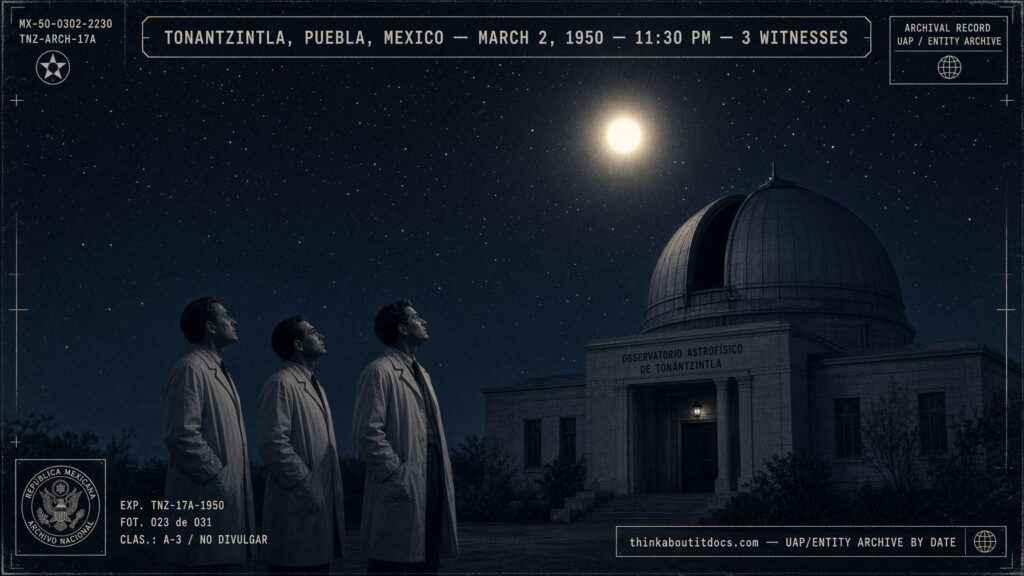
March 2, 1950 — Tonantzintla Observatory director Luis Erro and two colleagues observe and photograph an unexplained object.
THINK ABOUTIT UFO|UAP SIGHTINGS REPORT
1950: Tonantzintla Observatory Photograph, Erro’s Unknown Object
On March 11, 1950, the director of Mexico’s Tonantzintla Astronomical Observatory handed reporters a photograph and a question. The plate, made at the observatory, showed a diagonal band of light across a black square. “The strange object crossed the sky March 2,” Luis Enrique Erro said. “Since that day we have wondered what it could have been. We don’t know.” A United Press writer thought it looked more like an amateur’s snapshot of a klieg light, and the Mexico City newspaper Excelsior captioned it as possibly the only picture of a flying saucer from outside the larger countries.
The Tonantzintla Observatory photograph arrived in the middle of Mexico’s first saucer wave, days after True magazine’s flying saucer articles ran in a Mexico City paper, and it went straight into Project Blue Book’s files as an information-only clipping. One later account says two astronomy students playing with the telescope camera left its shutter open. What the record contains is a professional observatory’s photographic plate, its director’s public “we don’t know,” and no surviving account from anyone who watched the object by eye.
Date: March 2, 1950 (the photograph was released on March 11, 1950)
Sighting Time: Unknown (no source I found gives a time)
Day/Night: Night (a telescope camera exposure)
Location: Tonantzintla Astronomical Observatory, near Puebla, Mexico
Urban or Rural: Rural (observatory grounds)
No. of Entity’s: Not Applicable
Entity Type: Not Applicable
Entity Description: Not Applicable
Hynek Classification: NL (Nocturnal Light; photographic evidence only)
Duration: Not recorded (the exposure length is not given)
No. of Object(s): 1 (as recorded on the plate)
Description of the Object(s): A diagonal band of light across a black square, which a United Press writer said looked like an amateur’s snapshot of a klieg light and a later account compares to the trace of a race car; no source describes a body, a color or any structure
Shape/Size/Color of Object(s): A streak or band of light; size and color not recorded
Distance to Object(s): Not determined; a later account says Erro described it as a large meteorite passing between the orbits of the Moon and the Earth
Height & Speed: Not recorded
Number of Witnesses: Not established. The telescope camera was operated by two astronomy students, Luis Munch and Lauro Herrera, according to one secondary account; observatory director Luis Enrique Erro released the photograph and spoke for the observatory; no one on record says they watched the object by eye
Special Features/Characteristics: Photograph made with an observatory’s own telescope camera; released and discussed publicly by the observatory’s director; published by Excelsior and in True magazine; filed by Project Blue Book as an information-only item; part of Mexico’s first saucer wave in March 1950
Case Status: Insufficient Data. Project Blue Book filed the clipping as No Case (information only) and did not evaluate it. The observatory’s director said the observatory did not know what the object was.
Source: United Press dispatch from Mexico City, March 11, 1950, printed in the Los Angeles Times, March 12, 1950, as filed in Project Blue Book (No Case, information only: “Erro photo, 2 March 1950”) and transcribed by Project 1947; Robert Bitto, Mexico Unexplained, “The Mexico City Flying Saucer Crash of 1949,” citing the Spanish-language site Marcianitos Verdes (secondary); H. Edward Hill, Catalog Through 1950 (catalog listing; its details are not independently verified)
Summary/Description: On March 2, 1950, a telescope camera at the Tonantzintla Astronomical Observatory in Puebla, Mexico recorded a diagonal band of light across a black plate. Observatory director Luis Enrique Erro released the photograph on March 11, saying the object crossed the sky on March 2 and that the observatory did not know what it was. A secondary account says two astronomy students left the camera’s shutter open.
Related Cases: Dimmick, Mexico City crash claim (March 8-10, 1950); Mexico City airport, four objects tracked with a theodolite (March 13, 1950); Hawthorne, California, photograph (March 12, 1950); Clyde Tombaugh, Las Cruces, New Mexico (August 20, 1949)
Detailed Report
The Photograph
According to the United Press dispatch from Mexico City on March 11, 1950, the director of a Mexican observatory that day produced a photograph of what the wire called a flying saucer, though it looked more like an amateur’s snapshot of a klieg light. The photograph was a black square with a diagonal band of light across it. The Mexico City newspaper Excelsior’s caption said it was possibly the only picture of a flying saucer that existed outside the larger countries.
The Director’s Statement
Luis Enrique Erro, the director of the Tonantzintla Astronomical Observatory, where the photograph was made, said that the strange object crossed the sky on March 2, and that since that day the observatory had wondered what it could have been. He said: “We don’t know.” Erro was a founder of the observatory and had been an amateur astronomer and diplomat before directing it. The wire adds that dozens of saucer reports were reaching the capital from all over Mexico, and that the “saucer craze” began shortly after a Mexico City newspaper printed a series of articles that had appeared in True magazine.
The Open Shutter
A later retelling by Robert Bitto in Mexico Unexplained, which cites a Spanish-language source, says two astronomy students, Luis Munch and Lauro Herrera, were playing with the telescope camera at Tonantzintla on March 2 and left its shutter open. When the plates were developed, a streak of light appeared, like the trace of a race car. That account adds that Erro explained the object as a meteorite about 23 kilometers across passing between the orbits of the Moon and the Earth, that others dismissed it as the planet Venus, and that on March 9 the government newspaper El Nacional reported that a Mexican scientist claimed the students had captured an image of a flying saucer that had come from Mars. It also says the Excelsior ran a series on what it called “Flying Saucer Madness” that week. The United Press quote and this later account are not the same, and the file contains no document that decides between them.
What Survives
Project Blue Book’s file for the case holds only the newspaper clipping, labeled No Case (information only) with the heading Erro Photo, 2 March 1950. The original plate, its exposure time, the telescope’s pointing and the observers’ notes are not in any source I found, and no photograph of the plate is reproduced here.
RESEARCHER’S NOTES
A Band of Light, and a Director Who Did Not Know
- What the Record Actually Contains: Two things are documented: the United Press account of Erro’s statement and the photograph’s description, and a later retelling with the students’ names and the open-shutter detail. No source I found records a time, a duration, a shape or any observer watching the object by eye.
- A Photographic Plate Is Not a Sighting: An open-shutter exposure on a telescope camera records anything that crosses the field: a meteor, an aircraft’s lights, a bright planet if the drive is off. A diagonal band is the usual look of a streak. The sources do not say which it was.
- Two Statements From the Director: The United Press quotes Erro as saying the observatory did not know what the object was. The later account has him calling it a large meteorite. They may reflect different moments, since the later explanation is not dated, but they are not the same statement.
- The Press Setting: The photograph surfaced on March 11, nine days after it was made, in the middle of an excited week: True magazine’s articles had just run in Mexico City, Excelsior was publishing its “madness” series, and Dimmick’s Mexico City crash story reached the U.S. press on March 9 and 10.
- A Tone Worth Noting: The wire service treated the picture skeptically. It called it a snapshot of a klieg light, a description of how it looked to a reporter, not an analysis.
- Source Quality: The primary text is a short wire dispatch. The rest comes from a podcast-style retelling that cites a Spanish-language site, and the catalog entry is a one-line listing. The case rests on all three agreeing on little more than the date.
The Tonantzintla photograph is a short-lived news item from the first Mexican saucer wave: a professional observatory’s plate showing a band of light, a director who said he did not know what it was, and a later account of an open shutter. It is filed here as Insufficient Data, in line with Blue Book’s information-only treatment, because no record gives the time, the exposure or any visual witness, and because the plate itself is not in the sources.
“Since that day we have wondered what it could have been. We don’t know.”
Luis Enrique Erro, director of the Tonantzintla Astronomical Observatory, quoted by United Press on March 11, 1950.