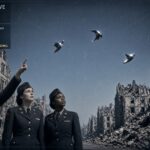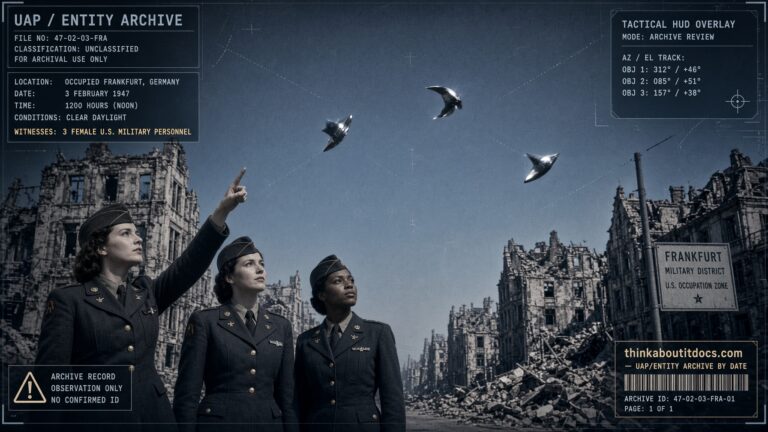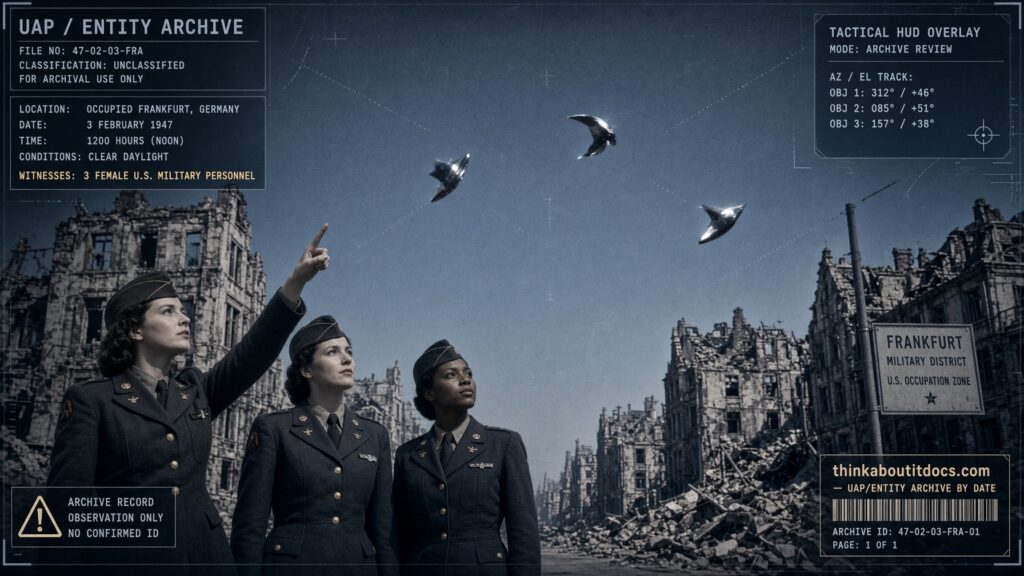
February 3, 1947 — Frankfurt, Germany. Three American military witnesses watched three unconventional objects perform aerobatics for 30 minutes, five months before Kenneth Arnold's famous sighting sparked the "flying saucer" era.
THINK ABOUTIT UFO|UAP SIGHTINGS REPORT
1947: Three Objects Over Occupied Frankfurt
In the middle of a February afternoon, three American military women stationed in occupied Frankfurt watched three unconventional objects perform aerobatics no aircraft of the period could match — for a full half hour, in broad daylight, with nothing else to explain it. This case survives through one of the more credible compilation efforts covering the entire 1947 wave: Jan Aldrich’s Project 1947, built directly from period military and press records rather than later retrospective retellings.
Date: February 3, 1947
Sighting Time: 12:00 (noon)
Day/Night: Day
Location: Frankfurt, Germany — then within the American Zone of occupied postwar Germany
Urban or Rural: Urban — occupation-era Frankfurt
No. of Entity(s): Not Applicable
Entity Type: Not Applicable
Entity Description: Not Applicable
Hynek Classification: DD — Daylight Disc. Multiple structured objects observed in clear daylight conditions performing maneuvers inconsistent with known aircraft, with no landing or occupant sighting.
Duration: Approximately 30 minutes
No. of Object(s): 3
Description of the Object(s): Described in the surviving record only as having an “unconventional appearance” and exhibiting “aerobatic performance” beyond that of conventional aircraft; specific shape, color, and size detail were not preserved in the compiled entry available to this archive.
Shape of Object(s): Not specified in surviving sourcing
Size of Object(s): Not specified
Color of Object(s): Not specified
Distance to Object(s): Not specified
Height & Speed: Not numerically specified; performance described only as “aerobatic,” implying maneuvering beyond that expected of period fixed-wing aircraft
Number of Witnesses: 3, all identified as female military personnel (surname Slack associated with the case in the source record)
Special Features/Characteristics: The witnesses’ military status and the location’s occupation-era context are notable — American servicewomen stationed in Frankfurt in early 1947 would have had reasonable familiarity with conventional Allied and any remaining German aircraft types operating in the area, making an “unconventional appearance” assessment from three such witnesses more evidentially significant than an equivalent civilian report; the 30-minute duration is unusually long for a daylight disc case, suggesting either a sustained, deliberate observation or an object/objects that remained in the general area rather than a brief transient sighting.
Case Status: Unexplained
Source: Jan L. Aldrich, Project 1947: A Preliminary Report on the 1947 UFO Sighting Wave, UFO Research Coalition, Washington, 1997
Related Cases: 1947: February UFO|UAP & Entity Sightings Archive
Detailed Report
At noon on February 3, 1947, in occupied Frankfurt, Germany, three American servicewomen observed three objects in the sky whose appearance did not match any conventional aircraft they recognized. The objects performed what the surviving record describes as “aerobatic performance” — maneuvering behavior inconsistent with the fixed-wing military and transport aircraft that would have been the normal air traffic over an American occupation zone city in this period. The witnesses watched continuously for approximately 30 minutes, an unusually sustained observation window for this type of case.
The case is preserved through Jan Aldrich’s Project 1947, a research compilation specifically dedicated to documenting the full scope of the 1947 UFO sighting wave using period military records, press archives, and other primary-adjacent sources, published by the UFO Research Coalition in 1997. Aldrich’s project is widely regarded within ufological research circles as one of the more methodologically serious efforts to catalogue 1947-era cases without the embellishment common to many popular UFO histories of the same events, lending this entry meaningfully more credibility than an unattributed or vaguely sourced claim would carry.
RESEARCHER’S NOTES
Three Trained Observers, Thirty Minutes, No Explanation
- On why the witnesses’ military status matters: Personnel stationed at an active occupation-zone posting would have routine, repeated exposure to the actual aircraft operating in their airspace — American transports, fighters, and whatever remained of German civil and military aviation infrastructure under Allied oversight. A collective assessment of “unconventional appearance” from three such witnesses, sustained over half an hour rather than a fleeting glance, carries somewhat more evidentiary weight than an equivalent report from observers with no comparable frame of reference.
- On the limits of what this case can currently establish: The surviving compiled entry, while attributable to a credible research effort, does not preserve the kind of physical detail (shape, size, color, altitude) that would allow a fuller technical assessment of what was observed. This report is honest that Aldrich’s compilation, valuable as it is for establishing that a documented case exists with named military witnesses, appears to summarize rather than fully reproduce whatever underlying source material — military report, press account, or witness interview — originally generated the entry. Locating that underlying primary document, if it survives, would substantially strengthen this case’s evidentiary standing.
- On the timing within the broader 1947 wave: This sighting occurred nearly five months before Kenneth Arnold’s June 24, 1947 encounter would trigger the nationally recognized “flying saucer” wave, and roughly three weeks after the RAF’s “Operation Charlie” radar pursuits over the North Sea in mid-January (documented elsewhere in this archive). Read together, these early-1947 European cases — before American media coverage created any possibility of copycat reporting or shared cultural framework — form a data set worth considering on its own terms, independent of the later, much larger and more publicized American summer wave.
Three trained military observers, half an hour of continuous watching, and objects that moved in ways nothing in the occupation-era Frankfurt skies was supposed to move. The case survives only in outline, but it survives through a genuinely serious research effort — and it remains, on the evidence available, unexplained.