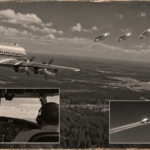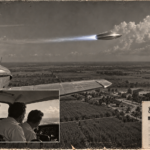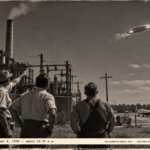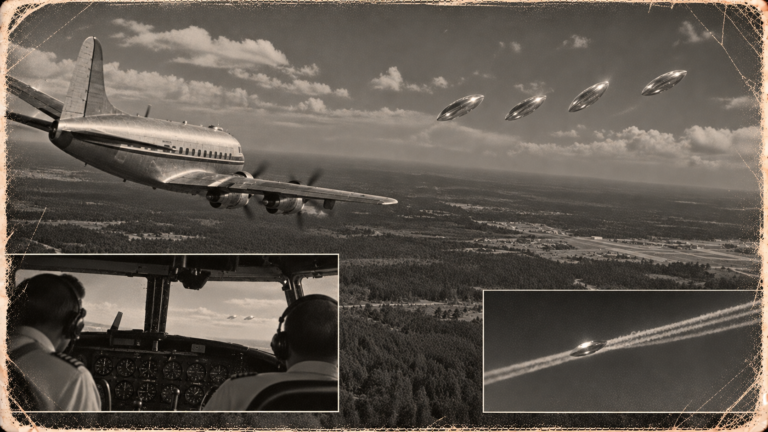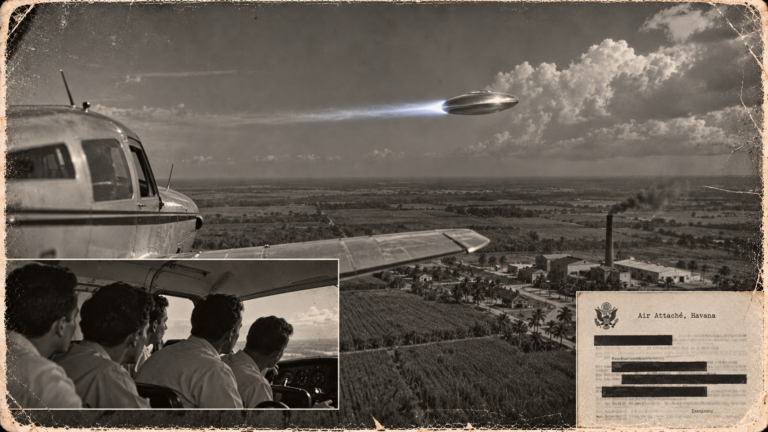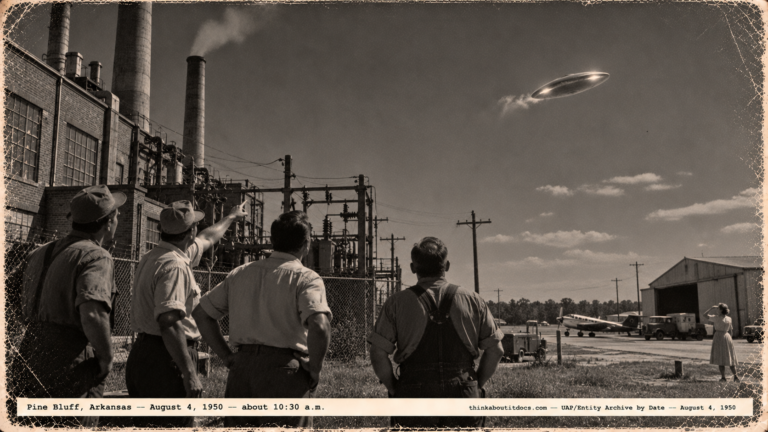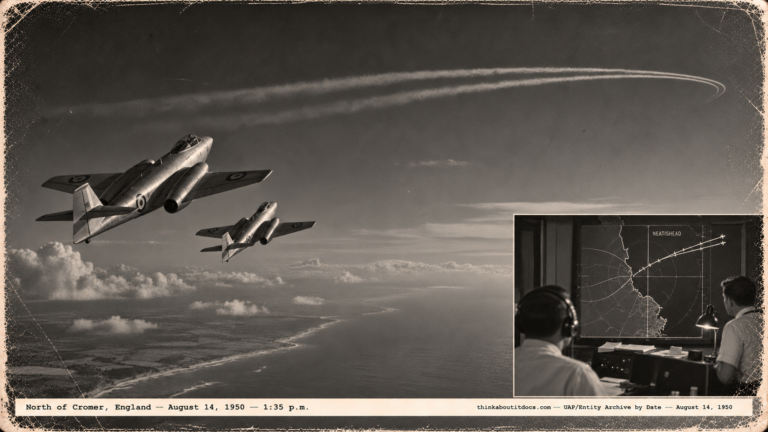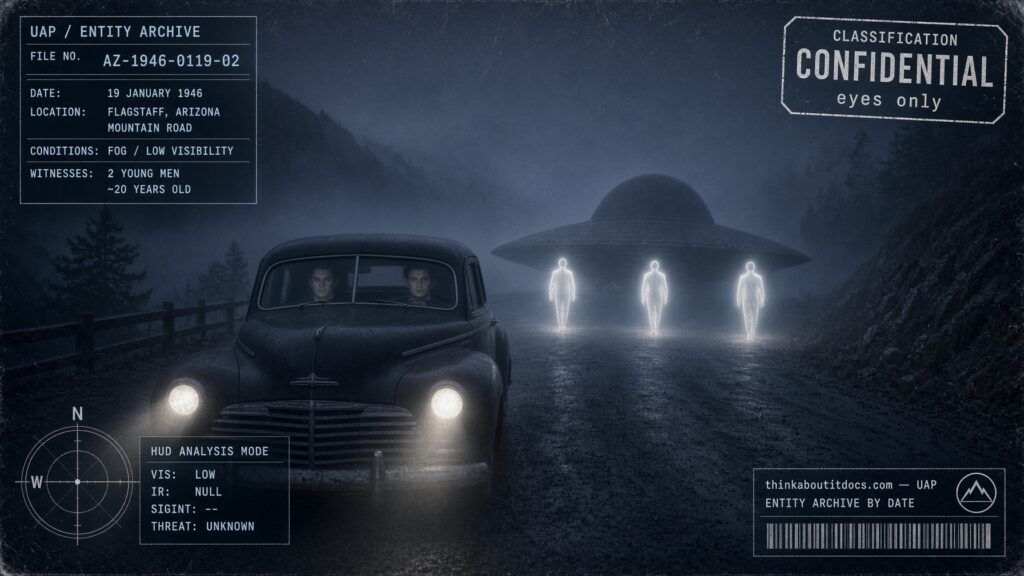
January 19, 1946 — Flagstaff, Arizona. Two young men lost roughly ten hours near a domed disc and three luminous beings, the encounter recovered only under hypnosis, fifteen years before the Hill case popularized the pattern.
THINK ABOUTIT UFO | UAP SIGHTING REPORT
1946: The Flagstaff, Arizona Missing-Time Encounter
Two young men, a foggy Arizona mountainside, a car that stopped without explanation, and roughly ten hours that neither of them could account for. What makes this case remarkable isn’t the disc or the beings — this archive has plenty of those. It’s the date. Every structural element of this account — missing-time, hypnotic recall, glowing humanoid figures, telepathic contact — is the signature pattern of the modern alien abduction narrative. And this one is dated January 1946, a full fifteen years before Betty and Barney Hill made that pattern famous.
Date: January 19, 1946
Sighting Time: Unknown; the missing-time interval was estimated at approximately 10 hours
Day/Night: Not established by the surviving conscious account; the hypnotically recovered material does not specify
Location: A mountain area near Flagstaff, Arizona; foggy conditions
Urban or Rural: Rural/mountainous
No. of Entity(s): 3
Entity Type: Humanoid, of undetermined origin
Entity Description: Each figure wore a luminous suit and appeared to move without visible feet, gliding rather than walking. A radiant glow surrounded them, and they displayed an apparent capacity for levitation. No facial or other physical detail survives in the available account.
Hynek Classification: CE-IV — Close Encounter of the Fourth Kind (abduction/missing-time case), by the standard definition applied when a witness reports being taken aboard a craft or otherwise directly interacting with occupants beyond simple observation, with an associated period of unaccounted time.
Duration: Approximately 10 hours of missing time; the duration of the recalled encounter itself, as opposed to the total missing interval, is not specified
No. of Object(s): 1
Description of the Object(s): A domed disc, described by the compiling source as “Mexican hat” shaped — a broad, low silhouette with a raised central dome, consistent with a classic sombrero profile.
Shape of Object(s): Domed disc (“Mexican hat” shape)
Size of Object(s): Not recorded
Color of Object(s): Not recorded
Distance to Object(s): The witnesses’ car reportedly stopped directly in front of the object, implying very close range
Height & Speed: Not recorded; the account as preserved describes a stationary encounter rather than a flight or pursuit
Number of Witnesses: 2 — both male, approximately 20 years old at the time
Special Features/Characteristics: The account was recovered under hypnosis rather than through conscious recollection, a detail with significant implications for how the case should be weighed (see Researcher’s Notes); telepathic communication was reported to have occurred between the witnesses and the entities; the ten-hour missing-time interval is itself independently notable, structurally identical to abduction-narrative missing-time claims that would not become a recognized pattern in ufological literature until the 1960s; the entities’ apparent levitation and footless gliding motion are recurring high-strangeness details found in other, later contact accounts.
Case Status: Insufficient Data
Source: David Webb, HUMCAT: Catalogue of Humanoid Reports
Related Cases: 1946: January UFO & Entity Sightings Archive
Detailed Report
In January 1946, two young men — both around 20 years old — were reportedly traveling near a mountain outside Flagstaff, Arizona, in foggy conditions, when their car came to a stop. What happened next was, for both men, not immediately available to conscious memory. Roughly ten hours passed that neither could account for at the time.
The details of the encounter itself entered the record only later, and only under hypnosis. According to the hypnotically recovered account, the car had stopped directly in front of a “Mexican hat”-shaped domed disc. Three beings, each wearing a luminous suit, were seen; they appeared to glide rather than walk, with no feet visible beneath them, surrounded by a radiant glow, and displayed an apparent capacity for levitation. Communication between the witnesses and the beings was reported to be telepathic in nature. Beyond these details, the surviving compiled account — via David Webb’s HUMCAT catalogue — does not preserve further specifics: no dialogue content, no stated purpose for the encounter, and no description of how the missing-time period ended or how the witnesses found themselves able to continue their journey.
RESEARCHER’S NOTES
Fifteen Years Before the Pattern Had a Name
- On why the date matters more than almost anything else in this case: The now-familiar structure of the “alien abduction” account — a period of missing time noticed first, followed by a fuller narrative recovered later through hypnosis — did not become a recognized pattern in ufological literature until Betty and Barney Hill’s case became public in the early-to-mid 1960s, roughly fifteen years after this account. If the Flagstaff case genuinely dates to 1946 with this structure intact, it represents a strikingly early instance of a pattern that supposedly hadn’t been “invented” yet by popular culture or ufological convention — which cuts against the common skeptical explanation that abduction narratives are shaped by cultural exposure to the Hill case and its many successors. If, alternatively, this account was recorded, compiled, or elaborated significantly after 1946 — closer to when HUMCAT itself was being assembled — the resemblance to the post-Hill pattern would be far less surprising.
- On why hypnotically recovered testimony requires particular caution: The psychological research literature on hypnosis and memory recovery, developed substantially after this case’s original date, has established that hypnosis can encourage confabulation — the confident recall of events that did not occur as described, or at all — particularly under leading questioning. This archive does not have access to the original hypnosis session, the practitioner’s methodology, or any contemporaneous 1946 documentation of the missing-time claim prior to the hypnotic session. Without that material, it’s not possible to assess how much of the account reflects an original 1946 experience versus material introduced or shaped during the recovery process itself, whenever that process actually occurred.
- On the HUMCAT sourcing specifically: David Webb’s HUMCAT (Humanoid Catalogue) is a serious, long-running compilation effort within ufological research, but it functions as a secondary catalogue of cases drawn from many original sources rather than a primary investigative record. This archive has not been able to trace this specific entry back to an original contemporaneous 1946 source, a named investigator who worked the case close to its claimed date, or independent corroboration from a second witness or party. That absence of primary documentation is the basis for this report’s Insufficient Data status — not a judgment that the witnesses’ account is untrue, but an honest statement of how little can currently be independently verified about it.
- On what would resolve the uncertainty: The single most valuable piece of missing information is when the hypnosis session that produced this account actually took place, and by whom it was conducted. If that could be established — and if any contemporaneous 1946 record of the missing-time claim (a police report, a family member’s account, a newspaper mention) could be located independent of the hypnotic recall — this case’s evidentiary status could be meaningfully upgraded in either direction.
Whatever happened on that foggy Arizona mountainside in January 1946, the account that survives reads like it belongs to a much later era of ufology — and that’s exactly what makes it worth taking seriously enough to examine closely, and cautiously enough not to overstate. Ten hours went missing. What filled them remains, by this archive’s own standard, unresolved.