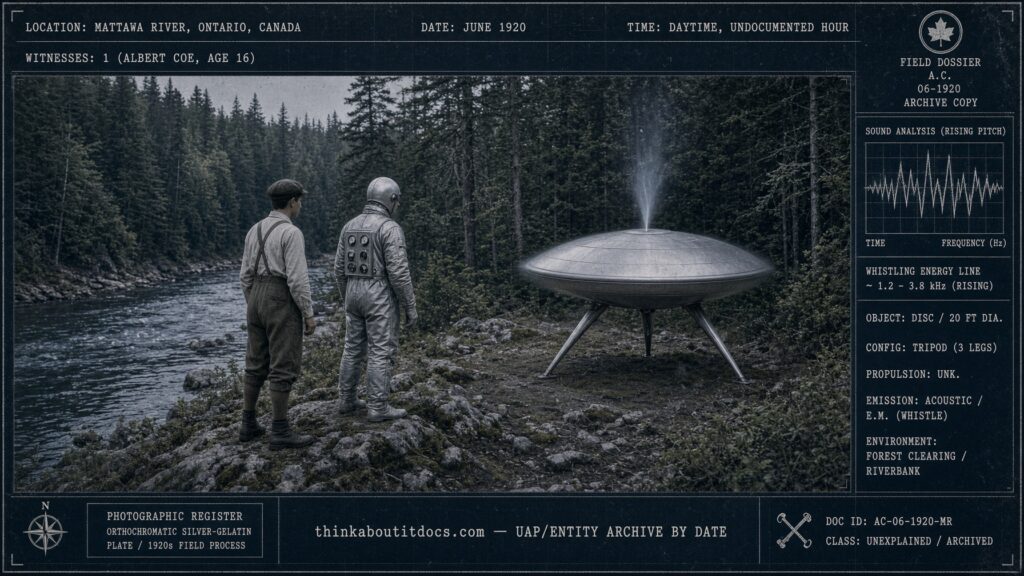
Mattawa River, Ontario, June 1920 — sixteen-year-old Albert Coe's account of a silver-suited occupant and a tripod-legged disc, as recorded by Timothy Good.
THINK ABOUTIT UFO|UAP | ENTITY ENCOUNTER REPORT
1920: Mattawa River Ontario CE-III Albert Coe Contactee Case
In June 1920, on a remote stretch of the Mattawa River in Ontario, sixteen-year-old Albert Coe answered a cry for help and found a man in a silver-gray, instrument-panel jumpsuit who had fallen among the rocks — a man whose “plane” turned out to be a wingless, engineless, twenty-foot tripod-legged disc that spun up its rim to an inaudible whine and flew away without him needing rescue at all. It is the opening scene of a claimed fifty-year contact relationship, and this report treats the physical encounter and the decades-long contactee narrative that followed it as two separable claims requiring separate evidentiary weight.
Date: June 1920 (initial encounter)
Sighting Time: Undocumented (daytime, canoeing vacation)
Day/Night: Day
Location: Mattawa River, Ontario, Canada
Urban or Rural: Rural / remote wilderness
No. of Entity(‘s): 1
Entity Type: Human-appearing occupant, claimed extraterrestrial (“Zret”)
Entity Description: Human in outward appearance, dressed in a silver-gray jumper-type suit fitted with an instrument panel of knobs and dials across the chest; no described physical abnormalities distinguishing him from an ordinary man
Hynek Classification: CE-III (Close Encounter of the Third Kind — craft and occupant both observed at close range) for the 1920 Mattawa River event specifically. The subsequent decades of alleged contact fall outside standard Hynek scale and are logged separately as Contactee Narrative, not scored on the CE scale.
Duration: Undocumented for the initial encounter; the broader relationship is claimed to have spanned roughly fifty years
No. of Object(s): 1
Description of the Object(s): A round silver disc resting on a tripod of three legs, with no visible windows, portholes, propeller, engine, wings, or fuselage; the outer rim revolved, producing a low whistling sound that rose to an inaudible high-pitched whine before the craft departed
Shape of Object(s): Disc, tripod-legged
Size of Object(s): Approximately 20 feet in diameter
Color of Object(s): Silver
Distance to Object(s): Close range — Coe walked the occupant back to it directly
Height & Speed: Grounded on landing legs prior to departure; speed and altitude on departure undocumented
Number of Witnesses: 1 (Albert Coe)
Special Features/Characteristics: Rim-based propulsion with an audible spin-up sequence rising past the range of human hearing; occupant wore an instrument panel built directly into the suit rather than carrying separate equipment; claimed decades-long recontact pattern beginning roughly six months after the initial event
Case Status: Insufficient Data. The 1920 encounter is single-witness and self-reported decades after the fact (Coe’s account was first published in 1969); it cannot be independently verified but is not internally contradictory. The subsequent contact narrative is treated as unverifiable contactee testimony.
Source: Good, Timothy. Alien Base, 1998; Coe, Albert. The Shocking Truth, self-published, 1969; case also documented by Dr. Berthold Schwarz, 1977. Secondary catalogue reference (now removed from this archive’s index page as a duplicate, preserved here as a sourcing note): Webb, David. HUMCAT: Catalogue of Humanoid Reports, entry citing Coe under Beverly, New Jersey, giving a Tau Ceti origin claim that directly contradicts Good’s Mars/Venus origin account.
Summary/Description: Sixteen-year-old Albert Coe, canoeing in Ontario, heard a cry for help on the Mattawa River and found a man in a silver-gray jumpsuit fitted with an instrument panel, who had fallen among rocks. After helping the man back to his craft — a wingless, engineless, tripod-legged silver disc about 20 feet across — Coe watched its rim spin up through an audible whine and depart. Six months later Coe received a note from “Xretsim” arranging a meeting at the McAlpin Hotel, Ottawa, beginning a claimed decades-long relationship with an entity calling himself Zret, who told Coe he was one of roughly a hundred extraterrestrial technicians from Mars and Venus who had infiltrated every major nation since 1904, pursuing an undisclosed mission. Coe reported no further craft sightings during the subsequent contact period.
Related Cases: 1920: UFO|UAP & Alien Sightings Archive | 1920 Rushville Missouri Mass-Witness Cylinder
Detailed Report
The Coe case divides cleanly into two evidentiary layers that this archive refuses to collapse into one another. The first layer is the 1920 Mattawa River event itself: a single teenage witness, a fallen man in an unusual suit, a landed craft with no conventional flight surfaces, and a departure sequence with a specific, describable sound profile. Considered on its own, this is a textbook pre-contamination CE-III — it predates the modern saucer era by 27 years, predates Adamski-style contactee culture by over three decades, and contains no borrowed post-1947 vocabulary or imagery. If Coe’s account is accurate to what he actually experienced in 1920, it is one of the earliest documented occupant encounters in the North American record.
The second layer is everything that follows: the note from “Xretsim,” the McAlpin Hotel meetings, Zret’s identity as one of roughly a hundred infiltrating Martian-Venusian technicians, and the fifty-year relationship Coe describes across the decades that followed. This material was not published until 1969 — the height of the contactee genre popularized by Adamski, Van Tassel, and Fry — and it carries every hallmark of that genre: named alien contacts, hotel-room meetings, planetary origin claims, and a vague, never-specified civilizational mission. Timothy Good’s interviews with Coe and Dr. Berthold Schwarz’s 1977 documentation establish that Coe told a consistent story over time to credentialed researchers, which speaks to his sincerity as a witness but does not independently verify the content of the claims themselves.
RESEARCHER’S NOTES
The Coe/Zret Case — 1920 and the Line Between Field Report and Contactee Narrative
- Classification Issues/Corrections: This archive scores only the 1920 encounter itself as CE-III. The decades of subsequent contact are not assigned a Hynek tier at all, since the Hynek scale was built to classify discrete sighting events, not ongoing claimed relationships. Treating the full fifty-year narrative as a single CE-III case would overstate what the classification system is designed to measure.
- Source Chain Conflict: Two credentialed secondary sources give contradictory origin claims for the same entity. Timothy Good’s Alien Base states Zret and his group came from Mars and Venus. David Webb’s HUMCAT, in an entry filed separately under Beverly, New Jersey and now removed from this archive’s index page as a duplicate, gives a Tau Ceti origin instead. Both sources are drawing on Coe’s own testimony, meaning either Coe’s account shifted between tellings, or one or both catalogues introduced an error in transcription. This archive cannot resolve which, and flags the conflict rather than silently picking one version.
- Pattern Context: The 1969 publication date places Coe’s account squarely within the first wave of contactee memoirs following Adamski’s Flying Saucers Have Landed (1953) and the broader contactee boom of the 1950s–60s. The retrospective application of that genre’s narrative conventions — named aliens, hotel meetings, vague planetary missions — to a claimed 1920 origin event is a recognized pattern in contactee literature, where an early anomalous experience is reframed decades later through a since-popularized cultural template.
- Evidentiary Weight: The 1920 event is single-witness, self-reported, and first published 49 years after it allegedly occurred, with no contemporaneous record. It is neither corroborated nor disprovable on the available evidence, which is why Case Status is logged as Insufficient Data rather than Unexplained — Unexplained implies a documented anomaly resisting conventional explanation, while Insufficient Data reflects a claim this archive cannot evaluate against independent evidence either way.
The Mattawa River encounter, taken alone, is a striking and unusually early occupant report with internal consistency and no post-1947 contamination. The fifty-year Zret relationship that Coe layered onto it decades later belongs to the contactee tradition and is logged as such — sincerely told, likely by Coe’s own lights, but unverifiable, internally contradicted on the question of origin depending on which catalogue is consulted, and evaluated here on those terms rather than folded uncritically into the field-observation record.
“A round silver disc, about 20 feet in diameter, was standing on three legs in the form of a tripod, without propellor, engine, wings or fuselage. Just then, the perimeter edge began to revolve. At first it gave off a low whistling sound, picked up speed mounting to a high-pitched whine, finally going above the audible capabilities of the ear.”
Albert Coe, describing the craft observed at the Mattawa River, Ontario, June 1920, as recorded by Timothy Good in Alien Base, 1998